Myth: A Lawn Is Harmless
A lawn looks like nature and behaves like a crop. Turf grass is the largest irrigated crop in the United States, ahead of corn, and a square metre of it in a dry climate drinks as much water as a square metre of wheat while producing nothing that can be eaten. What a lawn's water is, why the grass in a desert suburb is the least defensible water use on this site, why Las Vegas banned it, and what the alternatives look like.
Nobody thinks of a lawn as farming. It is the green thing in front of the house, the surface children play on and dogs are walked across, the default landscape of the suburb from Ohio to Perth to Riyadh, and it looks, from the street, like nature left alone. It is a crop. Turf grass is a plant of the cool wet grasslands of northern Europe, bred into a few varieties that will grow as a dense carpet if they are cut, fed and, above all, watered, and it covers more irrigated land in the United States than any food crop. The myth is that it costs nothing. In a wet climate it costs little. In the places where most of the world's lawns have been laid in the last fifty years, it is the least defensible use of water on this site.
A crop that is not harvested
A study using satellite images and land use data estimated the turf grass of the United States at about 163,000 square kilometres, an area larger than the country's corn, and found that it was, if irrigated as the lawn care industry recommends, the largest irrigated crop in the country by area. The same is true, at smaller scale, of Australia, the Gulf states, and the suburbs of Spain, South Africa and Latin America. Nobody eats it, and the water it uses is, by the accounting of this site, spent on a view.
Grass drinks the way any crop does. A square metre of turf in full leaf in a hot dry summer transpires four to eight millimetres of water a day, which is four to eight litres, and the sprinkler that replaces it loses a further share to evaporation from the wet blades and soil, to wind, and to runoff onto the pavement. Kept green through a Las Vegas or a Riyadh summer, a lawn needs somewhere between six and twelve litres per square metre a week, which for a modest front garden of thirty square metres is a bath and a half. Multiply by the months and the streets and the water is a river.
| A lawn's water | |
|---|---|
| Transpiration in a hot dry summer | 4 to 8 millimetres a day per square metre |
| Sprinkler losses to evaporation, wind and runoff | Roughly half of what is applied, at a typical setting |
| Water to keep 30 square metres green, dry summer | About 200 to 350 litres a week |
| Share of household water used outdoors, arid US cities | Over 60 percent |
| Share of that water that returns to the sewer | None |
Why it matters where the lawn is
The lawn's home is the cool wet north: Britain, the Netherlands, New England, the Pacific north west. There it grows on rain, the sprinkler is rarely used, and the water it takes from the soil would have evaporated or drained anyway. The green of an English garden costs the river nothing, and this article is not about it.
The lawn's problem is that it was carried, as a mark of prosperity, to places that are nothing like its home. The suburbs of the American south west, the Gulf, Australia and southern Europe were laid out with the same front lawn as Connecticut's, in climates with a tenth of the rain and twice the heat, and the lawn there is kept alive entirely by the hose. In those cities outdoor watering is more than half of all household use, in the driest months two thirds, and the lawn is most of the outdoor. In Phoenix and Las Vegas in the 1990s, before either city acted, a household used several hundred litres a day more in summer than in winter, and the difference was grass.
Why it is the water a city loses
The Las Vegas article on this site describes the arithmetic that made the city act. Water used indoors, in showers, kitchens and toilets, goes to a drain and from the drain to a treatment plant, and from the plant, in Las Vegas, back to the lake it came from. It is borrowed. Water sprayed on a lawn goes into the air through the grass or evaporates from the ground, and none of it comes back. It is spent. A city on a limited supply that wants to cut what it actually consumes finds that the lawn is nearly all of it, and that a shower is nearly none.
So Las Vegas paid its residents to tear out their grass, at rates that rose to several dollars a square foot, banned new front lawns in 2003, and in 2021 became the first place in the United States to ban by law the ornamental kind: grass that nobody walks on, in road medians, office parks and the fronts of apartment complexes, which from 2027 may not be watered with Colorado River water at all. Per person use fell by about half. Phoenix, Tucson, Los Angeles and the cities of southern California have run the same rebates, and Australia's cities did the same during the Millennium Drought, with the result that a Perth or Melbourne front garden is now more often gravel, native shrubs and drip lines than turf.
| What cities have done about lawns | |
|---|---|
| Las Vegas | Rebates since 1999, over 200 million square feet removed; new front lawns banned 2003; ornamental turf banned by law from 2027 |
| Los Angeles and southern California | Turf replacement rebates; watering days limited by ordinance |
| Phoenix and Tucson | Rebates; desert landscaping standard in new development |
| Australian cities | Watering restrictions and rebates through the 2000s drought; native gardens now the norm |
| Gulf cities | Treated sewage for public greenery; lawns on private land still mostly on desalinated water |
The Gulf
The lawn's furthest outpost is the Gulf, where the cities of Dubai, Abu Dhabi, Doha and Riyadh have laid turf along their highways, around their villas and across their golf courses in a climate with a hundred millimetres of rain and summers above forty five degrees. The grass survives on the most expensive water on Earth: desalinated seawater for the private gardens, and treated sewage, which the cities have wisely reserved for their public greenery, for the parks and the verges. A hectare of turf in the Gulf summer takes ten to fifteen thousand cubic metres of water a year, which at desalination's cost is a real sum, and the cities have begun to replace the roadside lawns with native planting for that reason. The golf courses, which are the largest lawns of all, run on treated effluent and are, in a country that would otherwise discharge it to the sea, a reasonable use of water that has already been used. The villa lawn on desalinated water is the least defensible square metre in this article.
The other costs
The water is the largest cost and not the only one. A lawn kept green is fed with nitrogen fertiliser, and a share of it runs off in the sprinkler water and the rain into the storm drains and the streams, where it does what the nitrogen and phosphorus articles describe, so that suburban lawns are a measurable source of the algae in the lakes of the American midwest. It is mown with engines, sprayed against weeds and grubs, and it supports almost nothing: a lawn is a monoculture of one grass, cut before it flowers, and the insects and birds that a garden of native plants feeds find nothing in it. The desert suburb's lawn is a small farm of the least useful kind, growing a crop nobody harvests, on water from a river that is already spoken for.
What the alternatives look like
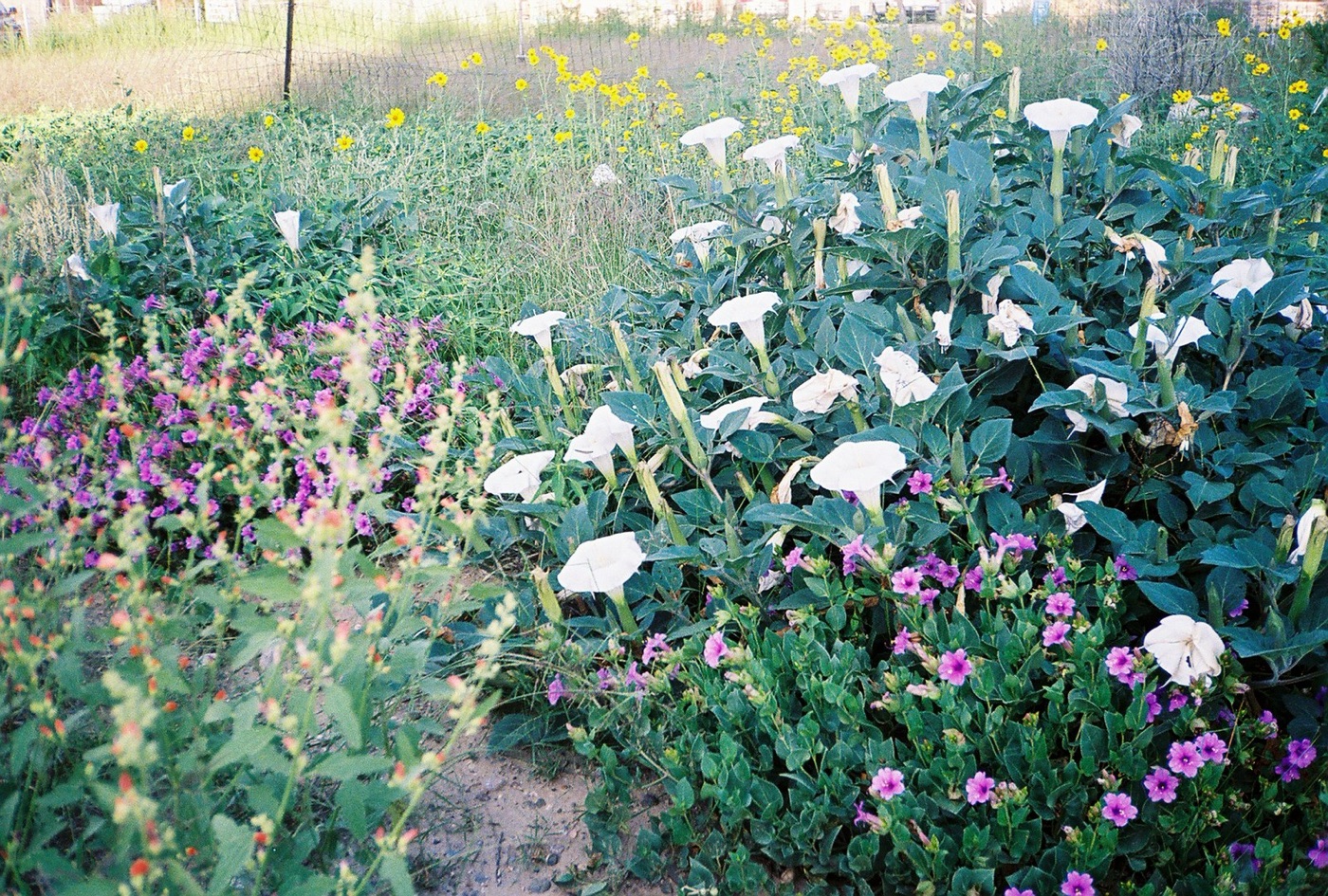
The alternative is not gravel and cactus, though that is what the rebate programmes are often mocked for. The gardens that have replaced lawns in the dry cities are, at their best, planted with the shrubs, grasses and trees of the region, on drip lines, with mulch to hold the soil's moisture, and they use a fifth to a tenth of the water of the turf they replaced, flower, feed birds, and need cutting never. Where a lawn is actually used, for children or a dog, a small one, of a drought tolerant variety, watered at dawn by a controller that reads the weather, uses a fraction of the traditional spread. And in the wet north, where the grass belongs, none of this applies, and the lawn can stay.
What it teaches
The lawn is the water use on this site that has the least to say for itself, in the places where it costs anything. It is a crop from a wet climate grown in a dry one, on water that a city cannot get back, for a look. Cities that have had to face their water have found, every time, that the grass was where the loss was and that people, paid or told, will give it up faster than anyone expected. The myth is that the green in front of the house is natural. In Las Vegas it was the only thing in the city that was not.
Nine litres a square metre a week, into the sky, for a crop that nobody eats.
Sources
- Milesi, C. et al. (2005). Mapping and modeling the biogeochemical cycling of turf grasses in the United States. Environmental Management 36. About 163,800 square kilometres of turf, the largest irrigated crop.
- US EPA WaterSense, outdoor water use: about 30 percent of household use nationally, over 60 percent in arid regions, and half of it lost to evaporation, wind and runoff.
- Southern Nevada Water Authority, Water Smart Landscapes rebate programme, and Nevada Assembly Bill 356 (2021) banning non functional turf.
- Allen, R.G. et al. (1998). Crop evapotranspiration: guidelines for computing crop water requirements. FAO Irrigation and Drainage Paper 56. Turf grass crop coefficients.
- Hayden, L. et al. (2015). Residential landscape aesthetics and water conservation best management practices. Landscape and Urban Planning 144.
- Photographs: opener: Sprinkler Irrigation - Sprinkler head by Anton (CC BY-SA) via Wikimedia Commons; inline: Lawn care in a vibrant garden as a person mows the grass on a sunny day by Shixart1985 (CC BY) via Wikimedia Commons; inline: Xeriscape2 by No machine-readable author provided. Jer (CC BY-SA) via Wikimedia Commons.