Plain Water: Cholera
Cholera is the disease that taught the world what a water supply is for. It killed by the hundred thousand in the cities of the nineteenth century until a doctor traced an outbreak to one pump, and it has been absent from every city with a treated supply and a sewer since. It still kills tens of thousands a year, in the places that have neither. What the bacterium does, how a pump handle changed medicine, why it is a water problem and not a medical one, and where it is now.
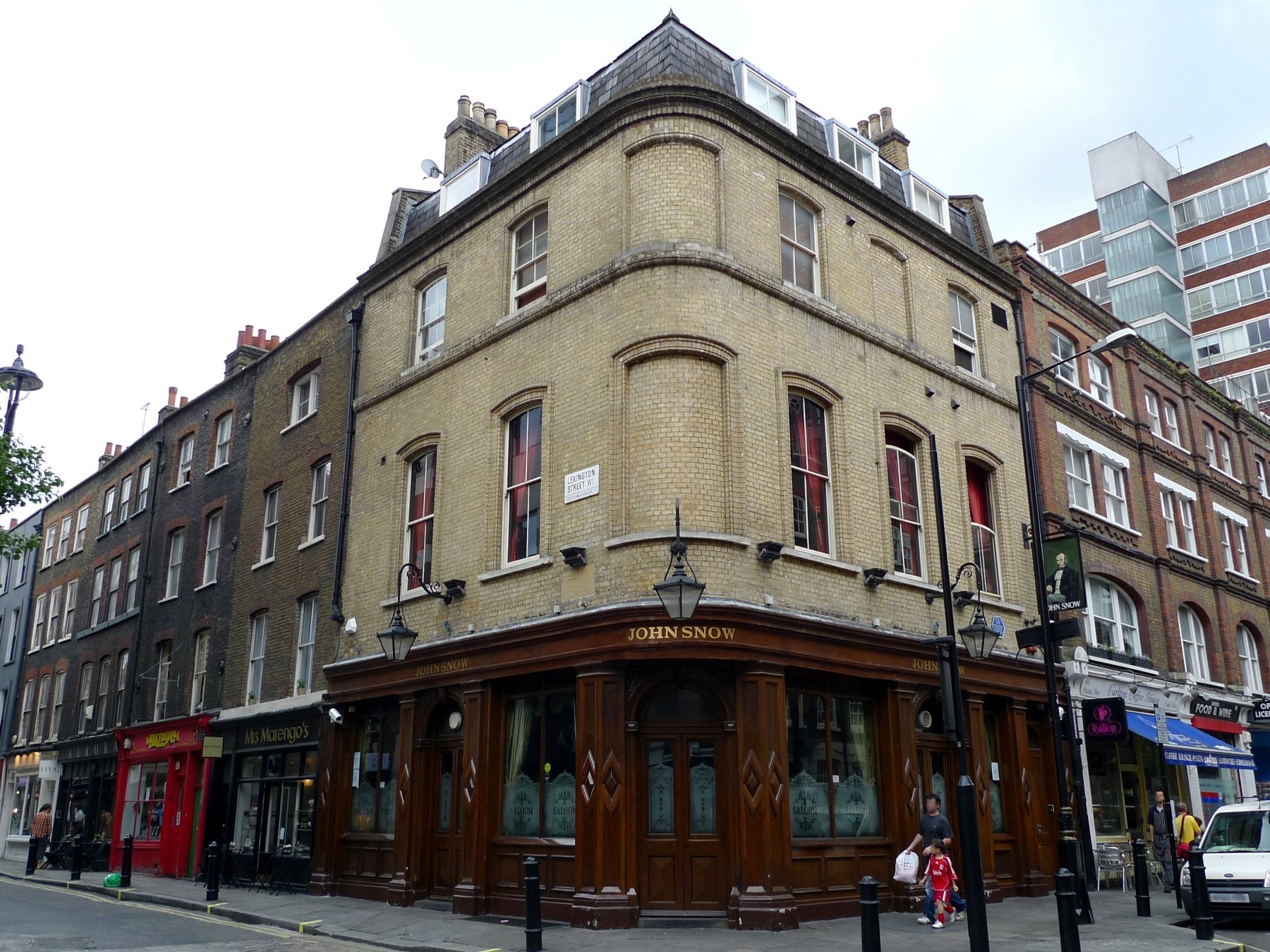
On a corner in Soho, in London, there is a water pump with no handle. It is a replica, put up in the 1990s outside a pub named for the doctor who took the original handle off, and it marks the place where, in the late summer of 1854, more than six hundred people died in ten days of a disease that emptied the bowels in hours and killed by the next morning. The doctor, John Snow, drew the deaths on a map of the streets and found that they lay in a ring around the pump. He was told that cholera travelled in the bad air of the slums. He said it travelled in the water, and he was right, and it took thirty years for the rest of medicine to agree.
This article is about the disease that taught the world what a water supply is for, and that is still killing, a century and a half later, in every place that has not built one.
What the bacterium does
Cholera is a bacterium, Vibrio cholerae, that lives in water and enters a person through the mouth. It settles in the small intestine and produces a toxin that makes the gut's lining pump out water and salts faster than they can be replaced, and the result is a diarrhoea of a volume that no other disease produces: ten to twenty litres a day, pale and watery, with vomiting, until the body has lost so much fluid that the blood thickens, the kidneys fail, and the patient dies of dehydration, sometimes within a day of the first symptom. Untreated, severe cholera kills about half of those who get it. Treated, with nothing more than the fluid and the salts replaced, by mouth or by drip, it kills fewer than one in a hundred.
The bacterium leaves the patient in the diarrhoea, by the billion, and where the diarrhoea reaches the water that other people drink, the disease spreads. That sentence is the whole of cholera. It is a disease of sewage in the water supply, and it appears wherever the two meet.
| Cholera, in short | |
|---|---|
| Cause | Vibrio cholerae, a bacterium, in water or food contaminated by faeces |
| What it does | A toxin that drains the gut of water and salt; death by dehydration |
| Untreated death rate | Up to half of severe cases |
| Treated | Under one percent; oral rehydration salts, or a drip |
| Cases a year, WHO estimate | 1.3 to 4 million |
| Deaths a year | 21,000 to 143,000 |
| Where | Yemen, Sudan, the Congo, Nigeria, Bangladesh, Haiti, Mozambique, and every war and flood |
The pump
The London of 1854 drew its water from the Thames, from wells, and from companies that piped river water, some of it from above the city and some from the stretch into which the city's sewers drained. The disease had arrived from India in 1831 and returned in waves, killing tens of thousands, and the medical consensus was that it was carried in miasma, the foul air of the poor districts. Snow, an anaesthetist, had argued in 1849 that it was swallowed, on the evidence that it attacked the gut and not the lungs, and nobody had listened.
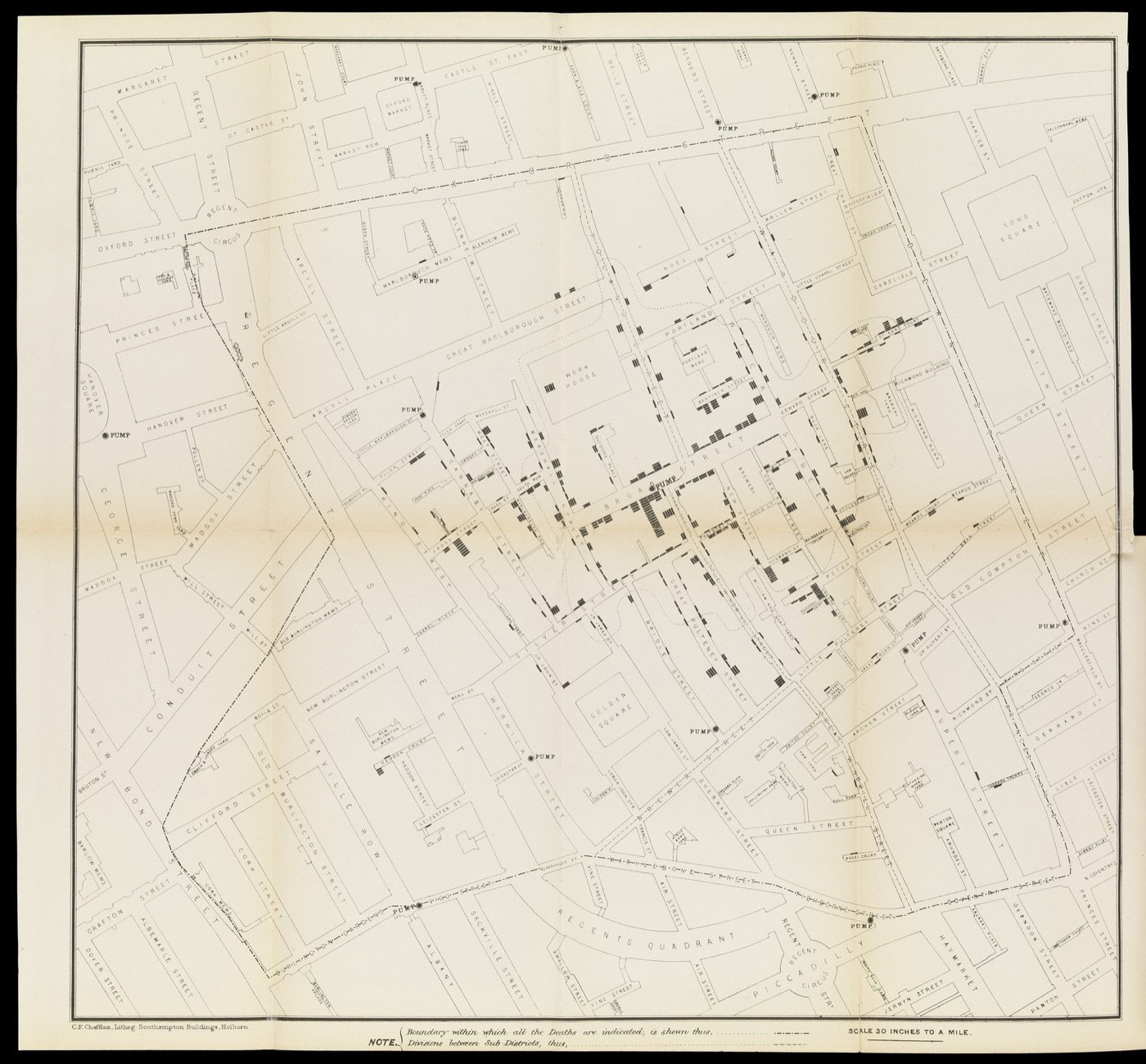
In the Soho outbreak he had a natural experiment. He walked the streets, recorded every death, and found that the dead had drunk from the Broad Street pump: the workhouse nearby, which had its own well, was almost untouched; the brewery, whose men drank beer, lost nobody; and a widow in Hampstead who had the pump's water sent to her because she liked the taste died of cholera miles from Soho. The pump's well was later found to be a metre from a cesspit into which the nappies of a baby with cholera had been washed. The parish removed the handle on Snow's request on 8 September; the outbreak was already declining, as outbreaks do once the people who could flee have fled, and the removal of the handle may have prevented a second wave. The map was the argument, and the map is the founding document of epidemiology.
His larger study, published the next year, compared the deaths in houses supplied by two water companies, one drawing from the sewage laden Thames in the city and one from upstream, and found the death rate in the first eight times the second. It was the evidence, and it was ignored for a generation, until the bacterium was seen under a microscope by Robert Koch in 1883 and the miasma theory died.
What the cities built
London did not wait for the theory. The Great Stink of 1858, a summer in which the Thames stank so badly that Parliament soaked its curtains in chloride of lime, produced the money for Joseph Bazalgette's sewers, which took the city's waste downstream of the intakes, and the water companies moved their intakes upstream and filtered what they drew through sand, which the Metropolis Water Act of 1852 had required after an earlier epidemic. Cholera visited London for the last time in 1866, in the one district the new sewers had not reached. Every city that could afford it followed, over the next fifty years: sewers to carry the waste away, sand filters and then chlorine, from 1908, to clean what came in. The disease left the cities that did it and has never returned to one that kept it up.
That is the plain water articles on this site, in one disease. The coagulation, filtration and disinfection of a treatment plant, the sewer that separates the waste from the supply, and the treatment works at the end of the sewer were built, in the first instance, to stop cholera and typhoid, and they did.
Bangladesh, and the sari
The delta of the Ganges and Brahmaputra is where cholera has always lived, in the rivers and ponds that the arsenic article describes as the water the villages drank before the wells, and it is where the two cheapest defences against it were worked out. Oral rehydration therapy, the salt and sugar solution that a mother can mix at home and that cut cholera's death rate from half to nothing, was developed in the cholera hospitals of Dhaka and Calcutta in the 1960s and tested in the refugee camps of the 1971 war, and a medical journal later called it the most important medical advance of the century. And a study in the villages of Matlab in the 1990s found that pouring pond water through a folded cotton sari before drinking it removed most of the cholera bacteria, which cling to the plankton the cloth catches, and halved the cases in the villages that did it. Neither is a water supply. Both are what a place does while it waits for one, and the delta, with its tube wells, has largely stopped waiting, which is why its cholera is a fraction of what it was and its arsenic is the problem the wells brought instead.
Where it is now
Cholera has not gone. It is endemic in the Ganges delta, where it probably began, and in parts of Africa, and it flares wherever the supply and the sewage meet: in Yemen from 2016, in a war that destroyed the water and sewage works, with more than two and a half million suspected cases, the largest outbreak on record; in Haiti after the earthquake of 2010, introduced, the evidence shows, by peacekeepers from Nepal whose camp drained into a river, with ten thousand deaths; in Zimbabwe in 2008, when the state's water system collapsed; in the camps of every war and flood from Sudan to Mozambique. The bacterium is in the water where sewage is in the water, and where that is so, the disease follows.
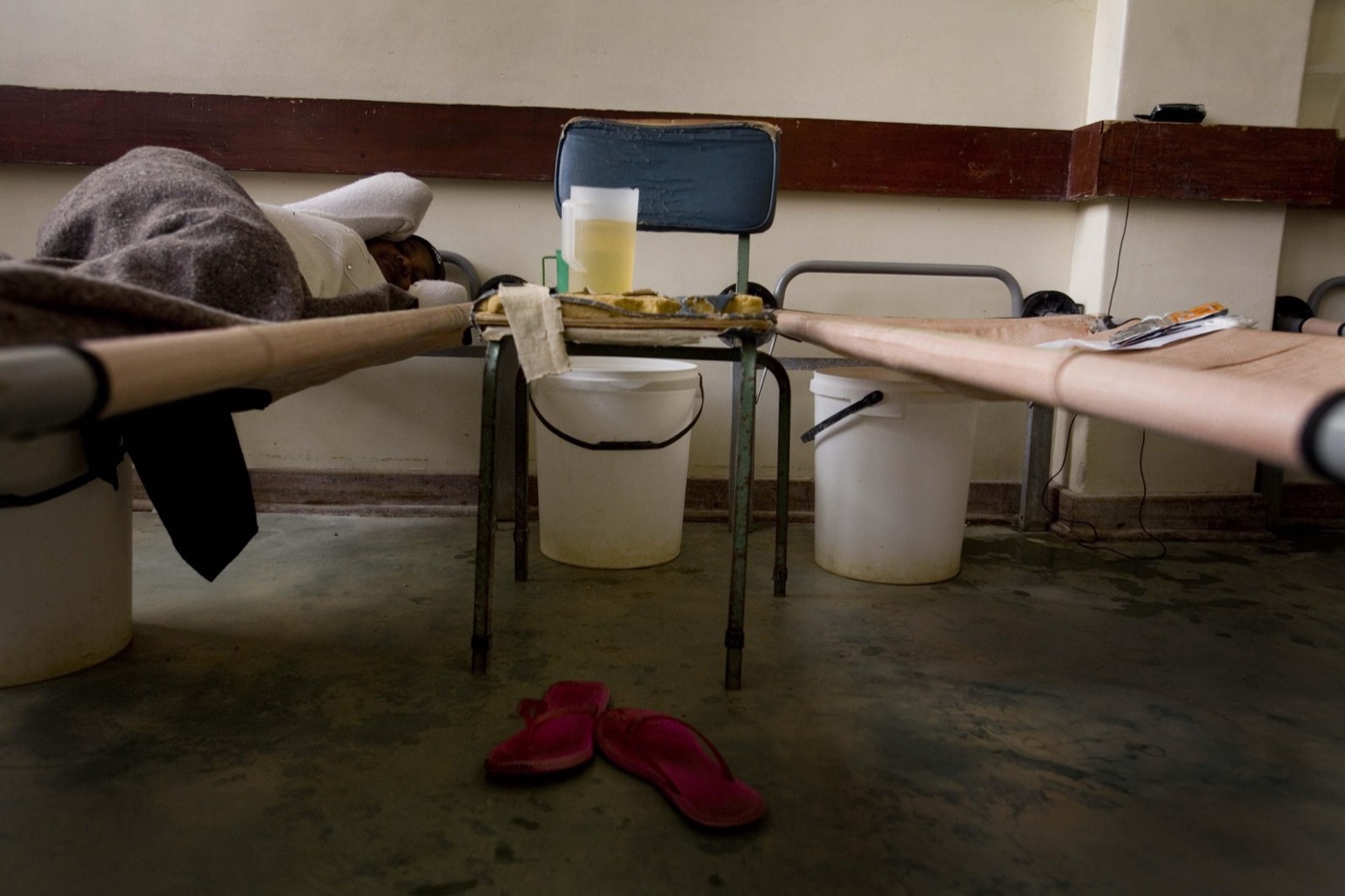
The treatment is a bag of salt and sugar dissolved in clean water, drunk by the litre, which the patient's gut can absorb even as the toxin drains it, and which costs a few cents. It has cut the death rate of treated cholera to below one percent since the 1970s. A vaccine, taken by mouth, gives a few years' protection and is used in outbreaks. Neither is the answer. The answer is the one London found: a supply that is treated and a sewer that carries the waste away from it, and where they exist the vaccine and the salts are never needed.
| Cholera since 1854 | |
|---|---|
| London, last outbreak | 1866, in the one district the new sewers had not reached |
| Cities with treated supply and sewers | None since |
| Yemen, 2016 to 2021 | Over 2.5 million suspected cases; water and sewage works destroyed by war |
| Haiti, 2010 | About 10,000 deaths; introduced by a camp draining to a river |
| Treatment | Oral rehydration salts; death rate under one percent |
| Prevention | A treatment plant and a sewer; a vaccine in outbreaks |
Why it belongs here
Cholera is the disease that makes the argument of this site without any help. It is caused by drinking water that sewage has reached, it is cured by clean water with salt in it, and it is prevented by the works that every plain water article on this site describes, which were built to prevent it. Where those works exist, the disease has been gone for a century. Where they do not, or where a war or a flood has broken them, it returns within weeks, and the map of its deaths, drawn today in Sanaa or Port au Prince, looks like the one Snow drew in Soho: a ring around the place where the water came from.
A pump handle in 1854, and the water works that every city built afterwards.
Sources
- Snow, J. (1855). On the Mode of Communication of Cholera. Second edition, with the Broad Street map.
- World Health Organization, Cholera fact sheet and Global Task Force on Cholera Control: 1.3 to 4 million cases and 21,000 to 143,000 deaths a year, and the 2030 roadmap.
- Ali, M. et al. (2015). Updated global burden of cholera in endemic countries. PLOS Neglected Tropical Diseases 9.
- WHO and UNICEF, Yemen cholera outbreak 2016 to 2021: over 2.5 million suspected cases, the largest recorded.
- Piarroux, R. et al. (2011). Understanding the cholera epidemic, Haiti. Emerging Infectious Diseases 17. The introduction of cholera to Haiti in 2010.
- Photographs: opener: John Snow, Soho, W1 (3696013128) by Ewan Munro (CC BY-SA) via Wikimedia Commons; inline: A map taken from a report by Dr. John Snow Wellcome L0072917 by Wellcome Collection (CC BY) via Wikimedia Commons; inline: Patients lie in bed at a cholera treatmen centre in the Budiriro District, that was badly affected by cholera, in Harare, Zimbabwe on the 21st April, 2009. Photo- Kate Holt - AusAID (10712704546) by Australian Department of Foreign Affairs and Trade (CC BY) via Wikimedia Commons.