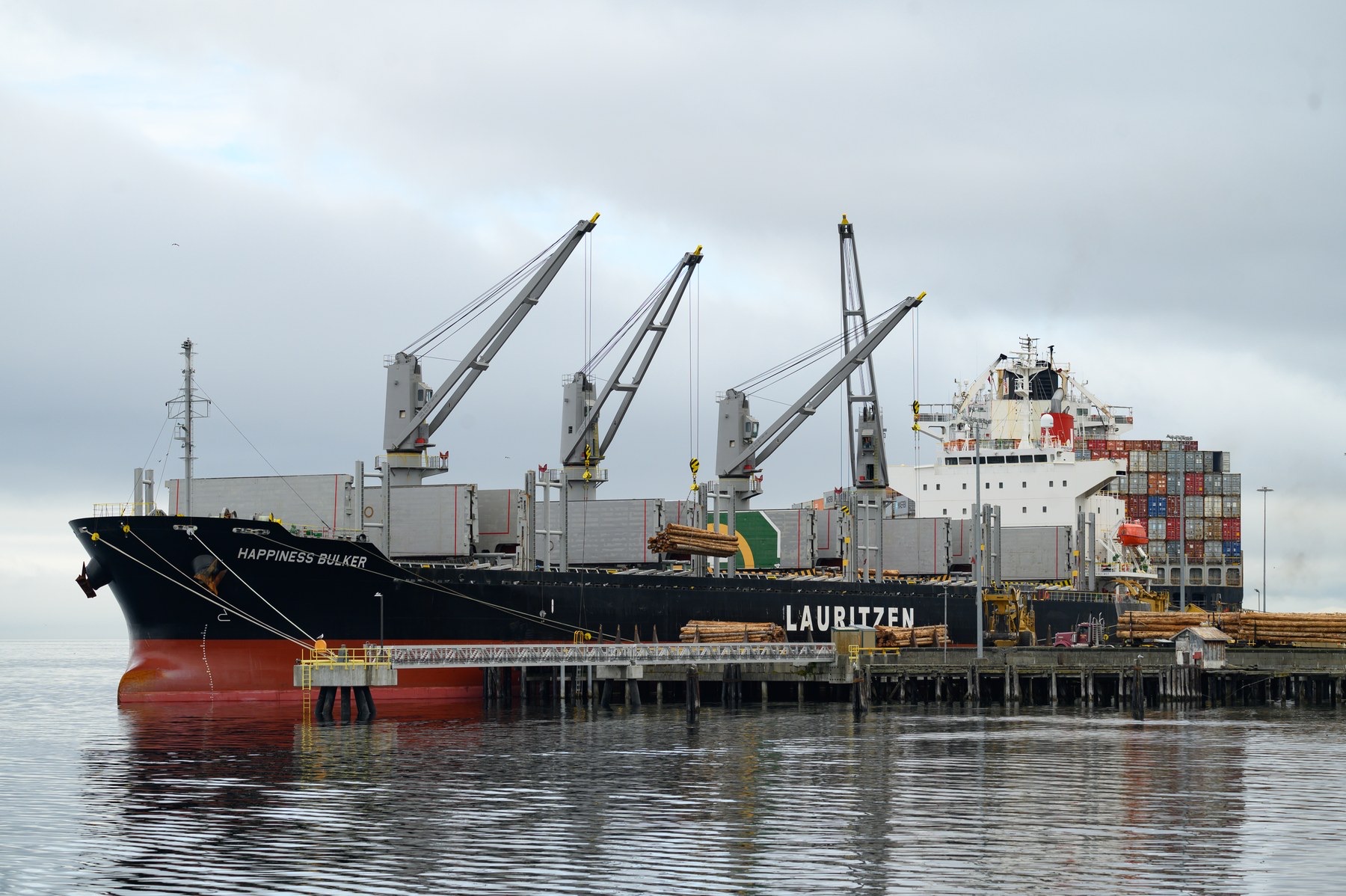
Plain Water: Ballast Water
Every large ship carries seawater in its hull for stability, pumps it in at one port and out at another, and in doing so moves about five billion tonnes of water and everything living in it around the world each year. What ballast water is and why ships need it, what it carried and where, how a mussel from the Caspian closed the intakes of the Great Lakes and a jellyfish from America emptied the Black Sea, what the treaty of 2004 required and why it took thirteen years to come into force, and how a ship now treats its water before it lets it go.
A cargo ship that has unloaded is too light to be safe at sea: it rides high, its propeller and rudder are half out of the water, and a wind or a wave can roll it. So it takes on ballast, which for the last century has meant seawater pumped into tanks built into the double bottom and the sides of the hull, tens of thousands of tonnes for a large ship, and carries the water to the port where it will load, where it pumps the water out to make room for the cargo. The world's fleet does this continuously and the sum is about five billion tonnes of seawater a year moved from one sea to another, each tonne carrying, alive, whatever was in the water where it was pumped aboard. This article is about what ballast water is and what it moved, what a mussel and a jellyfish did to two seas, what the convention of 2004 required and why it took thirteen years, and how a ship now treats its water before it lets it go.
Why ships carry water
Ships have always needed ballast. The sailing ships carried stone and sand, loaded by hand at one port and dumped at the next, which is why the harbours of the old trading cities have beaches of foreign rock; the steamships carried water in tanks, which could be pumped, and by the early twentieth century water was the ballast of every large vessel. A bulk carrier that unloads iron ore in China takes on forty or fifty thousand tonnes of water in the harbour there and sails empty to Australia, where it pumps the water out into the harbour at Port Hedland and loads ore; a tanker does the same between the Gulf and Rotterdam; a container ship trims its ballast tanks constantly to balance the boxes. The water is a structural necessity, and there is no substitute for it that a ship could carry.
The pumping is the problem. The water taken on in a harbour is harbour water, full of the plankton, larvae, eggs and spores of everything that lives there, and in the dark tanks of a ship for two weeks a share of them survive, and are released into a harbour on the other side of the world that has never met them.
| Ballast water | |
|---|---|
| Purpose | Stability and trim for a ship without cargo |
| Volume, large bulk carrier | 40,000 to 60,000 tonnes |
| Moved each year, world fleet | About 5 billion tonnes |
| Species in transit on a given day | About 7,000, by one estimate |
| Routes | Wherever cargo flows one way: ore, oil, grain, containers |
| Convention | Adopted 2004; in force 2017; treatment required on all ships since 2024 |
The mussel and the jellyfish
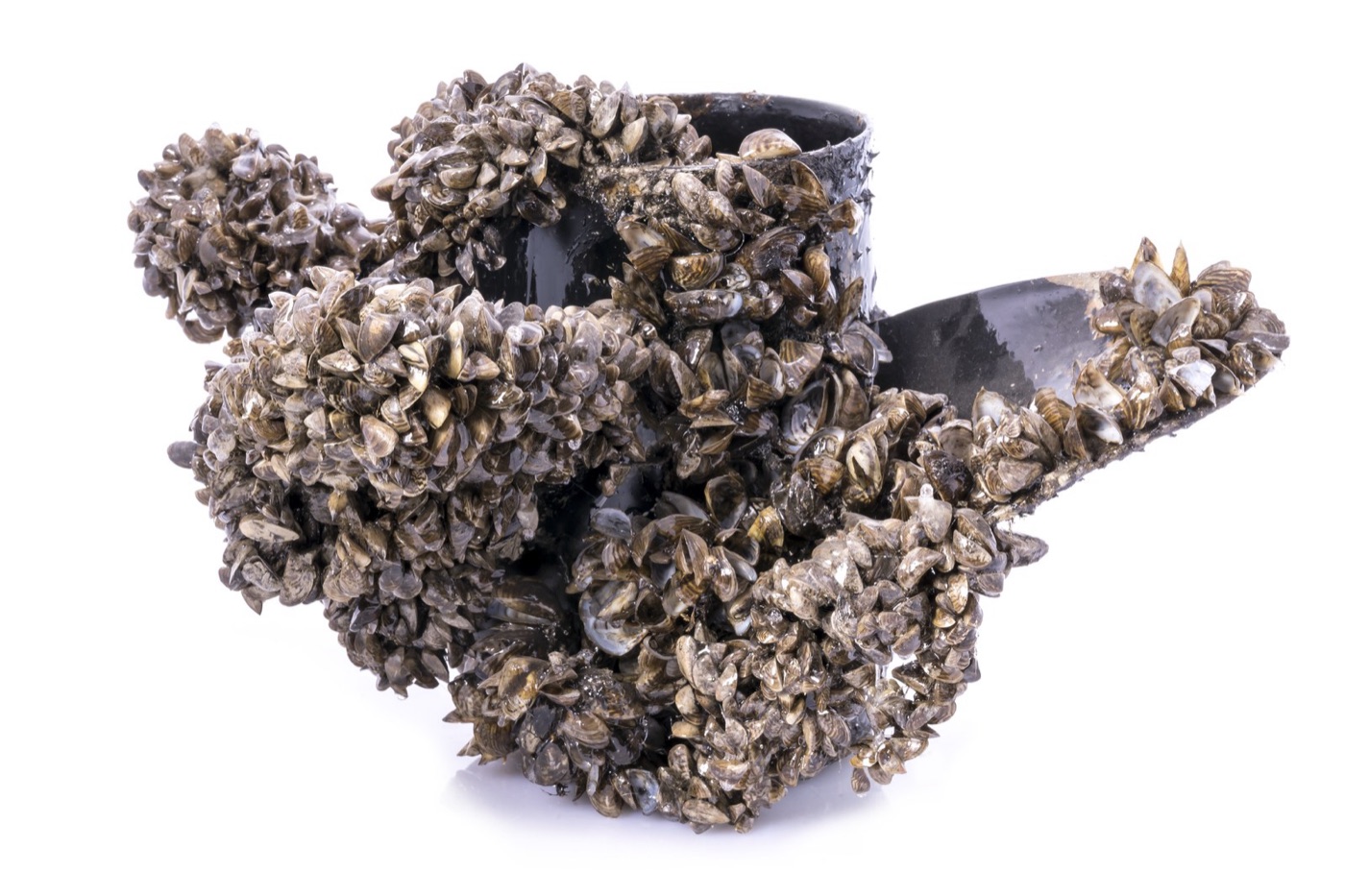
The zebra mussel is a thumbnail sized freshwater mussel from the rivers of the Caspian and Black Sea basins, and in 1988 it was found in Lake St Clair between Ontario and Michigan, arrived in the ballast of a ship that had taken on water in a Black Sea port and discharged it in the Great Lakes. Within five years it had spread through all five lakes and down the Mississippi, in numbers of tens of thousands to the square metre, and it settles on every hard surface it finds: the intakes of water works and power stations, which it clogs and which have to be scraped and chlorinated, the hulls of boats, the shells of the native mussels it smothers, and the pipes of the cities of the lakes, which the Chicago and Detroit utilities now treat at their intakes for the mussel before they treat for anything else. The cost has been put at hundreds of millions of dollars a year and the mussel is in most of the rivers of the eastern United States.
The comb jelly went the other way. Mnemiopsis is a small transparent jellyfish of the American Atlantic coast, harmless there because it has predators, and in the early 1980s it arrived in the Black Sea in ballast from an American port. It had no predators, it ate the plankton and the eggs and larvae of the fish, and by 1989 it made up most of the living mass in the sea and the anchovy fishery, which had fed Turkey, Bulgaria and the Soviet coast, had collapsed. It was checked, in the end, by a second comb jelly, which arrived in ballast in 1997 and eats the first, and the Black Sea's fish have partly returned; the same jelly has since reached the Caspian, the Baltic and the North Sea. The list of ballast introductions runs to hundreds: the Chinese mitten crab in the Thames and the Elbe, the North Pacific seastar in Tasmania, the cholera bacterium itself, which was found in the ballast of ships arriving in the American Gulf from Latin America in the epidemic of 1991.
| What ballast carried | |
|---|---|
| Zebra mussel | Caspian basin to the Great Lakes, 1988; intakes and pipes across North America |
| Comb jelly | American Atlantic to the Black Sea, 1980s; the anchovy fishery collapsed |
| Chinese mitten crab | East Asia to the Thames, the Elbe and San Francisco Bay |
| North Pacific seastar | Japan to Tasmania and Victoria |
| Cholera | Latin America to the US Gulf in ballast, 1991 |
| Toxic algae | Cysts moved between harbours, seeding blooms and shellfish poisoning |
The convention
The International Maritime Organization, which writes the rules for shipping, adopted a convention on ballast water in 2004, after fifteen years of drafting, and it took another thirteen years to come into force, in 2017, because a convention needs the ratification of countries holding a share of the world's tonnage and the shipowners argued, with some reason, that the treatment systems it required did not yet exist at the scale of a fleet. The convention has two standards. The first, exchange, required a ship to pump out its coastal ballast in mid ocean and replace it with open ocean water, which carries far fewer organisms and ones that will not survive in a harbour; it is cheap, it is dangerous in a storm, and it was the interim measure. The second, the performance standard, sets a limit on what may be discharged: fewer than ten living organisms larger than fifty micrometres in a cubic metre, fewer than ten per millilitre in the size class below, and limits on the cholera bacterium, E. coli and enterococci, which is a drinking water standard for the sea. Since 2024 every ship in international trade has been required to meet it.
The works below the waterline
Meeting it means a treatment plant on the ship. The systems that have been approved, several dozen of them, follow the plain water pillar of this site in miniature: a filter, usually a screen of fifty micrometres that takes out the larger organisms and the sediment as the water is pumped aboard, and then a disinfection stage, which is ultraviolet light in about half of the systems and electrochlorination in most of the rest, in which the seawater's own salt is turned into chlorine by an electric current, dosed into the tanks, and neutralised again before discharge. Ozone, heat and deoxygenation are used on a few. The systems cost a few hundred thousand to a few million dollars a ship, the world's fleet of some sixty thousand ships has fitted them over a decade, and the port inspectors now sample the discharge and count what is alive in it, which is the first time the sea has had an inspector at the outfall.
The systems work, on the tests, and the arguments now are about the ones that do not, in cold or turbid water where the ultraviolet cannot reach, and about the sediment in the bottom of the tanks, which the convention also covers and which carries the cysts of the algae that survive everything. The mussels and the jellies that have already moved will not move back.
The sediment and the hull
Two things the convention reaches for and does not fully hold. The first is the sediment: the mud that settles in the bottom of a ballast tank over years of pumping harbour water in and out, which holds the resting cysts of the algae that cause the toxic blooms, and which the treatment systems, which treat the water as it flows, do not touch. The convention requires the tanks to be cleaned and the sediment landed at a port facility, and the ports with such a facility are few. The second is the hull itself, on which the barnacles, the mussels and the weed of one harbour grow and travel to the next, and which the convention on ballast does not cover; the organisms moved on hulls are, by the surveys, at least as many as those moved in tanks, and the rules for them are guidelines rather than law. The ship, in other words, is treated inside and carries the sea on its outside, and the mussel that the Great Lakes' intakes are scraped for could have come either way.
What it teaches
Ballast water is the plain water article about the water nobody meant to move. Five billion tonnes a year, pumped from one harbour into another for a reason that has nothing to do with water, carried the living contents of every port to every other, and the mussel in the Great Lakes' pipes and the jelly in the Black Sea's plankton are the result. The fix, agreed in 2004 and fitted by 2024, is a water treatment works in every ship's hull, filtering and disinfecting seawater to a standard written like a drinking water rule, because that is what it took to stop the sea being poured, alive, from one side of the world into the other.
Five billion tonnes a year, seven thousand species in transit, and a treatment works below the waterline of every ship.
Sources
- International Maritime Organization, International Convention for the Control and Management of Ships' Ballast Water and Sediments (BWM Convention), adopted 2004, in force 8 September 2017; the D-1 exchange and D-2 performance standards.
- Carlton, J.T. (1999). The scale and ecological consequences of biological invasions in the world's oceans. In Invasive Species and Biodiversity Management. Kluwer. Estimate of species in transit.
- Pimentel, D. et al. (2005). Update on the environmental and economic costs associated with alien invasive species in the United States. Ecological Economics 52. Zebra mussel costs.
- Kideys, A.E. (2002). Fall and rise of the Black Sea ecosystem. Science 297. Mnemiopsis leidyi and the anchovy fishery.
- Lloyd's Register and IMO GloBallast, ballast water treatment technologies: filtration with ultraviolet or electrochlorination; type approval and the 2024 status of the world fleet.
- Photographs: opener: 2024-09-11 HAPPINESS BULKER - IMO 9919515 – Port Angeles WA USA by Gordon Leggett (CC BY) via Wikimedia Commons; inline: Zebra Mussels on Boat Propeller by US Fish and Wildlife Service (Public domain) via Wikimedia Commons; inline: Bulk carrier ship view from top by Alet123 (CC BY-SA) via Wikimedia Commons.