Plain Water: Coagulation
The oldest chemical trick in water treatment is to add metal to the water on purpose. What coagulation does to the particles a filter cannot catch, why aluminium and iron work, how a row of six beakers on a bench decides the dose for a whole city, and where the dirt goes afterwards.
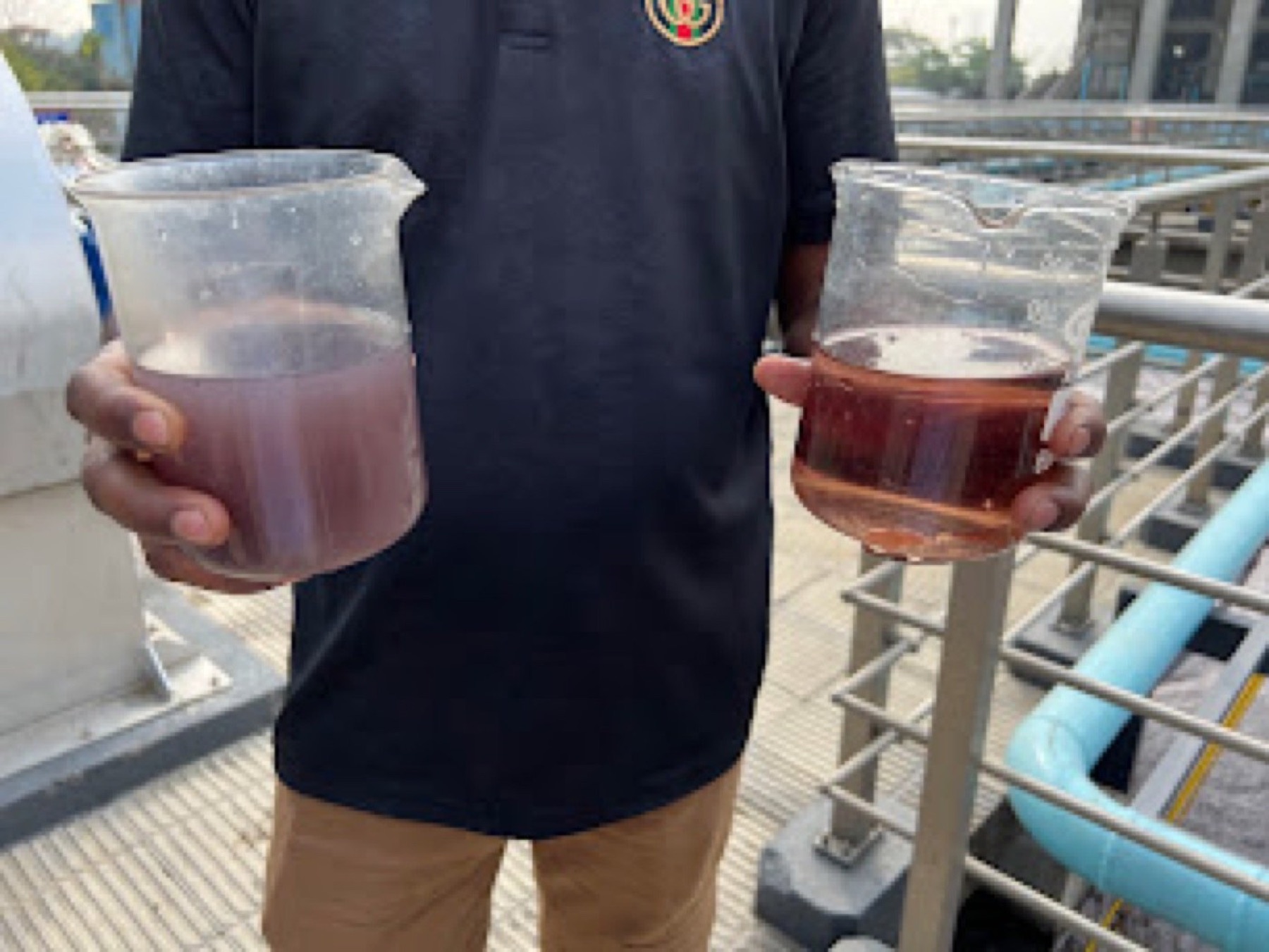
Every drinking water plant that draws from a river begins its work with a paradox. The water arrives carrying particles too small to settle and too small for any sand filter to catch, and the plant's first act is to make the water dirtier, by adding a metal salt to it in quantity. Minutes later the water is clearer than it has been since it fell as rain. The trick is called coagulation, it is at least as old as ancient Egypt, and it is still the step on which most of the world's clean water depends.
This article is about why adding metal to water cleans it, how the dose is chosen, and what happens to the dirt.
The particles a filter cannot catch
River water is cloudy, and the cloudiness is made of particles a thousandth of a millimetre across and smaller: clay washed off fields, algae, fragments of leaves and soil, the brown stain of peat, bacteria. They are called colloids, and they have two properties that defeat ordinary treatment. They are too light to settle, in any tank a plant could build; a clay particle a micron across takes days to fall a metre. And they are too small for a sand filter, which catches things by size and would let them through.
They stay suspended for a reason that is the key to the whole process. Each particle carries a small electrical charge on its surface, negative for almost everything found in natural water, and like charges repel. The particles never touch, so they never stick together, so they never grow large enough to sink or be caught. Cloudy water is a crowd of tiny objects held apart by electricity.
Adding metal on purpose
Coagulation cancels the charge. The plant doses the water with a salt of a metal that carries a strong positive charge in solution, aluminium sulphate, called alum, or ferric chloride or sulphate, or a modern relative called polyaluminium chloride. The positive ions are drawn to the negative particles and neutralise them, and, at the same time, the metal reacts with the water to form a fluffy, gelatinous precipitate of aluminium or iron hydroxide that sweeps through the water like a net.
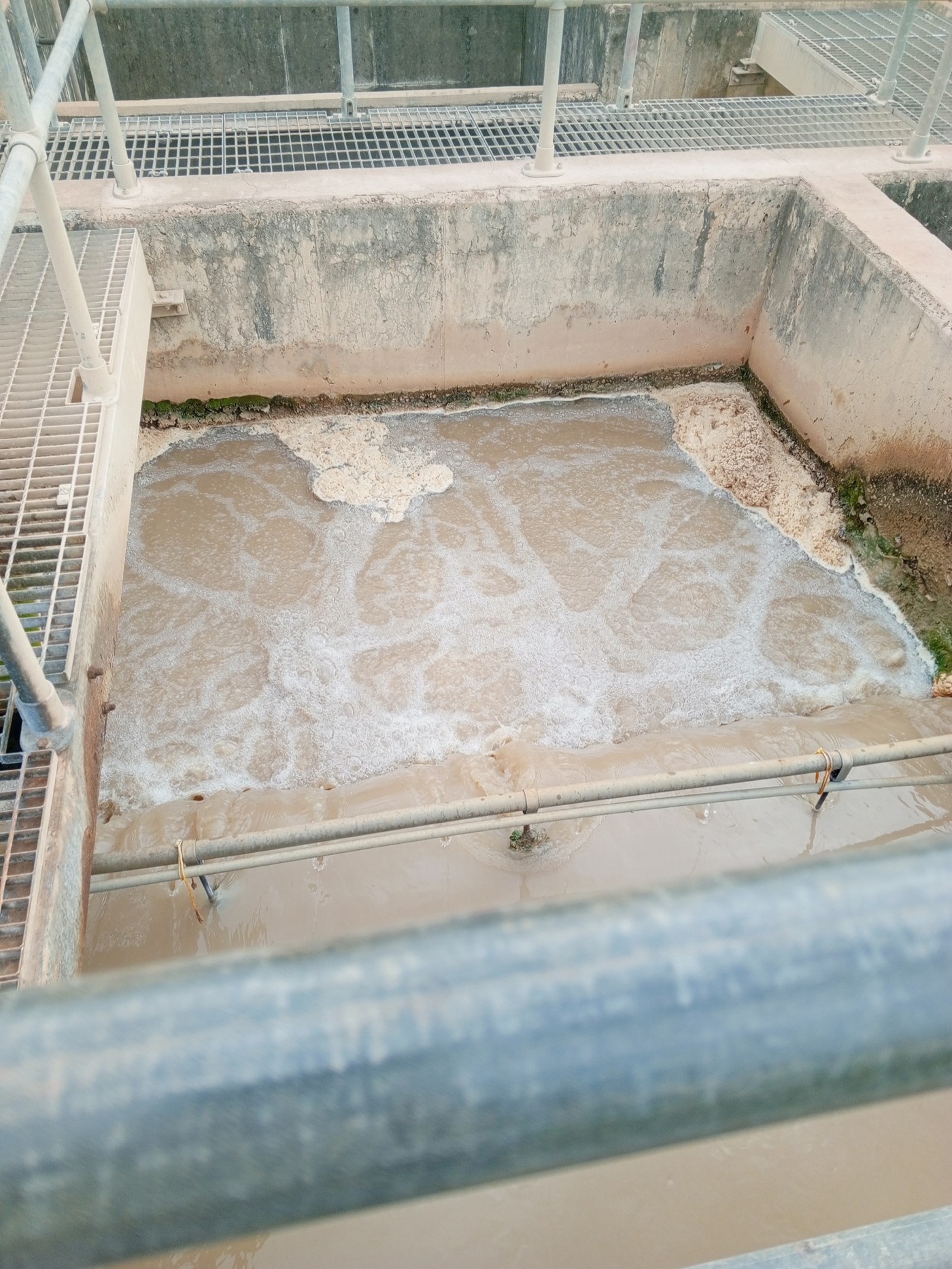
The particles, no longer repelling one another, touch and stick. Within a minute of the dose they have begun to form clumps, and the plant then stirs the water slowly and gently, in a stage called flocculation, so that the clumps collide and grow without being torn apart. After twenty or thirty minutes the water is full of flocs the size of snowflakes, brown or white, visibly drifting, and the whole of what was cloudy is inside them. They sink in a settling tank, or are floated off with fine bubbles, or are caught by the sand filter that could not catch their parts.
| The coagulation sequence | What happens | How long |
|---|---|---|
| Rapid mix | The coagulant is dispersed through the water in seconds | Seconds |
| Coagulation | The particles' charge is cancelled and they begin to stick | A minute |
| Flocculation | Slow stirring grows the flocs | Twenty to thirty minutes |
| Settling or flotation | The flocs sink, or are lifted off with air | One to three hours |
| Filtration | Sand catches what remains | Minutes |
What it removes
Coagulation was invented for cloudiness, and it removes a great deal else, which is why it turns up throughout this series.
It removes colour: the brown of peat water and the dye of a textile effluent are dissolved organic molecules that a coagulant binds and drags down, and the industry article on textiles described colour being knocked out with coagulants at the front of the plant. It removes phosphorus, which precipitates with iron or aluminium as an insoluble phosphate, and most sewage works that have to meet a phosphorus limit dose iron for exactly this purpose. It removes arsenic, fluoride and some metals, which bind to the hydroxide floc. And it removes a large share of the bacteria, viruses and parasites, which are particles too, and which leave the water inside the floc long before disinfection.
| Coagulation removes | Because |
|---|---|
| Cloudiness, clay, algae | They are the particles it was designed for |
| Colour, peat and dye | Dissolved organic molecules bind to the floc |
| Phosphorus | It precipitates as an insoluble metal phosphate |
| Arsenic, fluoride, some metals | They adsorb onto the hydroxide floc |
| Bacteria, viruses, protozoa | They are particles, and are swept into the floc |
| Salt, nitrate, most dissolved chemicals | It does not; they are not particles and do not bind |
The jar test
The dose is the art, and it is set by one of the simplest experiments in the industry.
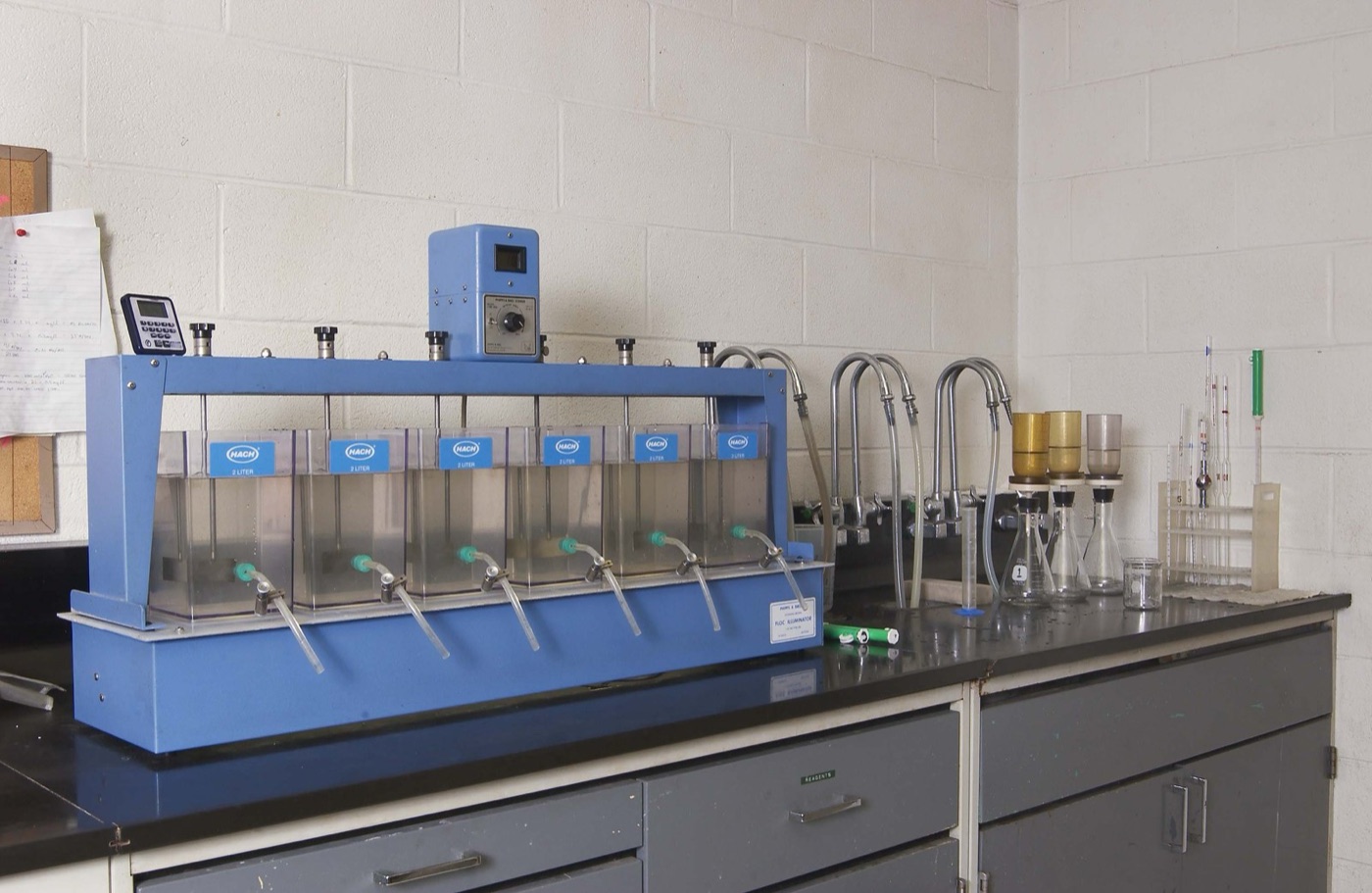
On a bench in the plant's laboratory stands a row of six beakers on a frame, each with a paddle above it driven by a common motor. Each beaker is filled with a litre of the raw water. A ladder of doses of the coagulant is added, one to each beaker, ten milligrams per litre in the first, twenty in the next, and so on. The paddles spin fast for a minute, then slow for twenty, then stop, and the beakers are left to settle. The operator looks at them. In some the water is still cloudy; in one or two it is clear with a layer of floc on the bottom; in the highest doses it may be cloudy again, with fine floc that would not settle, because too much coagulant restores the charge in the other direction. The beaker that cleared best, at the lowest dose, is the plant's dose for the day.
The jar test is repeated whenever the river changes, after rain, in an algal bloom, with the seasons, and it is done by eye and by a turbidity meter and, in the better plants, by measuring the charge on the particles directly. A plant serving a million people is run, in the end, on which of six beakers cleared. It has been that way for a century and no instrument has replaced it.
Floating instead of sinking
Some flocs would rather float. Algae, which carry gas inside their cells, and the light flocs formed from coloured water and from oils, settle slowly or not at all, and for those a plant uses the opposite of a settling tank. Dissolved air flotation, DAF in the industry's shorthand, saturates a side stream of water with air under pressure and releases it into the bottom of the flocculated water, where the pressure drop produces a cloud of bubbles a few tens of microns across. The bubbles attach to the flocs and carry them to the surface, where they form a thick brown blanket that is scraped off. The water below is clear. DAF is faster than settling, takes a fraction of the space, and handles algae, which is why it is common at drinking water plants on reservoirs that bloom, at textile ETPs for dye floc, and in the chain at Windhoek's reuse plant described elsewhere on this site.
The helper: polymers
The metal salt does the coagulation. A second chemical often does the growing. Polyelectrolytes, long chain organic polymers carrying a charge along their length, are dosed at a fraction of a milligram per litre after the coagulant and act as bridges, each molecule linking several small flocs into a large, tough one that settles fast and does not break up in the filter. They are used at nearly every plant, in tiny amounts, and they are also what makes sludge dewatering possible: the same bridging that builds a floc in the tank binds the sludge into a cake on the press. A plant's chemical store holds a bag of coagulant by the tonne and a drum of polymer by the litre, and the litre does a surprising share of the work.
The pH window, and the sludge
Two things about coagulation the operator watches, and both have appeared in earlier articles.
The first is pH. Alum forms its floc between about pH 6 and 7 and dissolves again outside that window; iron salts work over a wider range but consume alkalinity as they react. A plant that doses coagulant into water at the wrong pH wastes the chemical and clouds the water, and most plants dose lime or acid alongside the coagulant to hold the window, as the pH article described.
The second is the sludge. Everything the coagulant swept out of the water is now a wet, gelatinous mass on the floor of the settling tank, and it is made of the dirt plus the metal hydroxide that caught it. A plant that doses more coagulant makes more sludge, and coagulant sludge is one of the harder kinds to dewater, because the hydroxide holds water like a sponge. The sludge article on this site described the pile at the back of every plant; at a drinking water works, this is what the pile is made of, and it goes to landfill, to the sewage works, or, from a clean river, back to farmland.
A very old trick
Coagulation predates the understanding of it by a few thousand years. Egyptian and Indian texts describe clearing muddy water with alum, and with the crushed seeds of the moringa tree, whose proteins carry a positive charge and coagulate clay exactly as alum does; moringa seeds are still used in villages across Africa and South Asia for the purpose, and they work. The chemistry was understood in the nineteenth century, the first large alum dosed plants were built in the 1880s, and the process has barely changed since. It is cheap, it uses a chemical that is made by the million tonnes, and it turns a river into something a filter can finish. Almost every glass of tap water drawn from a river has been through it, and almost nobody who drinks the glass has heard the word.
Sources
- AWWA and ASCE, Water Treatment Plant Design. Coagulation chemistry, coagulant selection, rapid mix and flocculation, the jar test procedure.
- Metcalf and Eddy, Wastewater Engineering. Chemical precipitation for phosphorus and colour removal; sludge production from metal salts.
- Standard Methods for the Examination of Water and Wastewater (APHA, AWWA, WEF), method 2710 and ASTM D2035, jar test.
- Photographs: Cesar Chu Ortega, from water laboratories and plants in India and Bangladesh; inline: Activated Sludge Aeration Basin by Jemir Shamir (CC BY-SA) via Wikimedia Commons; inline: Jar testing equipment for testing water quality. (15052115711) by USEPA Environmental-Protection-Agency (public domain) via Wikimedia Commons.