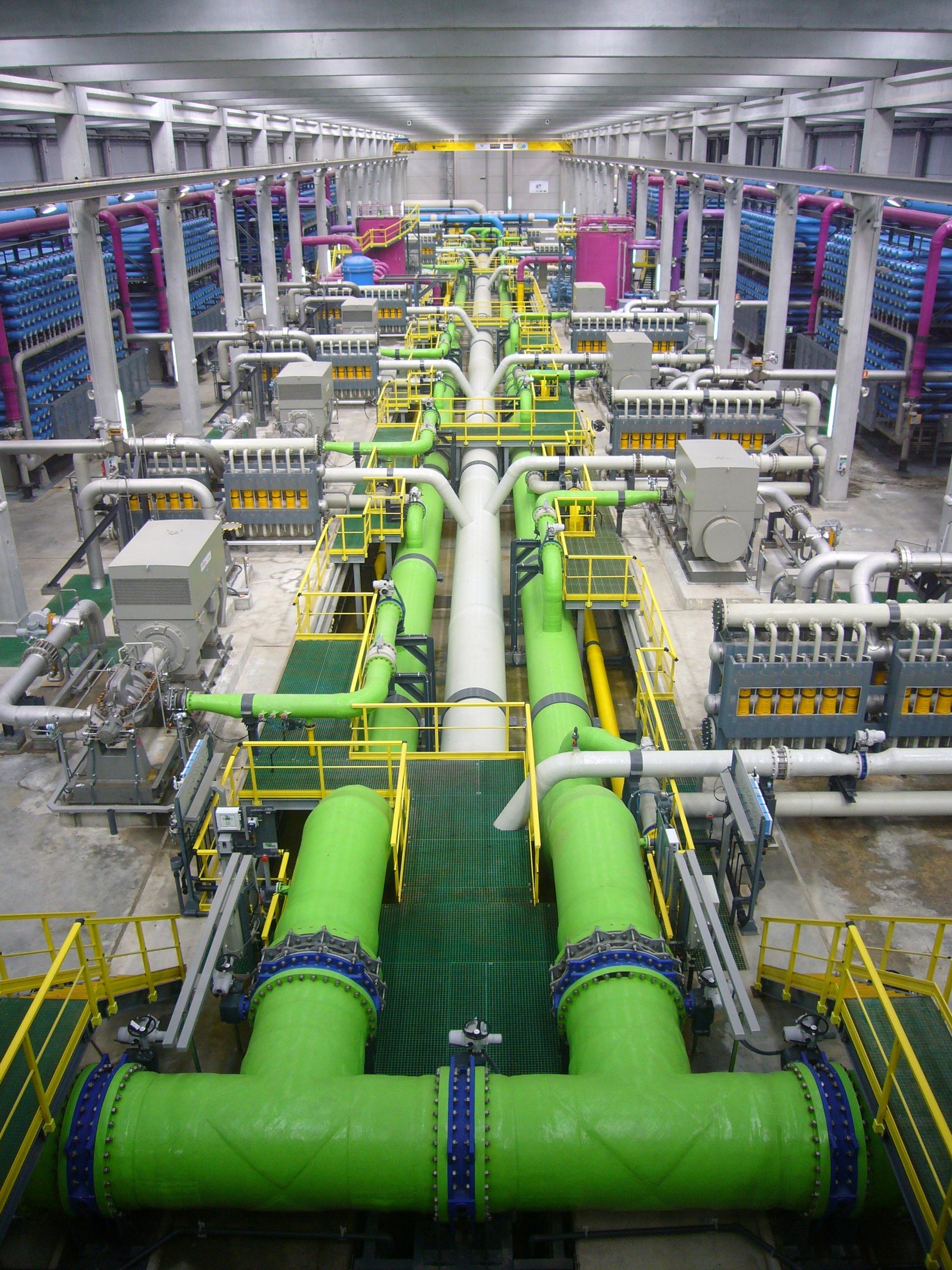
Plain Water: Desalination
About one percent of the world's people drink the sea, and in the Gulf it is most of them. How seawater becomes drinking water, why the process moved from boiling to membranes, what it costs in money and energy, and why a plant on a coast is easier to build than to explain.
Fly into Dubai, Doha or Riyadh at night and the city below is a field of light in a desert that receives almost no rain and has no river. The taps in those cities run, and what comes out of them is the sea. Desalination, the removal of salt from seawater to make it drinkable, is how a large part of the Middle East lives, how Israel and Singapore and Australia's coastal cities insure themselves against drought, and how about one percent of the world's population gets its water. It is a technology with a long history, a recent transformation, and a set of costs that are worth understanding before anyone proposes it as the answer to everything.
Boiling the sea
For most of the twentieth century, desalination meant distillation: boiling seawater and condensing the steam, which leaves the salt behind, as it has since sailors first rigged a still on deck. The industrial version, developed in the 1950s and built at enormous scale in the Gulf, is called multi stage flash. Hot seawater is passed through a chain of vessels each at a lower pressure than the last, so that at each stage a fraction of it flashes instantly into steam, which is condensed on tubes carrying the incoming feed and warms it on its way in. The plants were built beside power stations and ran on their waste heat, which is why the Gulf's water and electricity have always come from the same site.
Thermal desalination works, it is robust, and it produces very pure water. It also uses a great deal of energy, roughly ten times what the best membrane plants use today, and it is being replaced everywhere except where the waste heat is free and the water is very hard to treat any other way.
| Process | How it works | Energy per cubic metre | Where it is used |
|---|---|---|---|
| Multi stage flash | Seawater flashed to steam in a chain of vessels, condensed | High, mostly heat; tens of kWh equivalent | The Gulf, beside power stations |
| Multi effect distillation | Seawater evaporated in stages using the steam of the last | Lower than flash, still mostly heat | The Gulf, some islands |
| Reverse osmosis | Seawater pushed through membranes at 55 to 80 bar | About 3 kWh of electricity | Nearly all new plants |
Pushing the sea through a membrane
The transformation came from the membrane, described in two earlier articles. Reverse osmosis pushes seawater against a membrane that lets water through and holds salt back, at a pressure greater than the sea's own osmotic pull of about 27 bar, and what comes through is fresh water with 99 percent of the salt removed. The first practical membrane was made at UCLA in 1960; the first large seawater plants followed in the 1980s; and by the 2000s reverse osmosis had displaced boiling as the way new plants were built, because its energy use had fallen to about 3 kilowatt hours per cubic metre and was still falling.
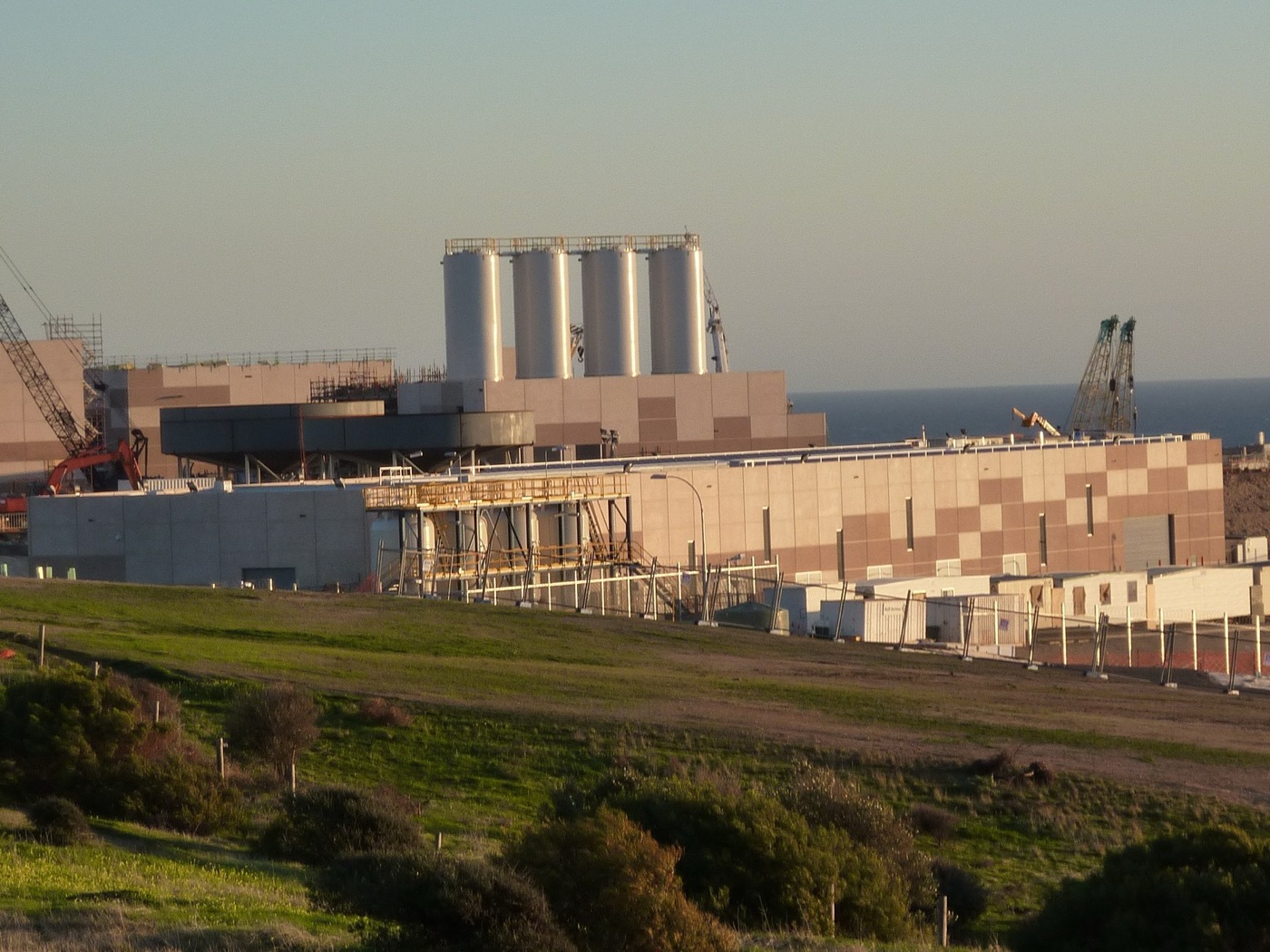
A seawater reverse osmosis plant is a sequence. Seawater is drawn in through screened intakes, or through wells drilled into the beach that use the sand as a first filter. It is pretreated: coagulated, filtered through sand or ultrafiltration membranes, and dosed with antiscalant, because the membranes will foul on anything the pretreatment misses. It is pumped, at 55 to 80 bar, through racks of pressure vessels, and about half of it emerges as fresh water while the other half leaves as brine. The brine's pressure is recovered and handed to the incoming seawater. The fresh water, which is too pure to drink, is passed over limestone to put minerals back, disinfected, and sent to the city.
How much, and where
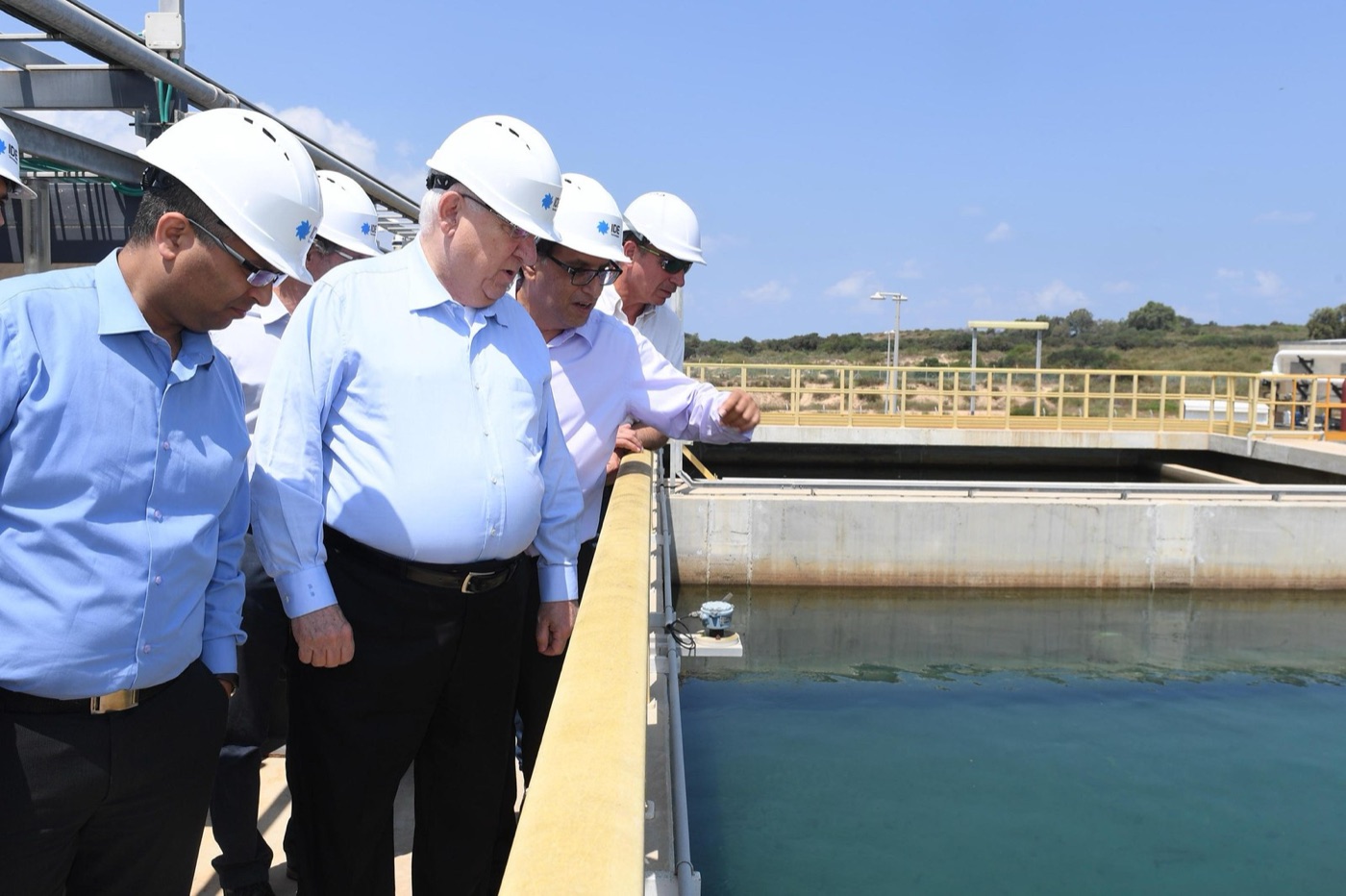
The world now has more than twenty thousand desalination plants, with a capacity of about 100 million cubic metres a day, roughly one percent of the freshwater that people withdraw. About half of that capacity is in the Middle East and North Africa, where it is not a supplement but the supply. Saudi Arabia is the largest producer. The Emirates, Kuwait, Qatar and Bahrain get most of their water from the sea. Israel, which built five large reverse osmosis plants on its Mediterranean coast between 2005 and 2015, now takes the majority of its domestic water from them, and the Sorek plant south of Tel Aviv, commissioned in 2013 at about 624,000 cubic metres a day, was for a time the largest reverse osmosis plant in the world.
Outside the dry belt, desalination is insurance. Spain built plants along its Mediterranean coast during the droughts of the 2000s, and Barcelona's El Prat plant has been switched up and down with the rain ever since. Australia's coastal cities, Perth, Sydney, Melbourne, Adelaide, built plants during the long drought of that decade, mothballed some when the rain returned, and have restarted them since. Singapore's fourth national tap is desalination, at up to a quarter of demand. California's Carlsbad plant, opened in 2015 beside San Diego at about 190,000 cubic metres a day, is the largest in the Americas and supplies about a tenth of the county's water.
| Where the sea is drunk | Share of supply |
|---|---|
| Gulf states | Most of the domestic supply |
| Israel | The majority of domestic water |
| Singapore | Up to 25 percent of demand |
| Spain's Mediterranean coast, Australia's cities | Drought insurance, run when the rain fails |
| San Diego County | About a tenth |
The intake
The part of a desalination plant that attracts the most argument is often the one that seems simplest: the pipe that draws the sea in.
An open intake, a screened pipe some distance offshore, draws in seawater and, with it, whatever is swimming or drifting in it. Fish and larger animals are held against the screens; eggs, larvae and plankton, too small for any screen, are drawn through the plant and killed. The effect on a stretch of coast is real and hard to measure, and it was the centre of a decade of dispute over the Carlsbad plant in California before it opened. The alternative is a subsurface intake, wells drilled into the beach or the seabed that draw seawater through the sand, which filters it before it reaches the plant and harms nothing that swims. Beach wells produce cleaner feed water and need less pretreatment, and they are the preferred design wherever the geology allows. Where it does not, an open intake with fine screens and a slow approach velocity, so that fish can swim away, is the compromise, and the permit sets the velocity.
What it costs
The cost of desalinated seawater has fallen steadily and is now, at a large modern plant, somewhere between half a dollar and a dollar a cubic metre, with the lowest tenders in the Gulf and Israel below that. It is a figure worth placing. It is several times what a city pays to treat river water, and it is far too expensive for irrigating field crops, which is why desalination will never grow the world's wheat. It is also, for a coastal city with no other source, cheap: a person's daily water at a dollar a cubic metre costs a few cents.
The cost is mostly energy, and the energy is mostly electricity for the high pressure pumps. That is where the two real questions about desalination sit.
The two catches
The first is the brine. Half of what a seawater plant takes in goes back to the sea at twice the salt, and, as the brine article described, it is denser than seawater and has to be returned through diffusers that mix it quickly, in a place with current, so that it does not pool on the seabed. Done well, the effect is confined to a small area around the outfall. In an enclosed, shallow, warm sea that receives the brine of dozens of plants, which is a description of the Gulf, the salinity of the whole body of water is measurably rising, and the plants themselves are drawing in saltier water year by year.
The second is the electricity. Three kilowatt hours per cubic metre is a small number per glass and a large one per city, and where that electricity comes from a coal or gas plant, the desalinated water carries a carbon cost that river water does not. A city that solves its water problem with desalination has moved part of it into its power system, and the honest accounting says so. The plants being built now in the Gulf and Australia are increasingly paired with solar and wind, which is the right answer and not yet the usual one.
| The two catches | |
|---|---|
| Brine | Half the intake, twice the salt, returned to the sea; local seabed effects, and a rising Gulf |
| Energy | About 3 kWh per cubic metre; a carbon cost wherever the grid is fossil |
Easier to build than to explain
A desalination plant is a settled technology. The membranes are catalogue items, the pumps are standard, the energy recovery devices are made by a handful of firms, and a competent engineering company can build one in a few years. What is hard is the conversation around it: the cost per cubic metre against the cost of doing nothing, the brine against the fish, the electricity against the climate, and the question, which every drought raises and every rain lets people forget, of whether the city should have built it sooner. Perth built, and has never regretted it. Sydney built, mothballed, and restarted. Cape Town, in its Day Zero year, built small emergency plants in a hurry and has argued about a large one ever since.
The sea is not going to run out, and the process that turns it into drinking water is understood to the last bar of pressure. Whether a city drinks it is a decision about money, energy and how much rain it is willing to bet on, and that is the part of desalination that no membrane can settle.
Sources
- International Desalination Association and Global Water Intelligence, DesalData. More than 20,000 plants and about 100 million cubic metres per day of installed capacity; reverse osmosis the majority of new capacity.
- Jones, E. et al. (2019). The state of desalination and brine production. Science of the Total Environment 657. Global capacity, regional shares, brine.
- Elimelech, M. and Phillip, W.A. (2011). The future of seawater desalination: energy, technology and the environment. Science 333. Energy of reverse osmosis versus thermal processes; about 3 kWh/m³ for modern RO.
- Israel Water Authority: desalinated seawater supplying the majority of the country's domestic water; the Sorek plant, commissioned 2013, about 624,000 cubic metres a day.
- San Diego County Water Authority: the Carlsbad plant, 2015, about 190,000 cubic metres a day.
- Photographs: El Prat desalination plant by James Grellier (CC BY-SA 3.0) via Wikimedia Commons; inline: Port Stanvac Desalination Plant P1000725 by User:Vmenkov (CC BY-SA) via Wikimedia Commons; inline: Reuven Rivlin in a visit at IDE - Sorek Desalination Plant (6317) by Mark Neyman (CC BY-SA) via Wikimedia Commons.