Plain Water: Membranes
The most important piece of equipment in modern water treatment is a sheet of plastic with holes in it too small to imagine. What a membrane is, the four sizes it comes in, what each one catches, and why a plant built around them looks nothing like the tanks of the last century.
Every treatment plant built before about 1990 was a set of tanks. Water flowed in, sat, was stirred, was aerated, settled, and flowed out, and the plant was recognisable from the air as a row of circles and rectangles. A plant built today for reuse or for drinking water from a poor source looks different: long racks of white tubes in a shed, a bank of pumps, and very few tanks. The tubes hold membranes, and the membrane is the single change that has made it possible to turn used water into drinking water, seawater into a city's supply, and a dye house's effluent into water it can dye with again.
This article is about what a membrane is, in plain terms, and why a sheet of plastic with holes in it reorganised an industry.
A filter taken to its limit
A filter works by being too small to pass. Sand catches grit because grit will not fit between the grains. A cloth catches lint. The trouble with ordinary filters is that they stop somewhere around the size of a fine particle, and most of what makes water unsafe or unusable is smaller than that: bacteria, viruses, dissolved molecules, and salt, which has come apart into ions barely larger than water itself.
A membrane is a filter with holes engineered to a chosen size, and the sizes go down far past anything sand or cloth could reach. It is a thin sheet of polymer, a plastic, cast with a structure of pores, and water is pushed through it under pressure. What is bigger than the pores stays behind. What is smaller goes through. That is the whole idea, and the art is in making the holes the right size, making enough of them, and keeping them open.
| Membrane | Pore size | What it holds back | Pressure |
|---|---|---|---|
| Microfiltration | About 0.1 to 10 µm | Suspended solids, bacteria, protozoa | Under 2 bar |
| Ultrafiltration | About 0.01 to 0.1 µm | The above, plus viruses and large molecules | 1 to 5 bar |
| Nanofiltration | About 1 nm | The above, plus hardness and larger dissolved molecules | 5 to 20 bar |
| Reverse osmosis | Under 1 nm, no true pores | Almost everything, including salt | 10 to 80 bar |
A micron is a thousandth of a millimetre. A human hair is about seventy microns across. A bacterium is about one. A virus is a few hundredths. The ultrafiltration membrane that a reuse plant relies on has pores about a hundredth of a micron across, which is roughly seven thousand times smaller than the hair.
What each size catches
Microfiltration is the coarsest of the family and the workhorse. Its pores are too small for any bacterium or protozoan to pass, so water that has been through one is, in practice, free of the organisms that cause most waterborne disease, without a drop of chlorine. It is the first membrane step in Singapore's NEWater and in most reuse plants, and it needs little pressure.
Ultrafiltration goes an order of magnitude finer and catches viruses, which are far smaller than bacteria, along with large organic molecules and the colloids that make water cloudy. It is the membrane that makes water clear and biologically safe, and it is the usual pretreatment before reverse osmosis, because it delivers water that will not foul the finer membrane downstream.
Nanofiltration sits between ultrafiltration and reverse osmosis, and it is a specialist. Its pores are close to the size of a molecule, and it holds back the larger ions, calcium and magnesium among them, while letting sodium and chloride through. It softens water without removing all its salt, and it is used where hardness or colour is the problem and full desalination would be wasteful.
Reverse osmosis is the end of the scale, and it works on a different principle from the others: its membrane has no true pores, and water passes through it by dissolving into the polymer and diffusing across, which salt cannot do. It holds back nearly everything, and it is the subject of its own article, because it is the membrane that desalinates the sea.
What a membrane looks like
The polymer sheet is not used as a sheet. To pack enough area into a small volume it is made into one of two shapes.
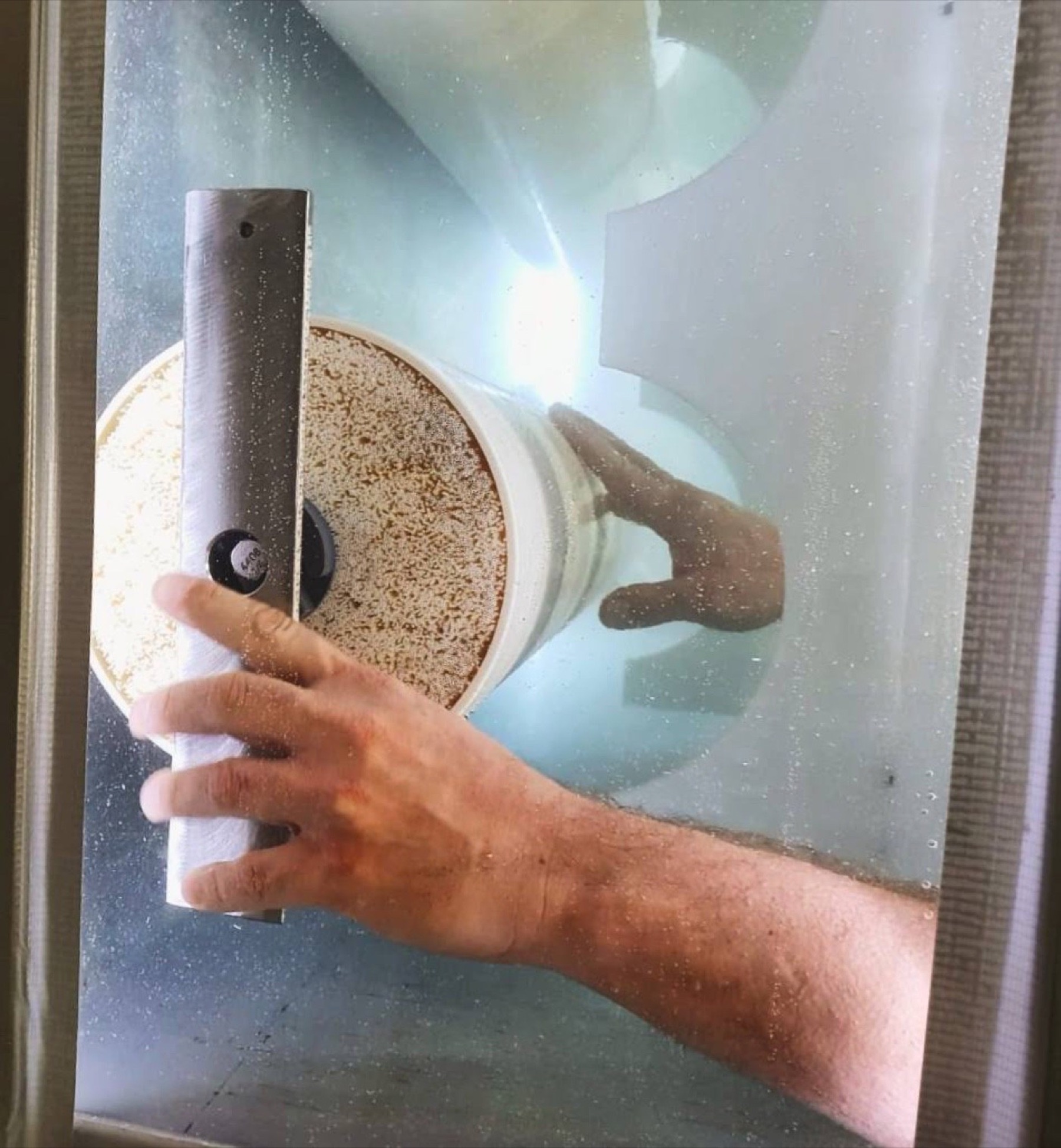
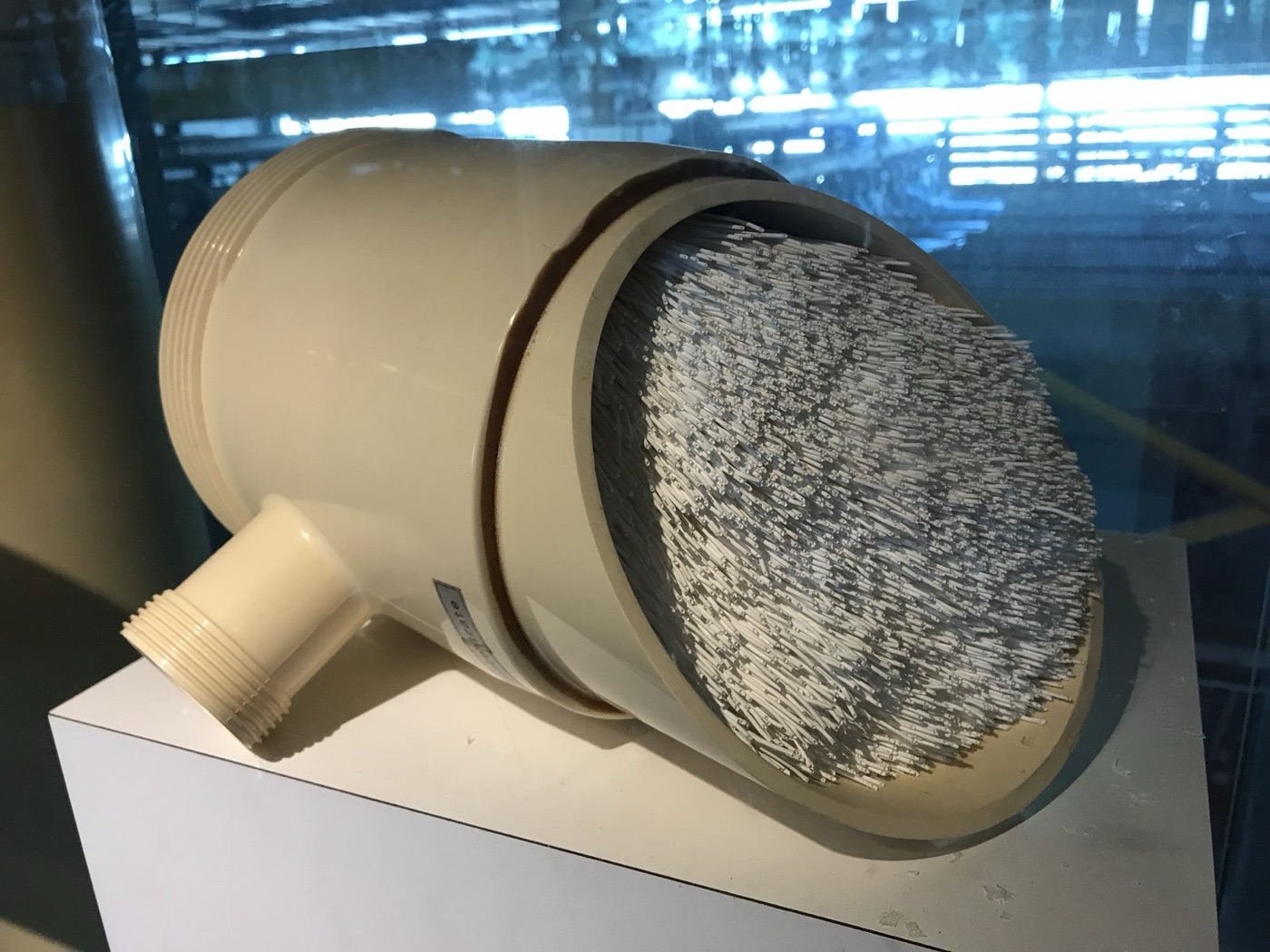
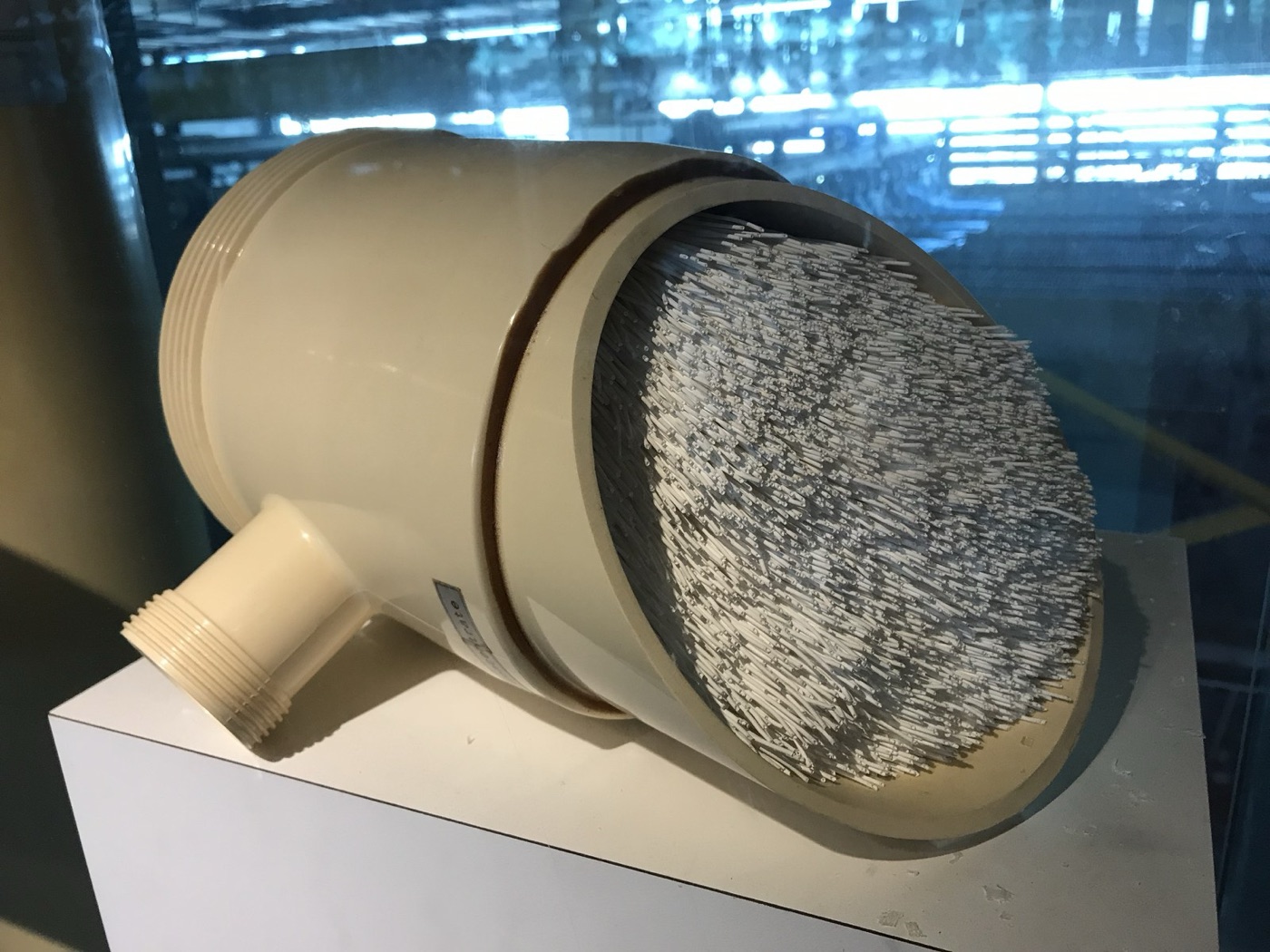
Hollow fibres are threads of membrane, a millimetre or less across and a metre or two long, hollow down the middle, bundled by the thousand into a tube. Water is pushed through the wall of each fibre, from outside to inside or the reverse, and the bundle gives enormous filtering area in a module the size of a drainpipe. Microfiltration and ultrafiltration are nearly always hollow fibre.
Spiral wound modules are flat sheets of membrane, layered with mesh spacers, rolled around a central tube and slid into a pressure vessel. Water enters one end, passes along the spacers, and the part that crosses the membrane spirals inward to the tube. Reverse osmosis is nearly always spiral wound, because the flat sheet can be made as a thin composite film that hollow fibres cannot.
A rack of either kind, in a shed, with pumps, valves and a control panel, is what a membrane plant looks like, and it is why the plant has so few tanks. The membrane does in a tube what the tank did in a hectare.
A short history
The membrane is older than the plants that use it, and its history explains why the plants arrived when they did.
The first practical reverse osmosis membrane was made in 1960 at the University of California, Los Angeles, by Sidney Loeb and Srinivasa Sourirajan, who found a way to cast cellulose acetate into a sheet with a very thin dense skin on a thick porous backing. The skin did the separating and the backing held it up, and that asymmetric structure is still the pattern of every membrane made. In the 1970s John Cadotte, working for a small American company, made a far better skin by forming a film of polyamide a fraction of a micron thick directly on the support, and the thin film composite membrane he patented is, with refinements, what every reverse osmosis plant on Earth runs on today.
Microfiltration and ultrafiltration in hollow fibre form arrived for water treatment in the late 1980s and 1990s, first for drinking water plants that needed to remove Cryptosporidium after the Milwaukee outbreak, then for reuse. The price fell by an order of magnitude between the early 1990s and the 2010s as production scaled, and it is the price, as much as the performance, that took membranes from a specialist tool to the default. A membrane plant that would have been an extravagance in 1990 is now, per cubic metre, often the cheaper option, and that is why the new plants have so few tanks.
The enemy is fouling
A membrane's holes are its whole value, and everything in the water is trying to block them. Particles settle on the surface. Organic matter forms a slime. Bacteria grow on it and build a film. Hardness, on the reject side of a fine membrane, comes out of solution as scale. The process is called fouling, and managing it is most of what operating a membrane plant means.
The tools are simple in principle. Microfiltration and ultrafiltration membranes are backwashed every few minutes to an hour, water pushed briefly the wrong way through them to lift what has settled, and air scoured to shake the fibres. Every few weeks they are cleaned in place with chemicals, an acid to dissolve scale and a caustic or a chlorine solution to strip organic matter and biofilm. Reverse osmosis membranes cannot be backwashed, so their feed is pretreated with care, dosed with antiscalant, and the modules are cleaned chemically when the pressure needed to push water through them has risen by a set amount. A membrane that is run well lasts five to ten years. One that is run badly lasts a season.
| Keeping the holes open | |
|---|---|
| Backwash | Water pushed backwards through the membrane, every few minutes to an hour |
| Air scour | Bubbles shaking loose what has settled on the fibres |
| Chemical clean | Acid for scale, caustic or chlorine for slime, every few weeks |
| Pretreatment | Coarser membranes and filters upstream, so the fine ones see clean water |
| Integrity test | Pressure held on the module to prove no fibre has broken |
The last line matters more than it looks. A membrane plant's promise is that nothing larger than the pores gets through, and a single broken fibre breaks the promise. So the modules are tested regularly by holding air pressure on them and watching for a leak, in the same way a tyre is tested, and a module that fails is taken out and its fibre pinned. Singapore publishes these results. It is the reason the public trusts the water.
The membrane in the biology tank
One combination deserves a mention, because it is where membranes have changed the ordinary treatment plant rather than only the exotic ones. A membrane bioreactor, or MBR, puts ultrafiltration membranes directly into the tank of bacteria described in the article on the ETP. Instead of letting the bacteria settle out in a second tank, which takes hours and a great deal of space and does not always work, the water is drawn out through the membranes and the bacteria stay behind. The tank can hold a denser population, the plant takes a fraction of the land, and the water that leaves is already clear and free of bacteria, ready for reverse osmosis if reuse is the aim. Most of the textile reuse plants that recover 70 to 90 percent of their water are built this way.
Why it changed everything
For a century, treatment meant letting nature do the work in tanks: gravity to settle, bacteria to eat, time to finish. The result was water safe to discharge and, with disinfection, safe to drink from a clean source. It was not water that could be drunk again, because the tanks could not remove what was dissolved, and they could not promise what they had removed.
The membrane can do both. It removes down to a chosen size, it can be proved to have done so, and at the bottom of the scale it removes even the salt. That is why used water can be drunk in Singapore, why seawater is drunk in the Gulf, and why a dye house can use its water more than once. The tanks are still there, in front of the membranes, doing the cheap work first. But the membrane is where the water becomes new, and the next article follows it to the finest end of the scale.
Sources
- Metcalf and Eddy, Wastewater Engineering, Treatment and Resource Recovery (5th edition). Membrane classification by pore size and operating pressure; membrane bioreactors.
- AWWA Manual M53, Microfiltration and Ultrafiltration Membranes for Drinking Water. Hollow fibre configuration, backwashing, integrity testing.
- Loeb, S. and Sourirajan, S. (1963). Sea water demineralization by means of an osmotic membrane. Advances in Chemistry 38. The first practical asymmetric membrane.
- Photographs: Cesar Chu Ortega, from membrane plants in India; inline: Cutaway of a microfiltration module with hollow fiber membranes at a NEWater plant by Z22 (CC BY-SA) via Wikimedia Commons; inline: Cutaway of a microfiltration module with hollow fiber membranes at a NEWater plant by Z22 (CC BY-SA) via Wikimedia Commons.