Plain Water: Reverse osmosis
The process that turns seawater into drinking water and used water into new water is a plant's worth of pumps pushing against a force that nature runs the other way. What osmosis is, why reversing it takes so much pressure, what the membrane actually does, and why the last thirty years cut its energy in half.
Cut a potato in half, put one half in fresh water and the other in brine, and leave them for an hour. The half in fresh water will be firm and slightly swollen. The half in brine will be limp, and the brine will have gained water. Nothing was pumped. The water moved by itself, out of the potato and into the salt, because that is the direction water moves when salt is on one side of a membrane and not the other. The process is called osmosis, and every living cell depends on it.
Reverse osmosis is that process made to run the other way, by force, and it is the reason a city can drink the sea. This article is about how, in plain terms, and about why it costs what it costs.
Osmosis, and the force behind it
A membrane that lets water through but not salt is called semipermeable, and the cell wall of the potato is one. Put such a membrane between fresh water and salt water and the fresh water flows through it towards the salt, diluting it, and keeps flowing until the pressure of the rising column on the salty side pushes back hard enough to stop it. That pressure, the height the salty side would climb to, is the osmotic pressure of the solution, and it depends only on how much is dissolved in it.
For seawater, at about 35 grams of salt in a litre, the osmotic pressure is about 27 bar, twenty seven times the pressure of the air around you, or the pressure at the bottom of a column of water 270 metres tall. That is the force with which seawater pulls fresh water towards itself through a membrane, and it is the force a desalination plant has to beat.
| Water | Osmotic pressure |
|---|---|
| Brackish groundwater, 2,000 mg/L | About 1.5 bar |
| Treated used water for reuse | About 1 bar |
| Seawater, 35,000 mg/L | About 27 bar |
| Seawater brine at 50 percent recovery | About 55 bar |
Reversing it
To make water flow out of the salty side and through the membrane into the fresh side, the plant has to apply a pressure greater than the osmotic pressure, and the more it exceeds it, the faster the water flows. Seawater plants run at somewhere between 55 and 80 bar, roughly two to three times the osmotic pressure, because the salt water gets saltier as fresh water is drawn out of it and the pressure has to stay ahead of that rising pull all along the membrane.
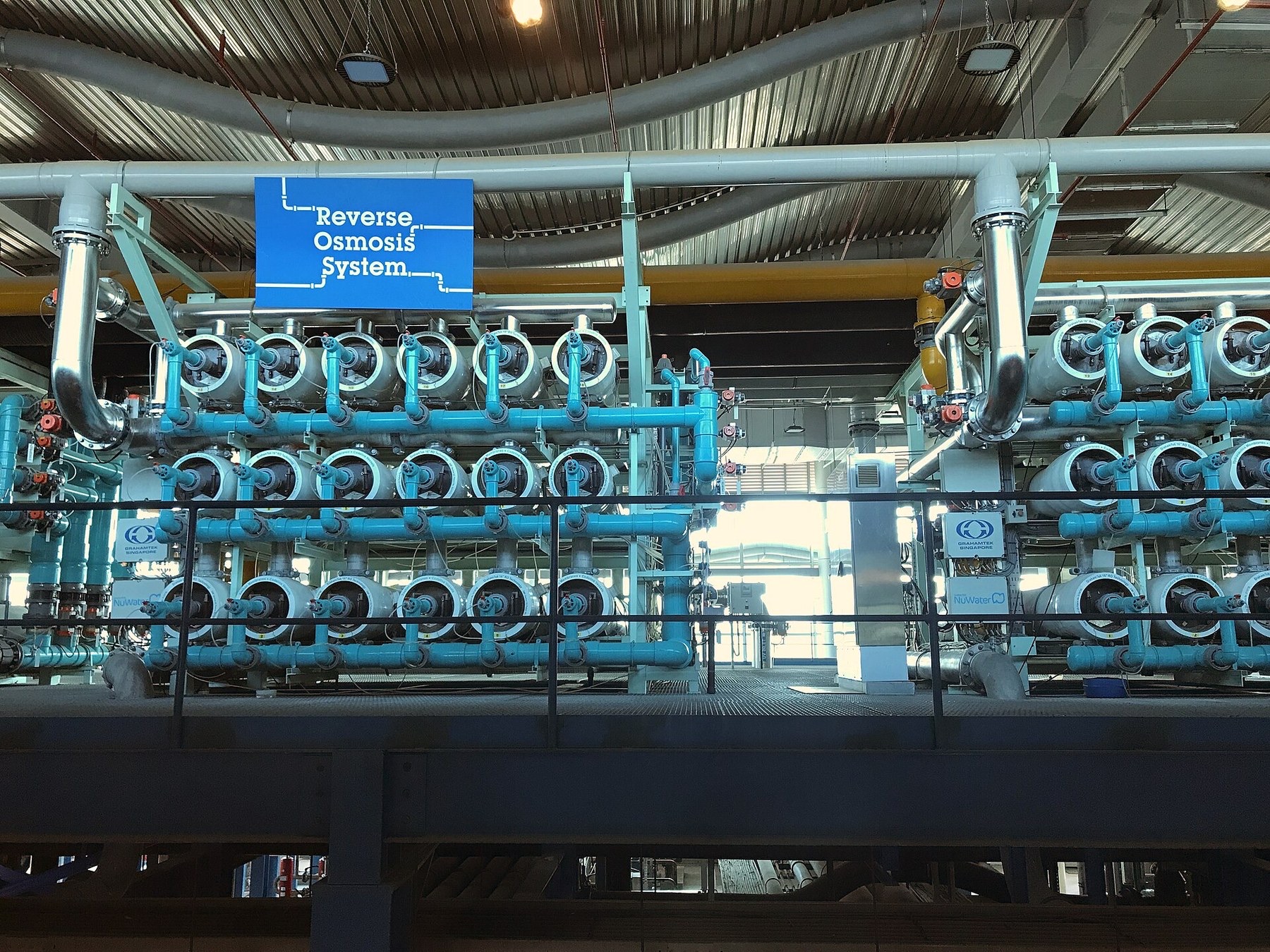
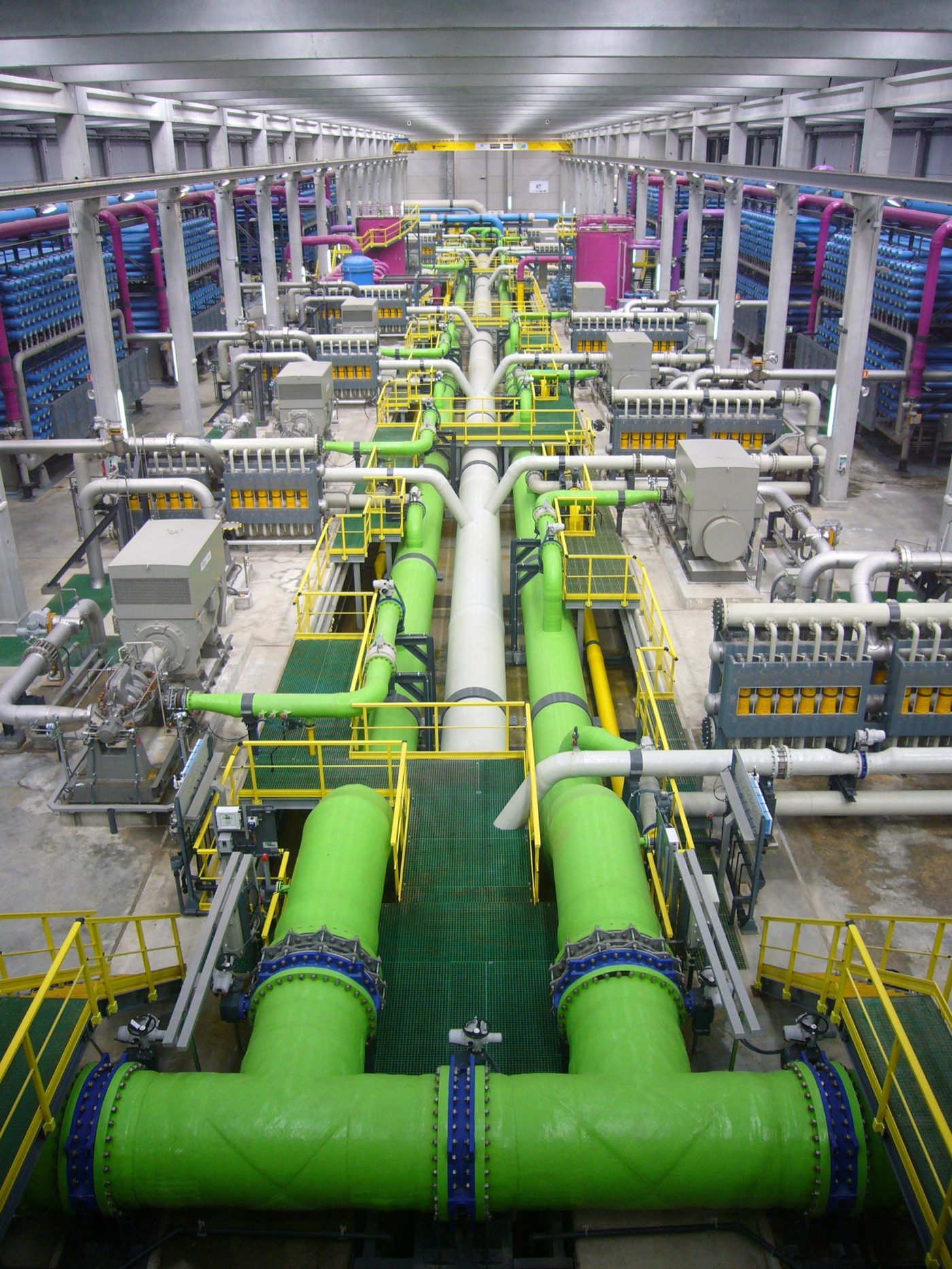
The pumps that produce that pressure are the heart of the plant and its largest cost. A seawater plant of any size is a hall of high pressure pumps, each one driving water into a rack of pressure vessels holding the spiral wound membranes described in the previous article. Fresh water emerges from the centre tube of each vessel. The salt, and everything else, is left behind in a stream that leaves the far end of the vessel at nearly the full pressure, and what is done with that stream is the subject of the last sections.
What the membrane actually does
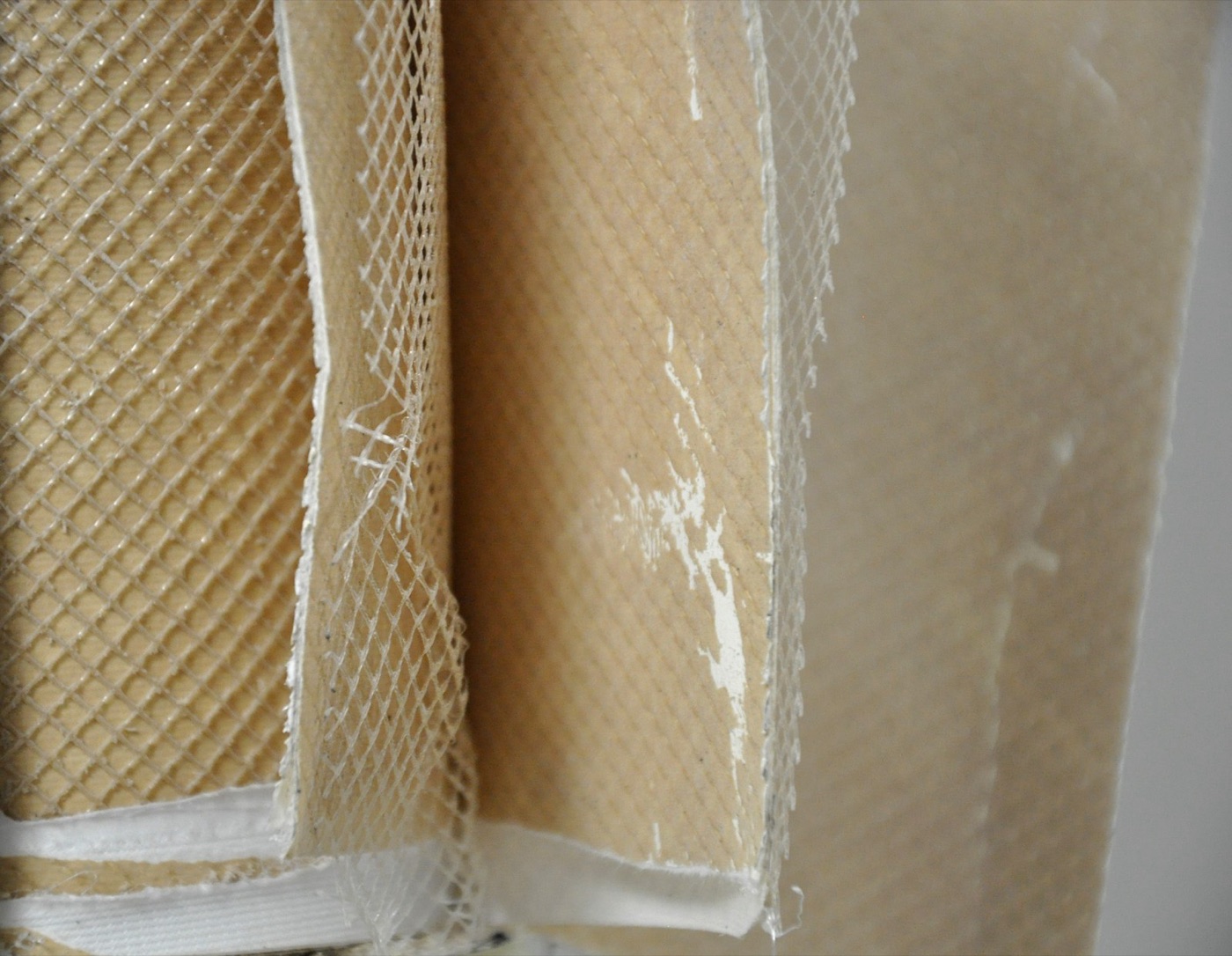
A reverse osmosis membrane is unlike the other membranes in the family, because it has no pores in the ordinary sense. Its active layer is a film of polyamide, a polymer related to nylon, about a tenth of a micron thick, cast on a porous support that gives it strength. Water crosses it by dissolving into the polymer on one side and diffusing through to the other, molecule by molecule, driven by the pressure. Salt ions, which are surrounded by a shell of bound water molecules and carry a charge, cannot dissolve into the film in the same way, and are held back.
The result is a membrane that rejects around 99 percent of the salt in seawater and nearly everything else: bacteria and viruses, of course, but also pesticides, pharmaceuticals, most dissolved organic molecules, and the metals. What comes through is very nearly pure water. It is so pure, in fact, that it is corrosive to pipes and flat to drink, and the last step in every desalination plant is to put some minerals back, usually by passing the water over limestone, before it goes to the city.
| What reverse osmosis removes | Share held back |
|---|---|
| Salt, sodium and chloride | About 99% |
| Hardness, calcium and magnesium | More than 99% |
| Bacteria, viruses, protozoa | Effectively all |
| Dissolved organic molecules, pesticides, pharmaceuticals | Most, typically well above 90% |
| Boron and some small neutral molecules | Less, and a known weakness |
| Dissolved gases such as carbon dioxide | Pass through |
The last two rows are the fine print that an engineer knows. Boron, present in seawater, passes the membrane more easily than salt and is regulated in drinking water, so seawater plants often run a second pass or adjust the chemistry to catch it. Carbon dioxide passes freely, which is why the product water comes out slightly acid and needs its limestone.
Recovery, and the brine
Not all the water that enters a plant comes out fresh. The share that does is called the recovery, and it is limited by the rising osmotic pressure on the salty side and by the point at which the salts in the brine come out of solution on the membrane as scale.
For seawater the recovery is usually 40 to 50 percent: half the water comes through, and the other half leaves as a brine carrying all the salt of the whole, at roughly twice the sea's concentration. For brackish groundwater and for reuse, where the feed is far less salty, recovery can reach 75 to 85 percent, and the brine is a smaller stream. Either way there is a brine, it is saltier than anything the plant started with, and it leaves the plant at high pressure, which turns out to be the key to the energy story.
| Feed | Typical recovery | Brine |
|---|---|---|
| Seawater | 40 to 50% | Half the volume, twice the salt |
| Brackish groundwater | 75 to 85% | A quarter or less of the volume, four times the salt |
| Treated used water for reuse | 75 to 85% | The same, with whatever the treatment left behind concentrated in it |
The energy story
In the 1990s a seawater reverse osmosis plant used around 8 kilowatt hours of electricity for every cubic metre of water it produced. The best plants today use about 3, and the theoretical minimum, the energy it would take to separate salt from water with no losses at all, is around 1. Cutting the figure by more than half in thirty years is one of the quieter engineering achievements of the age, and it came from two things.
The membranes got better: thinner active layers, more water through the same area at lower pressure, and better resistance to fouling. And the brine's pressure was recovered. The brine leaves the membrane at nearly the pressure the pump put into it, and for years that pressure was simply thrown away through a valve. Energy recovery devices, the best of them a rotating ceramic cylinder that transfers the pressure of the outgoing brine directly to the incoming seawater, now hand most of it back, so that the main pump only has to make up the difference. A modern plant is, in effect, a pump that recycles its own effort.
| Seawater reverse osmosis, energy per cubic metre | kWh |
|---|---|
| 1990s plants | About 8 |
| Modern plants with energy recovery | About 3 |
| The theoretical minimum | About 1 |
Where it is used
Reverse osmosis is the process behind nearly every desalination plant built in the last twenty years, having displaced the thermal plants that boiled seawater in the Gulf. It is the middle step of Singapore's NEWater and of every reuse plant that turns used water into water that can be drunk or dyed with. It makes the ultrapure water that rinses silicon chips, in fabs where the water has to be purer than anything a human would drink. It softens and desalts brackish groundwater for towns across the American Southwest, the Middle East and inland Australia. And it sits in the corner of textile mills in India, recovering water from a dye house effluent that a decade ago went to the river.
The other extreme: water too pure to drink
Reverse osmosis is also the first step in making the purest water in industry, which is the opposite problem from the sea and uses the same membrane.
A semiconductor plant rinses its silicon wafers, between the hundreds of steps that build a chip, in water so pure that a single dissolved ion or a single particle a few nanometres across can ruin a circuit. Ultrapure water, as the industry calls it, starts with reverse osmosis, often two passes of it, to remove nearly everything, and then goes through electrodeionisation, which uses an electric field and ion exchange resins to strip the last traces of salt, then ultraviolet light to break down any organic molecule, then final filters finer than ultrafiltration. The result is water with a resistivity close to the theoretical maximum for pure water, about 18 megohm centimetres, which means it barely conducts electricity at all because there is almost nothing dissolved in it to carry a charge. It is aggressive, dissolving what it touches, and it is piped in special plastics. Nobody drinks it, and it would taste of nothing if they did.
The same membrane that makes the sea drinkable makes water that is, by every measure, purer than anything in nature, and the two industries that depend on it most, coastal cities and chip fabs, have almost nothing else in common.
The catch, again
Everything reverse osmosis removes, it concentrates. The brine that leaves a seawater plant is denser than the sea and has to be returned to it carefully, through diffusers, so that it does not pool on the seabed. The brine from an inland plant, with no sea to return it to, is the hardest problem in the business, and it is the subject of the next article. The membrane solved the water. It handed the salt to someone else.
Sources
- Loeb, S. and Sourirajan, S. (1963). Sea water demineralization by means of an osmotic membrane. The first practical reverse osmosis membrane, UCLA, 1960.
- Cadotte, J.E. (1981). Interfacially synthesized reverse osmosis membrane. US Patent 4,277,344. The thin film composite polyamide membrane in use today.
- Elimelech, M. and Phillip, W.A. (2011). The future of seawater desalination: energy, technology and the environment. Science 333. Energy of seawater RO from about 8 kWh/m³ in the 1990s to about 3 kWh/m³ with energy recovery; the thermodynamic minimum near 1 kWh/m³.
- Osmotic pressure of seawater at 35,000 mg/L about 27 bar; typical seawater RO operating pressures 55 to 80 bar; recovery 40 to 50 percent for seawater and 75 to 85 percent for brackish water and reuse.
- Photographs: reverse osmosis at Bedok by Z22 (CC BY-SA 4.0) via Wikimedia Commons; Cesar Chu Ortega; inline: Reverse osmosis desalination plant by James Grellier (CC BY-SA) via Wikimedia Commons; inline: Membrane fouling by Piotr Pisarski (CC BY-SA) via Wikimedia Commons.