Thirsty: Chicken
Chicken is the cheapest meat, the fastest growing meat, and, per kilogram, the least thirsty meat by a wide margin. The reason is a bird that turns grain into flesh more efficiently than any other farm animal. What a kilogram of chicken's 4,300 litres are made of, where they were spent, and why a processing plant is the water part most people never see.
Chicken has become the world's meat. It passed pork as the most produced meat on Earth around 2020, it is the cheapest animal protein in nearly every supermarket, and it is growing faster than any other. It is also, per kilogram, the least thirsty meat, and by a distance. A kilogram of chicken carries about 4,300 litres of water in the global averages. A kilogram of pork carries about 6,000. Beef carries more than 15,000.
The reason is a bird that has been bred, over seventy years, to do one thing better than any other farm animal: turn grain into flesh. This article is about that arithmetic, about where the 4,300 litres were spent, and about the one part of the chain that the footprint numbers fold away, which is the plant where the bird stops being a bird.
The bird
A modern broiler chicken hatches at about forty grams and reaches its slaughter weight, around two and a half kilograms, in about six weeks. In 1950 the same journey took twice as long and twice the feed. The change is the result of selective breeding and formulated diets, and whatever one thinks of it, the outcome for water is plain. A broiler eats about 1.6 to 1.8 kilograms of feed for every kilogram it gains. A pig needs about three. A beef cow, depending on how it is raised, needs six to ten, and a large part of what it eats is grass and hay that a chicken could not digest.
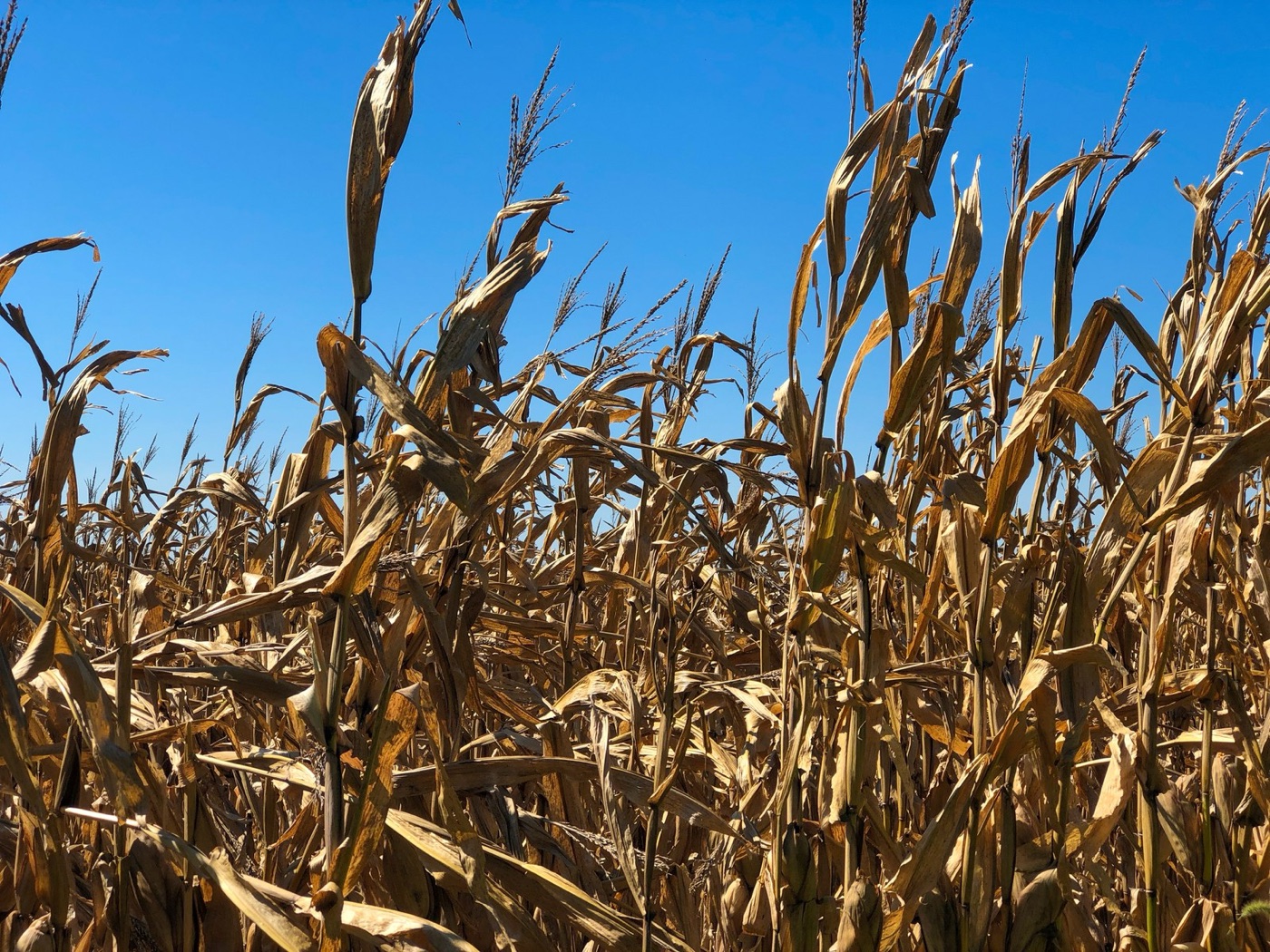
The feed is where the water is. Chicken feed is mostly maize and soy, with some wheat and a little fat and mineral. Those crops were grown, on the whole, on rain, in the maize belt of the United States, the soy fields of Brazil, and the wheat lands of Europe and the Black Sea, and the water they took from the soil is the green water of the footprint method. A small share came from irrigation, and a small share is the grey water needed to dilute the fertiliser that ran off.
| Water in a kilogram of chicken, global average | Litres |
|---|---|
| Green water, rain on the feed crops | About 3,500 |
| Blue water, irrigation and the water the birds drink | About 300 |
| Grey water, diluting the fertiliser and the manure | About 450 |
| Total | About 4,325 |
The bird itself drinks very little, a few litres over its life, and the water for washing the house and cooling the birds in summer is a few litres more. Ninety percent of the footprint is in the feed, and the feed is mostly rain. Chicken shares that pattern with every meat, and it shares it in smaller quantity.
Why the comparison holds
Set beside the other animals on this site, chicken's advantage is nearly all feed conversion. The cow in the beef article is a ruminant that can eat what people cannot, and there is a real argument that its footprint on rain fed pasture is less of a burden than the numbers suggest. The chicken has no such argument. It eats grain that people could eat, and it eats less of it per kilogram of meat than anything else on four legs or two. Where beef's number is large and half of it is arguable, chicken's is small and nearly all of it is settled.
| Water per kilogram, global averages | Litres |
|---|---|
| Wheat | About 1,800 |
| Chicken | About 4,300 |
| Eggs | About 3,300 |
| Pork | About 6,000 |
| Cheese | About 3,200 |
| Beef | About 15,400 |
The comparison with wheat is the one worth keeping. Chicken is efficient for a meat and still carries more than twice the water of the grain it was fed, because every animal loses most of its feed to keeping warm and moving about. The cheapest way to eat the water in a maize field is still to eat the maize.
Where the water was spent
The map of chicken's water is the map of the feed trade. A bird raised in a shed in Thailand or Saudi Arabia or Brazil was fed on soy and maize that may have grown a hemisphere away, and its water footprint belongs to those fields. The largest single source is Brazilian soy, grown mostly on rain in the Cerrado and the southern states, and the second is maize from the American Midwest. The chicken industry is one of the largest buyers of both, and the expansion of soy across the Cerrado over the last thirty years, with its consequences for the savannah and the rivers of central Brazil, is a chicken story as much as a cattle one.
Where the birds are raised matters less, for water, than where the feed grows, except in one respect. In hot countries the sheds are cooled with evaporative pads, and the water for cooling can rival the water the birds drink. In the Gulf states and parts of India, the shed's water is the only blue water in the chain that is spent locally, in the driest places on Earth.
The plant
Every kilogram of chicken passes through a processing plant, and the footprint numbers, which trace water to the farm, fold the plant into a rounding error. From inside the water industry it does not look like one.
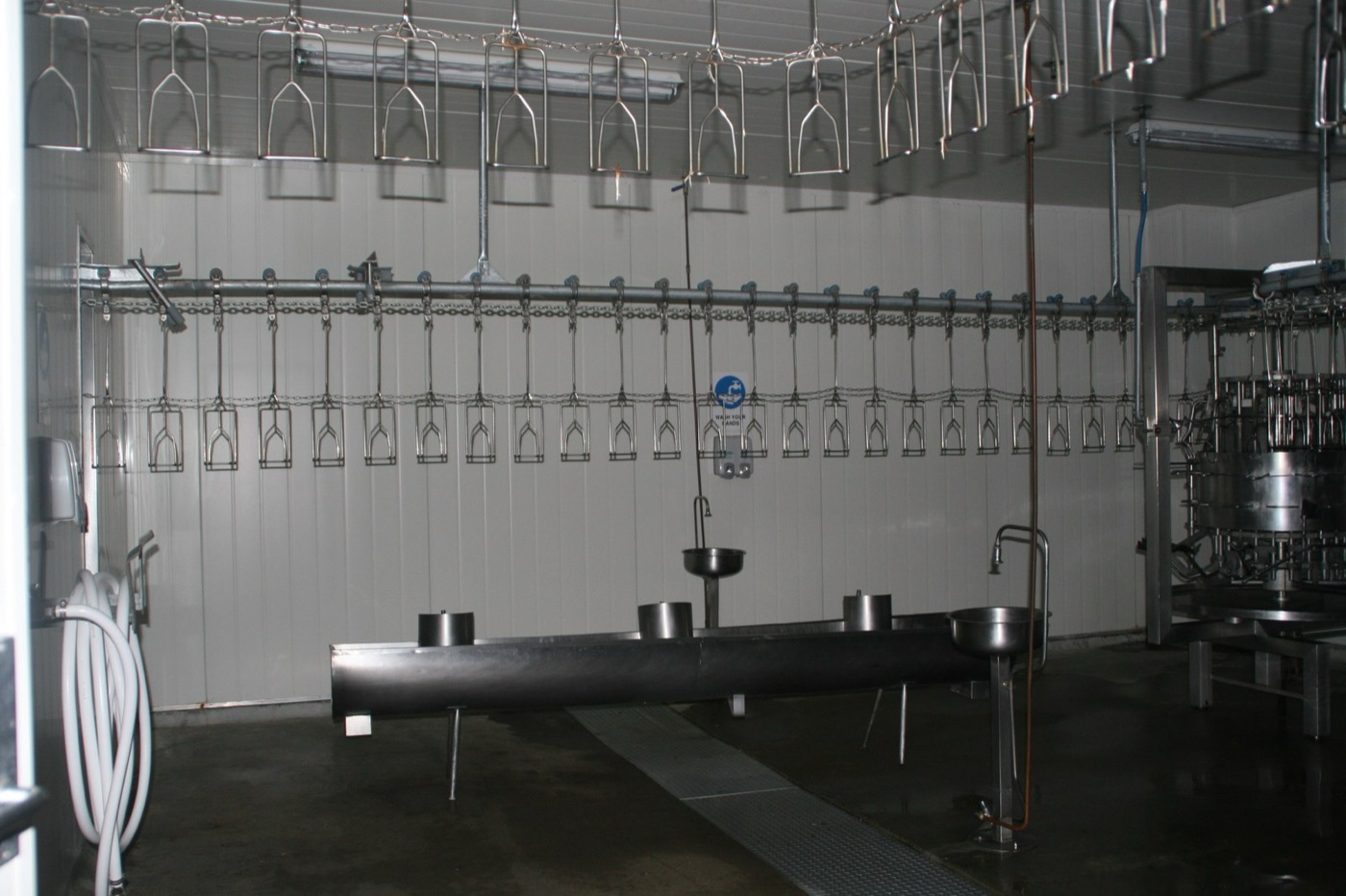
A broiler plant kills, scalds, plucks, eviscerates, washes and chills tens of thousands of birds an hour, and it does nearly every one of those steps with water. The birds are scalded in hot water to loosen the feathers, washed inside and out after evisceration, and then chilled in tanks of cold water, sometimes chlorinated, for three quarters of an hour. Between twenty and thirty litres of water go through the plant for each bird, and all of it comes out as one of the strongest effluents in the food industry: warm, rich in blood, fat, protein and feathers, with a chemical oxygen demand that can run to several thousand milligrams per litre, ten times a city's sewage. The plants in countries with rules treat it with the chain described in the effluent treatment article, beginning with a screen for the feathers and a flotation tank that lifts the fat off the top, and ending with a biological stage that eats the rest. The plants in countries without rules send it to the river, where it does what the BOD article described.
I have walked the effluent plant of a poultry processor, and it is the part of the chicken business that nobody films. It is also the part that decides what the river downstream looks like, in a way that the feed water, spread across a million acres of rain fed maize, never does.
| Water at the plant, per bird | |
|---|---|
| Scalding, washing, chilling, cleaning | About 20 to 30 litres |
| Effluent strength, COD | Often 2,000 to 6,000 milligrams per litre |
| Treatment | Screening, fat flotation, biological stage |
| Share of the footprint | Under one percent, and the only part that is discharged in one place |
The house
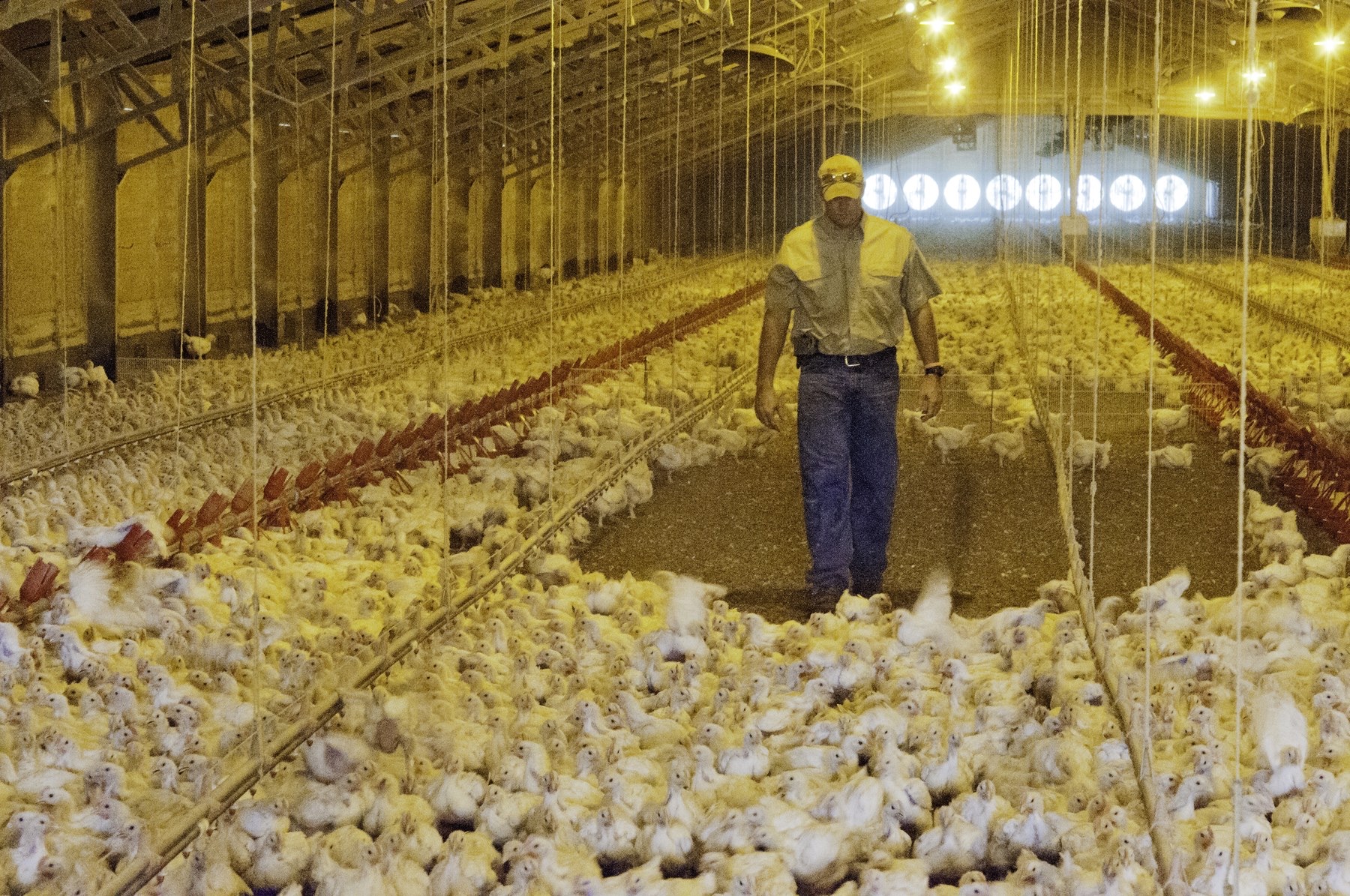
A broiler house is a long, low, windowless shed holding twenty to forty thousand birds on a floor of wood shavings, and its water is the part of the footprint that is spent where the bird stands. The birds drink from nipple lines that run the length of the shed, about two litres per kilogram of feed, which comes to five or six litres over a bird's life, and in the summer the shed is cooled by drawing air through wet pads at one end, which in a hot climate can double the house's water. Between flocks the shed is washed down. All of it is a rounding error beside the feed, and all of it is local, drawn from a well or a mains connection in the district where the sheds are, and in the districts where sheds are concentrated, the Delmarva peninsula of the eastern United States, the Vale of Evesham in England, the poultry belts of Brazil and Thailand, the sum of many rounding errors is a real draw.
The litter
What leaves the house, apart from the birds, is the litter: the shavings, now mixed with the droppings of forty thousand chickens over six weeks, and rich in nitrogen and phosphorus. It is a valuable fertiliser and it is spread on the fields nearby, and where the fields are few and the sheds are many, more of it is spread than the crops can take up. The surplus runs off in the rain, into the streams and, on the Delmarva peninsula, into Chesapeake Bay, where the nutrients feed the algae described in the nitrogen and phosphorus articles. The grey water in chicken's footprint, the 450 litres per kilogram needed to dilute what runs off, is largely this litter, and it is the one part of the footprint that the neighbours can see. The feed water was rain on a field in Iowa or Mato Grosso. The litter water is a green river in Maryland.
The water in the packet
There is one more litre, and it is in the shop. A bird chilled in a water tank absorbs some of it, and a chilled chicken in a supermarket can carry several percent of its weight as water taken up in the plant, which the label, in most countries, has to declare. The European Union restricts water chilling and most of its plants chill birds in cold air instead, which uses less water and adds none, at a higher cost in electricity. The difference is small beside the feed, and it is the only part of a chicken's water that the buyer takes home and pays for by the kilogram.
What the number says
Chicken is the meat to choose on water, and the numbers say so without much room for argument. It is also a meat, which means it carries several times the water of the grain that made it, and it is a meat that runs through a plant whose water is the concentrated kind. For the person choosing dinner, the first fact is the useful one. For the person choosing what to regulate, the second is.
4,325 litres, mostly rain on a maize field, and twenty five of them in a plant with a drain.
Sources
- Mekonnen, M.M. and Hoekstra, A.Y. (2012). A global assessment of the water footprint of farm animal products. Ecosystems 15. Chicken meat 4,325 litres per kilogram, global average, with the green, blue and grey split.
- FAO, Food Outlook and FAOSTAT: world poultry meat production and its growth relative to other meats.
- National Chicken Council (US) and Aviagen, broiler performance: feed conversion ratios of about 1.6 to 1.8 and growing periods of 35 to 45 days.
- US EPA, Meat and Poultry Products effluent guidelines (40 CFR 432) and typical poultry processing water use per bird.
- Poultry Science and Water Research literature on processing plant wastewater strength and dissolved air flotation.
- Photographs: opener: Bobby Morgan Poultry Farm Agriculture in the United States by USDAgov (public domain) via Wikimedia Commons; inline: Corn Fields - Farm in Missouri Valley - Iowa - Autumn Harvest by Tony Webster (CC BY) via Wikimedia Commons; inline: Inside slaughterhouse (4186777549) by Animal Freedom (CC BY) via Wikimedia Commons.