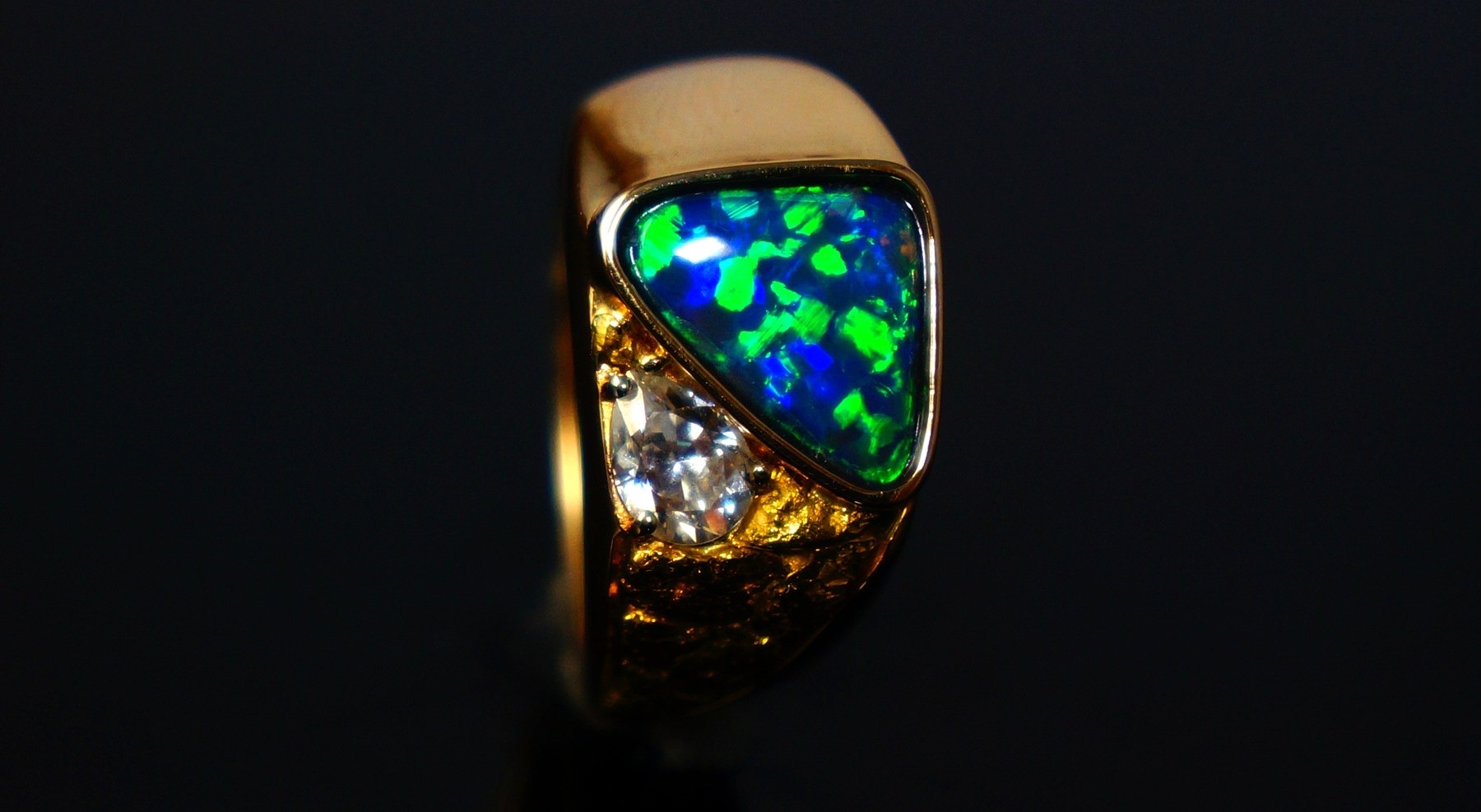
Thirsty: Gold
A wedding ring holds about five grams of gold, and the gold was won from about a tonne of rock, crushed to powder and washed with cyanide in a mine that used several hundred thousand litres of water for every kilogram it produced. What gold's water is for, where the mines are, what is left behind in the tailings dam, and why the smallest mines are often the worst.
The gold in a wedding ring weighs about five grams, and it was, before the ring, a gram or two in every tonne of rock in a hole in the ground somewhere in Nevada, Western Australia, South Africa, Ghana or Uzbekistan. To get it out, the tonne of rock was blasted, hauled, crushed to a powder finer than sand, mixed with water and a dilute solution of cyanide, and left until the gold had dissolved. The gold was then pulled from the liquid, melted, poured and shipped. The powdered rock, still wet, still carrying a little cyanide and whatever else was in the ore, was pumped to a dam. Multiply that by the five grams and the ring's water comes to roughly three and a half thousand litres.
This article is about the water in gold, which per kilogram is one of the largest footprints of anything humans make, and about the two places it ends up: the tailings dam behind the large mines, and the rivers of the small ones.
A gram in a tonne
Gold is rare, and it is getting rarer in the ore. A century ago mines worked rock carrying twenty or thirty grams a tonne. The average ore mined today carries around one gram, and some large mines profitably work half that. That single fact explains the water. To produce a kilogram of gold, a mine has to process something like a thousand tonnes of rock, and rock is processed wet. It is crushed and ground in mills that run as a slurry of water and powder, it is leached in water, and the waste is pumped as a slurry to its dam. The water per kilogram of gold is the water per tonne of rock multiplied by a thousand.
A study that gathered the water reporting of mines across the world found the average at around 690 cubic metres, close to 700,000 litres, per kilogram of gold, with a wide range around it: a mine in a wet country with a high grade ore might use a tenth of that, a low grade heap leach in a desert several times more. Per gram, that is 700 litres. Per ring, 3,500. Per kilogram it is roughly the water in forty tonnes of wheat.
| Gold's water | |
|---|---|
| Ore processed per kilogram of gold, at one gram a tonne | About 1,000 tonnes |
| Water per kilogram, global reporting average | About 690,000 litres |
| Water per gram | About 700 litres |
| A five gram ring | About 3,500 litres |
| Where most of it goes | Grinding, leaching and the tailings slurry |
What the water does
The water in a gold mine has three jobs, and the same water often does all three.
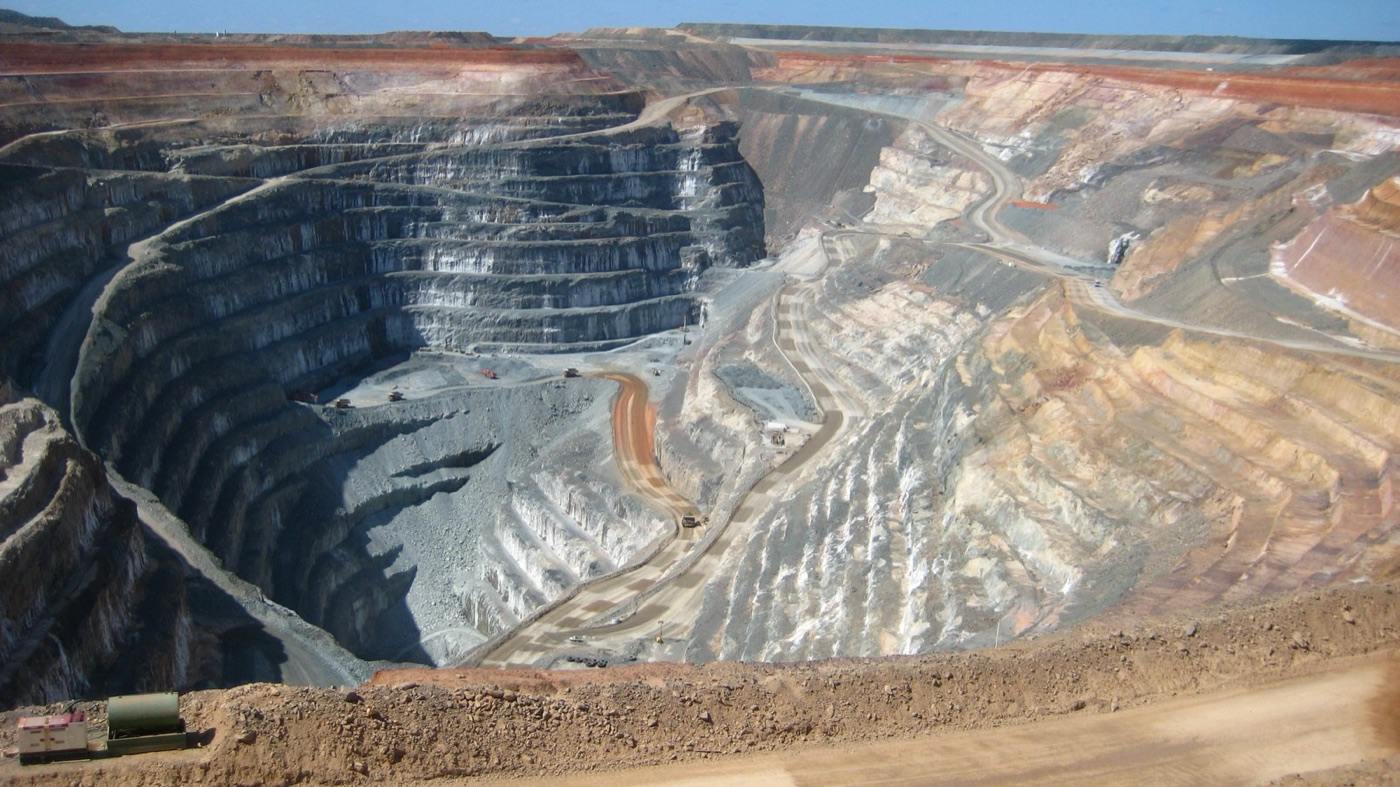
The first is grinding. Ore is crushed dry and then ground wet, in rotating drums full of steel balls, to a powder in which the gold particles, often microscopic, are exposed. The mill runs as a slurry of roughly equal parts rock and water.
The second is leaching. Gold, insoluble in plain water, dissolves readily in a weak solution of sodium cyanide, and the powdered ore is stirred in tanks of it for a day or two, or, in the cheaper heap leach method used for the lowest grade ores, piled in heaps tens of metres high on a lined pad and sprinkled with cyanide solution that trickles through for months. The gold bearing liquid is collected and the gold is stripped out of it onto carbon or zinc, and the barren solution, still carrying cyanide, is sent back to leach more ore.
The third is the tailings. The leached rock, a wet grey mud of powdered stone, is pumped to a dam, where the solids settle and the water pools on top. Some of the water is pumped back to the mill. The rest evaporates or seeps, and the dam grows, year by year, as the mine runs.
The dam
Tailings dams are the largest structures in mining and some of the largest on Earth, and they are built out of the tailings themselves, raised in stages as the mud accumulates, over decades. They hold a slurry that carries, besides the rock, whatever the ore contained: arsenic, often, in gold ores, along with the residual cyanide and, in sulphide ores, the makings of acid, because pyrite exposed to air and water forms sulphuric acid and the acid leaches metals. A well run dam is monitored, its water treated, its cyanide destroyed before discharge under an industry code adopted after the disasters of the 1990s. A badly run one is a lake of poison held up by mud.
They fail. At Baia Mare in Romania in 2000, a gold tailings dam overflowed after heavy rain and sent a hundred thousand cubic metres of cyanide solution into the Tisza and the Danube, killing the fish for hundreds of kilometres downstream through Hungary and Serbia. At Mount Polley in Canada in 2014 a copper and gold dam collapsed into a lake. At Brumadinho in Brazil in 2019 an iron ore dam gave way and killed 270 people in a wave of mud, which prompted the industry to adopt a global standard for the structures. Several hundred large tailings dams exist worldwide, many of them at gold mines, and the water they hold is water that the footprint numbers do not know what to do with: taken from a river, stored for ever, and returned only when something goes wrong.
| Tailings, and what has gone wrong | |
|---|---|
| Baia Mare, Romania, 2000 | Cyanide overflow into the Tisza and Danube; fish killed for hundreds of kilometres |
| Mount Polley, Canada, 2014 | Dam collapse into Quesnel Lake; 24 million cubic metres released |
| Brumadinho, Brazil, 2019 | Iron ore dam collapse; 270 dead; a global tailings standard followed |
| What the industry adopted | The Cyanide Code (2005) and the Global Industry Standard on Tailings Management (2020) |
The small mines
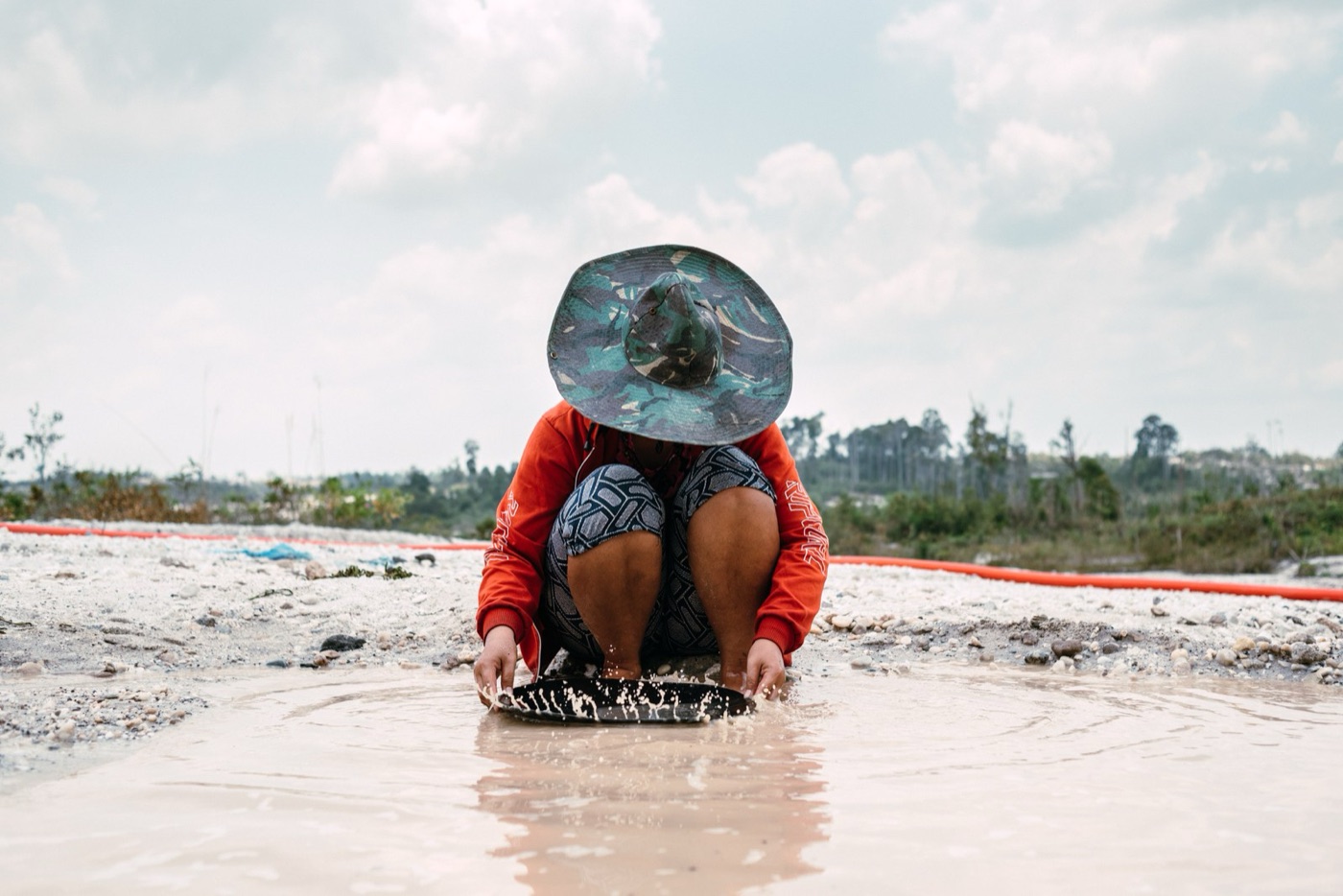
Around a fifth of the world's gold, by the United Nations' estimate, comes from artisanal and small scale mining: several million people, in Peru, Ghana, Indonesia, the Philippines, Tanzania, Sudan, Colombia and many other countries, working river gravels and shallow ore with hand tools, pumps and, above all, mercury. Mercury binds to gold and forms an amalgam that can be picked out of the gravel by hand, and the amalgam is heated over a fire to drive off the mercury and leave the gold. The mercury goes into the air and the rivers. Artisanal gold mining is the largest source of mercury pollution on Earth, ahead of coal burning, and the rivers of the Peruvian Amazon, the Madre de Dios in particular, carry it into the fish and the people for hundreds of kilometres.
The small mines use less water per gram than the large ones, because they work richer, easier ground, and they do far more harm with it, because nothing they use is contained. The dredges tear up riverbeds, the tailings go back into the river, and the mercury goes everywhere. It is the worst water story in mining, and it is the one that a treaty, the Minamata Convention of 2013, is slowly trying to close, by ending the mercury trade and teaching the miners methods that do without it.
Heap leaching, and the desert
The heap leach deserves its own note, because it is the method that made low grade gold worth mining and it is the one most exposed to the weather. Ore that carries a gram a tonne or less is crushed, stacked on a pad of clay and plastic in heaps that can cover a square kilometre and stand a hundred metres high, and dripped with cyanide solution from lines laid across the top, for months. The solution seeps through, dissolves the gold, and is collected at the base. In a desert the heap loses water to evaporation faster than the pad can be kept wet, and the mine's fresh water draw is largely the make up for that loss. In a wet climate the opposite happens, and the pad's collection ponds overflow in a storm, which is what happened at Baia Mare. The method's water footprint, per kilogram of gold, is among the highest in the industry, because the ore is the poorest, and it is used, by that logic, in the driest places.
Where the mines are
Gold is mined where it is found, and it is found, as it happens, in a great many dry places. Nevada, which produces most of America's gold, is a desert, and its mines pump groundwater to keep their pits dry and to run their mills, and the pumping has lowered springs and streams across the state's north. Western Australia's goldfields are among the driest inhabited places in the country, supplied by a pipeline from the coast built in 1903 for exactly that purpose, and by saline groundwater that the mines have learned to use in their mills. The Atacama, the Sahel and Central Asia all host large gold mines on the same terms. In South Africa, whose Witwatersrand produced more gold than anywhere in history, the mines are closing and filling with water, and the water rising through the old workings is acid, and it is reaching the surface in Johannesburg's streams.
What the industry has done
The large miners have, over twenty years, made their water use a reported number and, in the better cases, a falling one. Mills recycle most of their process water from the tailings pond, and a dry region mine may recycle four fifths of what it uses. Tailings are increasingly filtered and stacked dry, which stores less water in the dam and makes the dam safer, at a higher cost in energy. Cyanide is destroyed before the water leaves the site. And the water accounting that the industry's own principles now require means that the figure at the top of this article, which came from voluntary reporting a generation ago, can be checked, mine by mine, by anyone who reads the reports.
None of that reaches the small mines, which is where the mercury is, and where the effort belongs.
What it teaches
Gold is the extreme case of a pattern this site has met in copper, in lithium and in the phone article: a small quantity of a valuable thing, won from a large quantity of rock, with water, in a dry place, leaving a wet waste that has to be stored for ever. Per kilogram it is the thirstiest product in this series by a wide margin, and per ring it is a few days of a household's use, which is the arithmetic of rarity. What matters is less the litres than what is in them when they are done with, and where the dam that holds them stands.
3,500 litres in a ring, and a dam behind the mine that will outlast the marriage.
Sources
- Mudd, G.M. (2007). Global trends in gold mining: towards quantifying environmental and resource sustainability. Resources Policy 32. Water use averaging around 690 cubic metres per kilogram of gold across reporting mines.
- World Gold Council, Gold Demand Trends and Responsible Gold Mining Principles: production, ore grades and water reporting.
- UNEP (2013). Global Mercury Assessment: artisanal and small scale gold mining as the largest source of mercury pollution.
- International Cyanide Management Code, requirements for cyanide destruction and tailings management.
- Reporting on the Baia Mare cyanide spill (2000), the Mount Polley failure (2014) and the Brumadinho dam collapse (2019).
- Photographs: opener: Black Opal Ring with Gold Nuggets by Danmekis (CC BY-SA) via Wikimedia Commons; inline: Sunrise Dam Gold Mine open pit 11 by Calistemon (CC BY-SA) via Wikimedia Commons; inline: Female artisanal miner in Central Kalimantan panning for gold without using mercury by Mnlbali (CC BY-SA) via Wikimedia Commons.