Thirsty Industries: Concrete
Concrete is the most used material on Earth after water itself, and it is made with water, cured with water, and washed with water at every step from the quarry to the site. The industry that pours thirty billion tonnes a year takes about a tenth of the world's industrial water, and most of it is spent in the places building fastest, which are the places with least to spare.
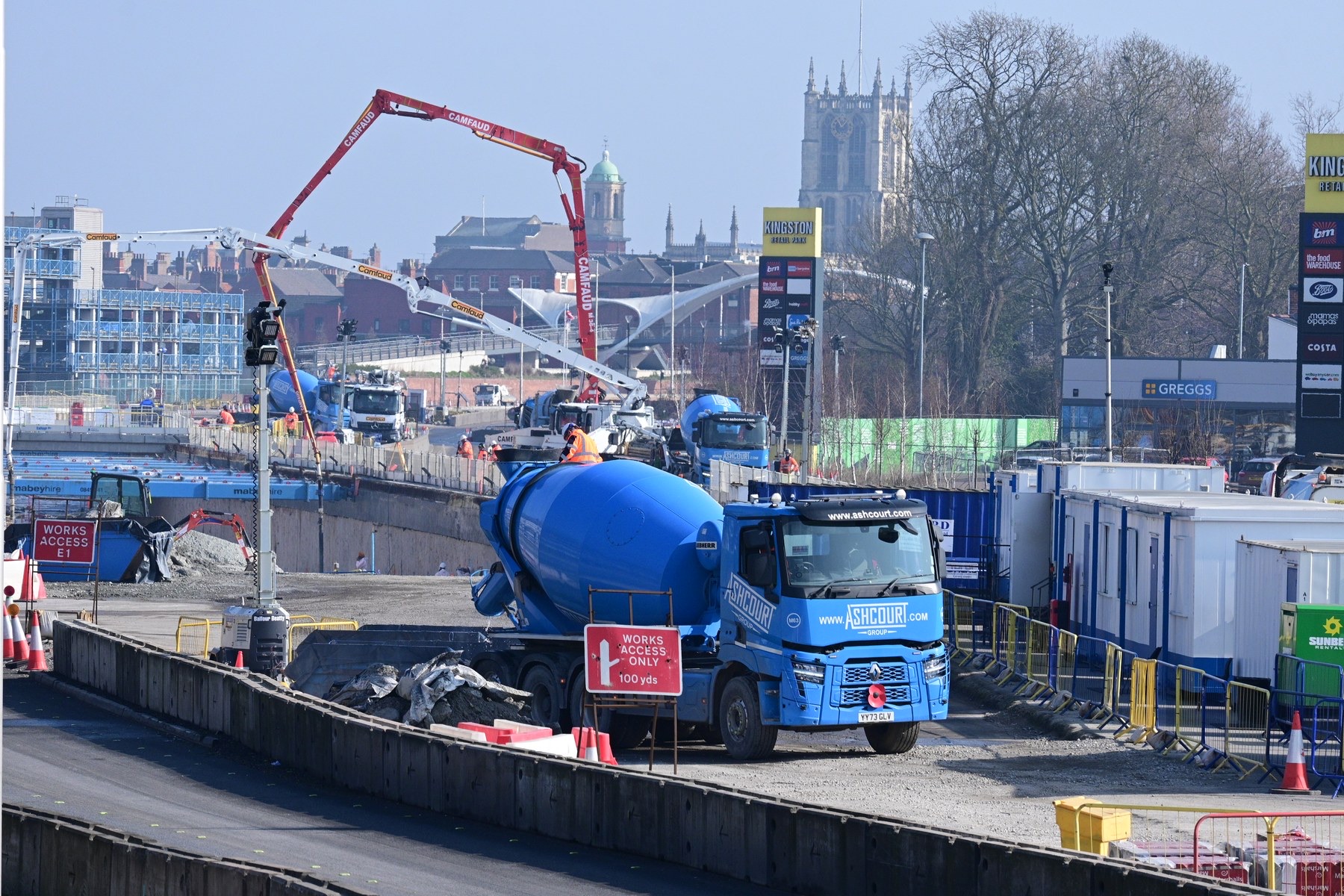
Stand beside a building site in any city on Earth at seven in the morning and the first thing to arrive, after the workers, is water. It comes in the mixer trucks, already in the concrete, and it comes in hoses, to spray the slab that was poured yesterday so that it does not dry too fast, and it comes in the wash water that cleans the trucks and the pumps at the end of the pour. Concrete is made of water, in a precise chemical sense, and the industry that makes thirty billion tonnes of it a year is one of the largest industrial users of water in the world, and one of the least often counted.
This article is about the water in the world's most used material. The number at the top is from the only study to have added it up globally, and it is large. The more interesting fact is where it is spent.
What concrete is
Concrete is four things: cement, water, sand and gravel. The cement, a grey powder made by burning limestone and clay at 1,450 degrees, is about a tenth of the mix by weight and nearly all of its cost and its carbon. The sand and gravel, together called aggregate, are about three quarters. The water is the rest, and it is the ingredient that makes the others into a solid.
When water meets cement, the two react. The reaction, called hydration, grows crystals that lock the grains of sand and gravel together, and it goes on for weeks, faster at first and then slowly, until the concrete has reached its strength. The water that reacts stays in the slab, bound into the crystals, and the concrete that has set contains most of the water that went into the mixer. It is a material that has, literally, absorbed its own water footprint.
| A cubic metre of ordinary concrete, about 2.4 tonnes | |
|---|---|
| Cement | About 300 to 400 kilograms |
| Water in the mix | About 150 to 200 litres |
| Sand | About 700 to 800 kilograms |
| Gravel or crushed stone | About 1,000 to 1,200 kilograms |
| Water to cure it, over a week | Often several hundred litres more |
| Water to wash the aggregate at the quarry | Often the largest share |
The ratio of water to cement decides the strength. Too little and the mix cannot be poured; too much and the concrete is weak, because the surplus water leaves pores as it evaporates. Every mix design begins with that ratio, and the site engineer's most common argument with the crew is about the bucket of extra water that makes a stiff load easier to place and a strong slab weaker.
Three waters
The mix water is the smallest of concrete's three waters, and the one everyone knows. The other two are larger.
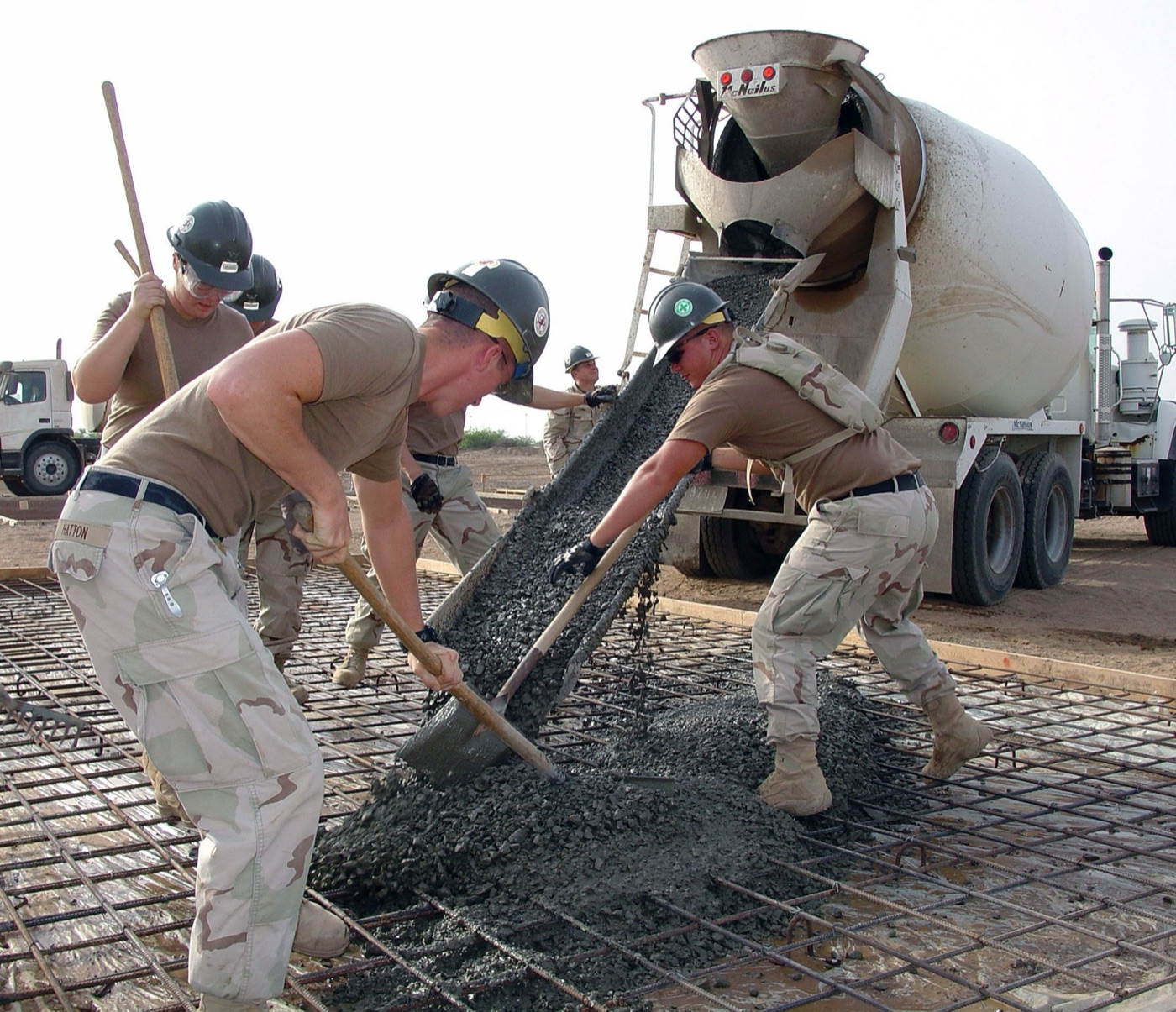
The first is curing. Concrete that dries out in its first days stops hydrating, because the reaction needs water, and it ends up weaker and cracked. So fresh concrete is kept wet, by spraying, by ponding water on a slab, by covering it with wet hessian, or by sealing it under plastic, for three to seven days. In a hot, dry, windy climate, which describes most of the places building fastest, the water sprayed on a slab over a week can exceed the water in the slab. Curing compounds that seal the surface use none, and they cost money, and on a site where water is free and labour is cheap the hose wins.
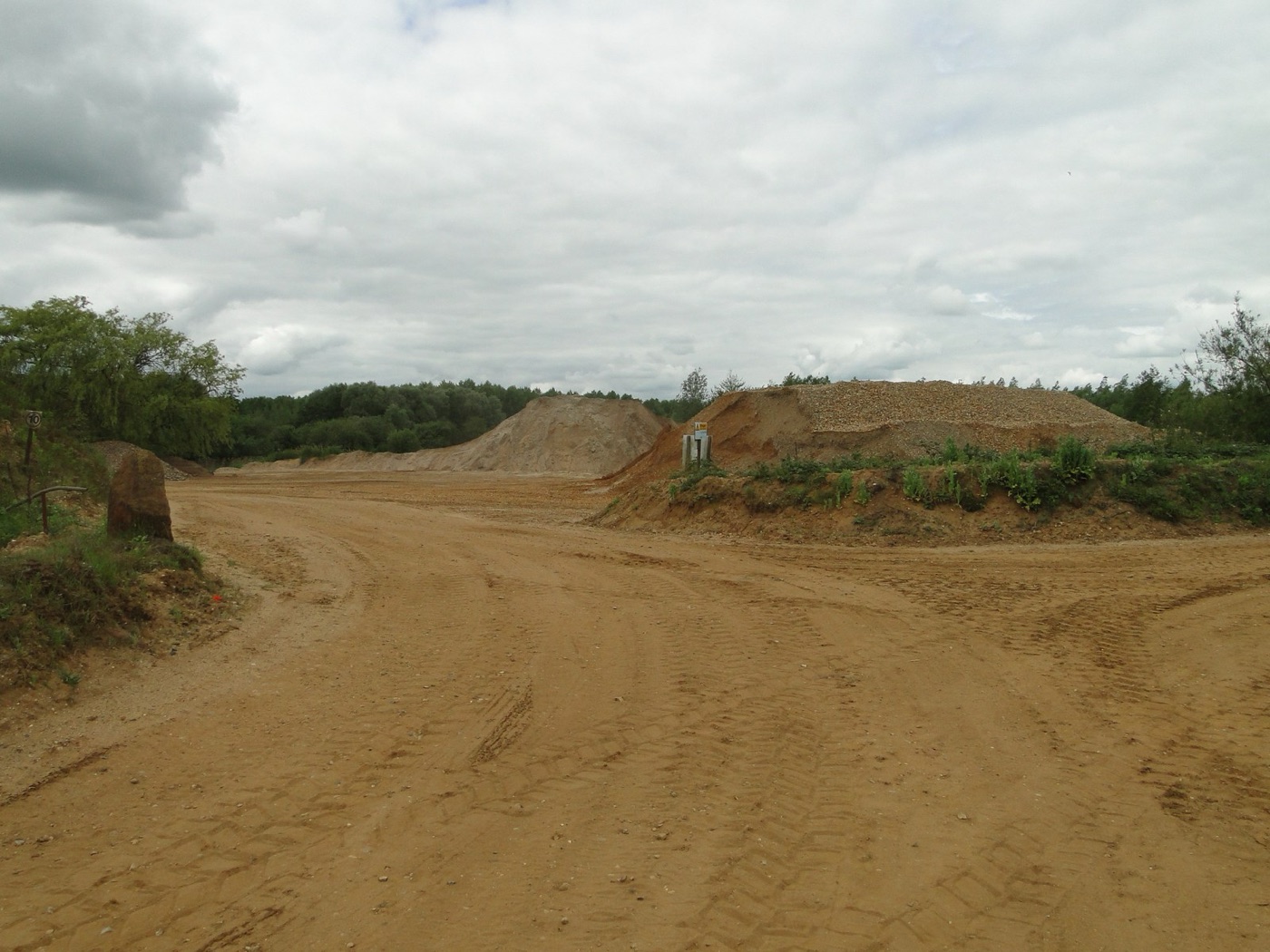
The second is the aggregate. Sand and gravel are dug from pits, riverbeds and, increasingly, crushed from quarried rock, and they are washed to remove the clay and silt that would spoil the concrete. A washing plant at a quarry runs thousands of litres a minute through its screens, recycles most of it, and loses a share to the wet fines it discharges and to evaporation from its settling ponds. The 2018 study that produced the number at the top of this article found that aggregate washing, added up across the world's pits, was the largest single part of concrete's water, ahead of both mixing and curing.
Behind all three is the cement plant, which uses water to cool its kiln and its grinding mills, and which, in the dry regions where limestone and demand coincide, is often the largest water user in its district.
The number
The study, from the University of California, Berkeley, estimated that the world's concrete consumed about 16.6 cubic kilometres of water in 2012, which was about nine percent of all industrial water withdrawals on the planet, and that the share was rising with the building boom in Asia and Africa. Sixteen cubic kilometres is a large number in the abstract and a modest one against agriculture, which uses two hundred times more. What makes it matter is the geography.
| Concrete's water, worldwide | |
|---|---|
| Concrete poured a year | About 30 billion tonnes |
| Water consumed, 2012 estimate | About 16.6 cubic kilometres |
| Share of global industrial withdrawals | About 9 percent |
| Where the growth is | India, China's interior, the Gulf, Africa |
| Share of that water in water stressed regions | The majority, by the study's mapping |
Concrete is poured where things are built, and things are built where cities are growing, and the cities growing fastest in this century are in the driest parts of the world. The study mapped concrete's water against regional scarcity and found that most of it was being drawn in places already short: northern India, northern China, the Middle East, parts of Africa and Mexico. A tower in Dubai or Riyadh or Delhi is built with local water, at a rough rate of a swimming pool per floor once curing and washing are counted, from an aquifer or a desalination plant that also supplies the people who will live in it. The cement plant and the aggregate quarry are somewhere nearby, drawing on the same source.
A slab, from the inside
It helps to follow one pour. A floor slab of a hundred square metres, twenty centimetres thick, is twenty cubic metres of concrete, delivered in three truckloads. The mix carries about three and a half thousand litres of water, batched at the plant to the design ratio, and the driver adds a little more on site if the crew asks, which the engineer wishes they would not. The slab is placed, levelled and left, and for the next week, in a dry climate, a labourer sprays it morning and evening, or floods it and holds the water with a bund of sand, and over the week that curing uses as much water again as went into the mix, sometimes more. The trucks and the pump are washed out at the end of the day, a few hundred litres each. And the sand and gravel in those twenty cubic metres, about forty tonnes of it, were washed at the quarry with, on the study's averages, several thousand litres, most of it recycled through the plant's ponds and some of it lost. The slab, when it is finished, contains three thousand litres and cost perhaps ten thousand. Multiply by the floors of a tower and the towers of a city, and the number at the top of this article appears.
The cement plant
Behind the pour is the plant that made the cement, and it has a water story of its own. A cement works burns limestone and clay in a kiln at 1,450 degrees, and the kiln, the clinker cooler and the mills that grind the product are cooled with water, some of it evaporated and some returned. A modern plant uses on the order of a few hundred litres of water per tonne of cement, and the four billion tonnes the world makes each year add up to a cubic kilometre or more. The plants stand beside the limestone, which in India, the Middle East and North Africa is often in dry country, and a cement works is, in many such districts, the largest single water user for fifty kilometres. The industry's carbon problem, which is the one it is usually asked about, is being addressed partly by grinding in materials that replace clinker, fly ash, slag and calcined clay, and each of those reduces the kiln's water along with its carbon. It is one of the few places on this site where the carbon fix and the water fix are the same fix.
The sand
There is a related story that belongs here, because it is about water in a different way. The world uses around fifty billion tonnes of sand and gravel a year, nearly all of it for concrete, and it has become the most extracted solid material on the planet. Desert sand is too round and too fine to use, so the sand comes from rivers, beaches, floodplains and the sea bed, and the taking of it changes rivers. Dredged riverbeds drop, banks collapse, bridges are undermined, the water table beside the river falls, and deltas that were built by sand arriving from upstream begin to shrink. The Mekong delta, described in the arsenic article for its groundwater, is sinking partly because the sand that once replenished it is now in the concrete of Ho Chi Minh City and Singapore. Sand mining is a water story told in rock.
What the industry is doing
Concrete's water, unlike its carbon, is largely a matter of housekeeping, and the housekeeping is improving where it is asked for. Curing compounds and plastic sheeting replace the hose. Ready mix plants recycle their wash water into the next batch, and the better ones return the trucks' rinse water to the mixer rather than the drain. Aggregate washing plants close their water loops and dewater their fines with presses instead of ponds. Recycled aggregate, from demolished buildings, needs less washing than virgin gravel. And the cement industry, under pressure over carbon, is reducing the cement in the mix, which reduces the water that the cement needs.
The larger lever is the one the almond article describes for orchards: the decision about where and how much to build. A building that lasts a hundred years spends its concrete's water once. The concrete of the last forty years, in much of the world, was poured for buildings that will not last that long.
What it teaches
Concrete is the material that the world's water infrastructure is made of. Every dam, reservoir, treatment plant, canal and pipe on this site was cast from it, and every one of them was made with water, cured with water and washed with water in a place that was, more often than not, short of it. That is a fair trade in most cases. It is worth knowing the price.
Nine percent of the world's industrial water, in the material that holds the rest of it.
Sources
- Miller, S.A., Horvath, A. and Monteiro, P.J.M. (2018). Impacts of booming concrete production on water resources worldwide. Nature Sustainability 1. About 16.6 cubic kilometres of water in 2012, roughly 9 percent of global industrial water withdrawal.
- Global Cement and Concrete Association, Cement Industry Net Zero Roadmap and production statistics: about 4 billion tonnes of cement and 30 billion tonnes of concrete a year.
- American Concrete Institute, ACI 308R Guide to External Curing of Concrete: curing water requirements and methods.
- UNEP (2019). Sand and Sustainability: finding new solutions for environmental governance of global sand resources.
- Portland Cement Association, water to cement ratios and typical mix designs.
- Photographs: opener: A63 Mar25 Cement Mixers and Concrete Pumpers by Hullian111 (CC BY-SA) via Wikimedia Commons; inline: US Navy 070515-N-0938M-005 Seabees attached to Naval Mobile Construction Battalion (NMCB) 133 pour concrete into a concrete pad located inside the expansion area of Camp Lemonnier by U.S. Navy photo by Lt. Edward Miller (public domain) via Wikimedia Commons; inline: Heaps of aggregate at the Nar Valley sand and gravel quarry - geograph.org.uk - 6169239 by Adrian S Pye (CC BY-SA) via Wikimedia Commons.