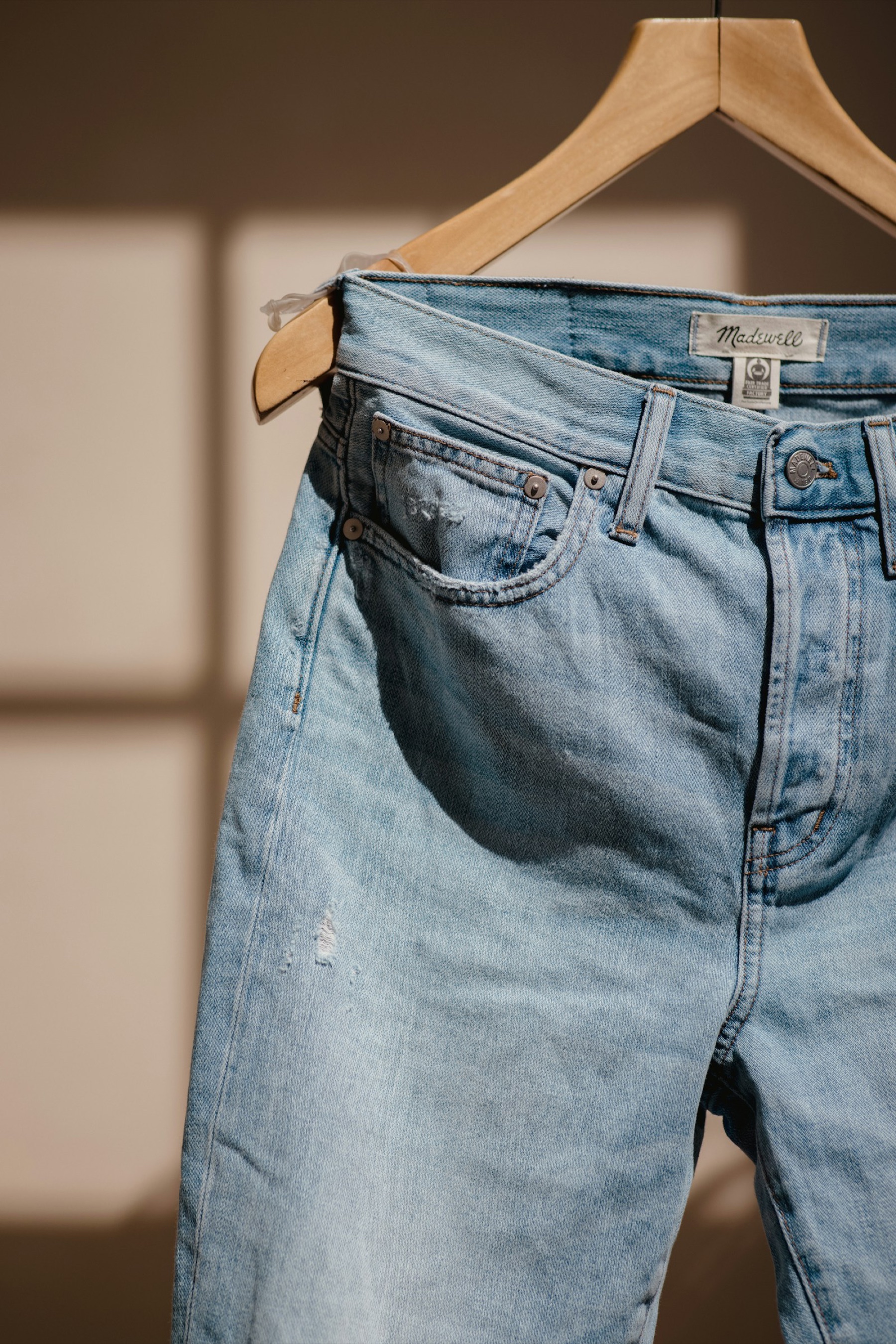
Thirsty: Jeans
A pair of jeans carries about 8,000 litres of water from the cotton field to the shop, and the most detailed study ever made of a single garment found that a quarter of its lifetime water is spent after it is bought. Where the litres go, why indigo is such a thirsty colour, and what the owner controls.
In May 2014 the chief executive of Levi Strauss, Chip Bergh, stood on a conference stage in a pair of the company's jeans and told the audience that they had not been washed in a year. The line was reported as a stunt, and it was a good one. It was also the public face of a piece of research that his company had recently finished, and that changed how the industry talks about the water in a pair of jeans.
Jeans are a useful garment to think about because almost everyone owns several, they last for years, and they are made from one crop, one dye and a great deal of water. This article follows a pair from the field to the shop, and then, because the study insisted on it, into the owner's washing machine.
Eight thousand litres
By the Water Footprint Network's method, the one every footprint on this site uses, a pair of jeans carries about 8,000 litres of water from the field to the shop. The method adds rain that the crop took up, irrigation applied to it, and the clean water it would take to dilute the pollution the crop and its processing caused, across the whole supply chain.
| Stage | Litres | Share |
|---|---|---|
| Growing the cotton | 6,800 | 85% |
| Dyeing and finishing | 800 | 10% |
| Spinning, sewing, transport | 400 | 5% |
The split is approximate. The total is the figure to remember, and the shape of the split is what matters: the field drinks first, and the dye house, for all its water, is a distant second. This is the pattern of every crop based product on this site, and jeans show it clearly because they are so much cotton.
Why jeans beat a t-shirt three to one
A cotton t-shirt carries about 2,700 litres. A pair of jeans carries three times that, and the reason is weight. Denim is a heavy, dense weave, and a pair of jeans holds close to a kilogram of cotton where a t-shirt holds a quarter of one. Cotton fabric runs at roughly 10,000 litres per kilogram in the global average, so most of the difference between the two garments is simply that one contains more crop.
Cotton itself is a thirsty plant. It needs a long, hot growing season, and heat means evaporation: a field of cotton in full leaf pumps water out of the soil and into the air all summer. It is also a demanding crop for fertiliser and pesticide, which is why its grey water, the volume needed to dilute what runs off the field, is larger than for most crops. Where the cotton grew decides how much of the footprint is rain and how much was pumped, and the article on the t-shirt takes that question to Central Asia, where the answer emptied a sea.
Indigo does not want to stay
The dye house is where jeans stop being cotton and become denim, and the colour has a chemistry that explains both why denim fades and why the rinse water runs blue.
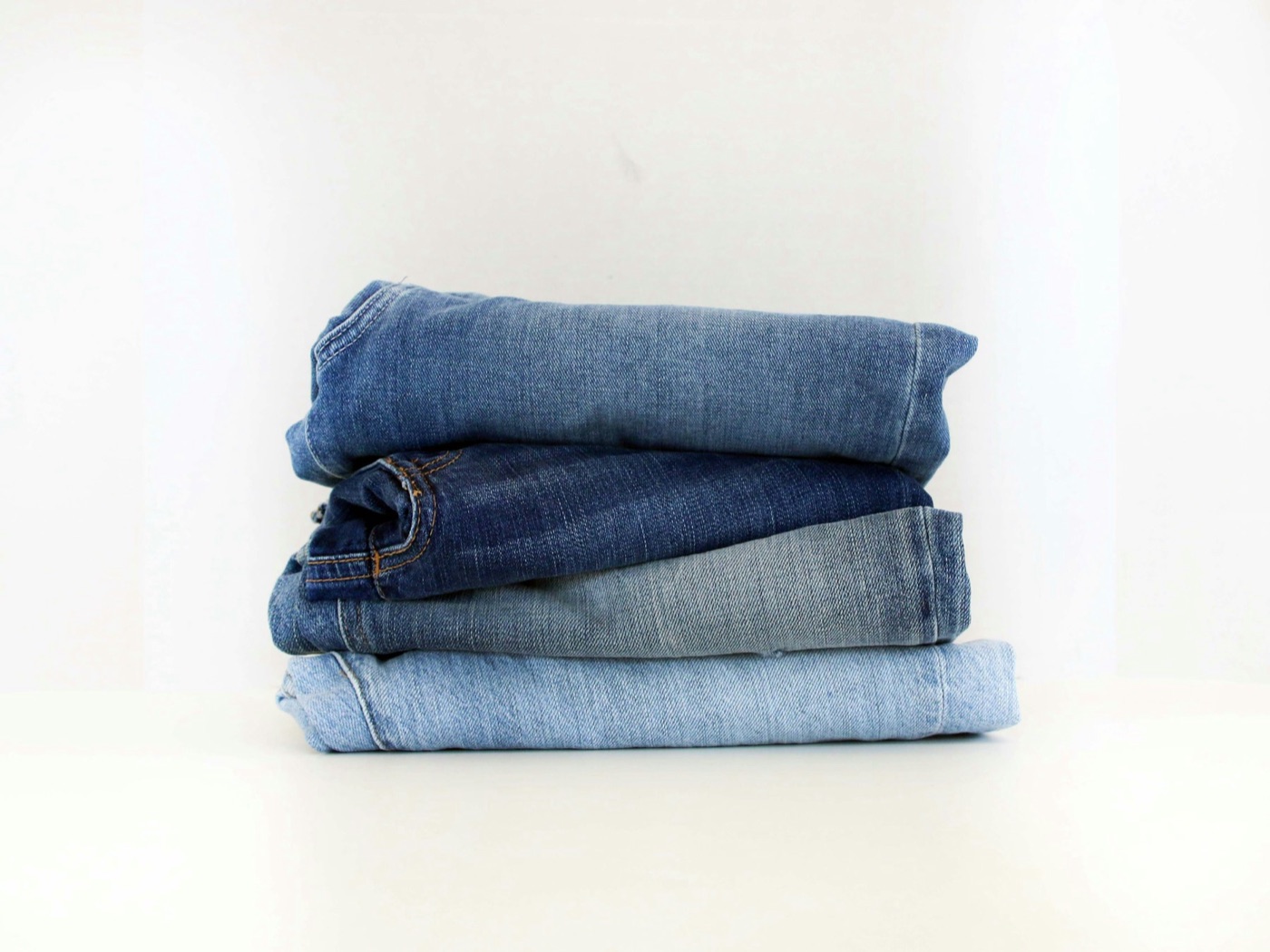
Indigo is unusual among dyes in that it does not dissolve in water. To get it onto yarn it has to be chemically reduced, in an alkaline bath, into a yellowish soluble form. The yarn, in ropes of hundreds of strands, is dipped into that bath, lifted out, and exposed to the air, where the dye oxidises back to its insoluble blue form and is trapped on the surface of the fibre. One dip gives a pale blue. Six to twelve dips, with a rinse and an airing between each, give the deep indigo of new denim, and the ropes of yarn run through the dye range for hundreds of metres to get them.
| Step in the dye house | What the water does |
|---|---|
| Sizing | Coats the warp yarn with starch so it survives weaving |
| Indigo dipping, repeated | Carries the reduced dye onto the yarn; rinses between dips carry the unfixed dye away |
| Desizing and washing | Strips the starch from the woven cloth |
| Garment finishing | Stone, enzyme and rinse washes give the worn look |
Because indigo sits on the surface of the fibre rather than inside it, the colour wears off where the fabric rubs. That is the fade at the knees and the seams, and it is the whole appeal of the garment. It is also why so much of the dye leaves in the rinse water. A share of every dip never bonds, and it goes down the drain along with the alkali, the starch from the sizing, and the salt. That coloured water is counted in the footprint as grey water, and it is the reason a denim mill has a treatment plant beside it.
The finishing is a second round. New denim is stiff and uniformly dark, and most jeans are sold looking worn, so finished garments are washed with pumice stones, with enzymes that eat the surface of the cotton, with bleach, and rinsed again. Every step is a machine full of water, and the laundries that do this work can use tens of litres per pair. Laser and ozone finishing, which fade denim with light and gas instead of water, are the industry's answer, and they are spreading because they save money as well as water.
Inside a denim mill
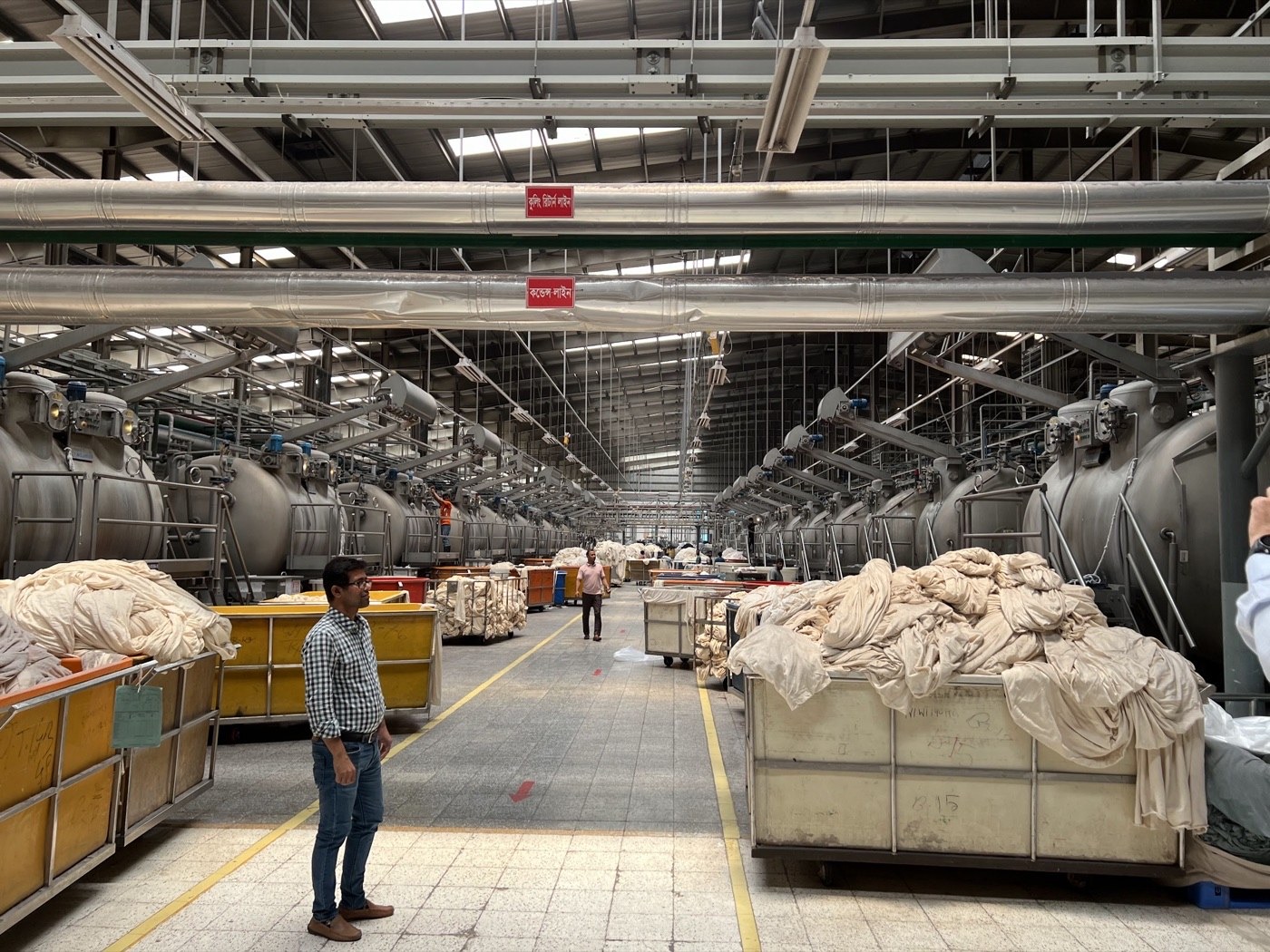
A denim mill is a particular kind of textile plant, and its water has a particular character. Most dye houses run batches: a machine fills, dyes a load of cloth, drains and fills again. A denim mill runs continuously. The rope dyeing range is a machine the length of a building, through which the warp yarn passes without stopping, from the sizing bath through the indigo dips and their rinses to the dryers, and the water in it is replenished rather than dumped. The effluent is therefore steady, all day, and it is a distinctive colour.
What leaves is alkaline, because the indigo bath has to be, and it carries unfixed indigo, the reducing chemicals used to dissolve it, starch from the sizing, and, from the finishing laundries, pumice dust, enzymes and bleach. Indigo itself is not eaten by bacteria, so the treatment plant beside a denim mill leans on chemistry: coagulants that make the dye clump and settle, before the biological stage deals with the starch and the organic load. The blue sludge that comes off the settling tanks is the colour of the jeans, and it has to be trucked away.
The better mills now recover a large share of this water. After the biological stage, membranes strip out the salt and the last of the colour, and the water goes back to the dye range. Some mills in Bangladesh and Pakistan, where water is scarce and the buyers demanding, run at recovery rates that were unthinkable twenty years ago, and the pressure to do so comes from the brands rather than from the local regulator. A pair of jeans made in such a mill still carries the field's six thousand litres. Its dye house water, though, has been used more than once.
The insider number
In 2015 Levi Strauss published a life cycle assessment of one specific product, the 501, following it from the cotton field through manufacturing, shipping, the years in a customer's wardrobe, and disposal. It remains one of the most detailed studies ever made of a single garment, and it found something the industry had not been saying.
Of all the water a pair of jeans uses in its lifetime, about 23 percent is spent after it is bought, in the owner's washing machine. Cotton cultivation was the largest share, at about 68 percent. Everything the company itself did, the mills, the factories, the finishing laundries, came to a few percent. The largest saving still available belonged to whoever wore the jeans, and that is what the chief executive was demonstrating on stage.
| Levi's 501, lifetime water use | Share |
|---|---|
| Growing the cotton | about 68% |
| Consumer washing | about 23% |
| Manufacturing, finishing, transport, the rest | the remainder |
Why the numbers differ
Anyone who looks the subject up will find two figures for a pair of jeans, and both are honest. The Water Footprint Network's 8,000 litres is a global average for the crop and its processing, counting green, blue and grey water, up to the shop. Levi's 3,781 litres is one product, made from cotton of known origin, counted by a different method, and followed through its whole life including years of washing. The two studies are asking different questions, and the lesson is the one every footprint article on this site ends up at: before comparing numbers, ask what each one includes.
What the owner controls
The practical conclusion is unusual among sustainability advice, because it requires buying nothing. Denim was built to go months between washes. It does not hold odour the way synthetic fabric does, it does not need to be washed to be clean by any reasonable standard after a few days' wear, and the fade that makes a pair of jeans look right is produced by wear, not by the machine. Wash less, and the 23 percent shrinks. Wear the pair for twice as long, and every litre in the field is spread across twice as many days.
The water that left the dye house is a different matter, and not one the owner can influence. It went somewhere, and that somewhere is a treatment plant beside the mill, which is one of the more interesting buildings in industry and has its own article in the Plain Water series.
Sources
- Water Footprint Network, product gallery: cotton and cotton products. Global average water footprint of cotton fabric about 10,000 L/kg; a pair of jeans about 8,000 litres.
- Levi Strauss and Co. (2015). The Life Cycle of a Jean: Understanding the environmental impact of a pair of Levi's 501 jeans. 3,781 litres per pair over the full life cycle; cotton cultivation about 68 percent and consumer care about 23 percent of water use.
- Chip Bergh, Levi Strauss and Co., remarks at the Fortune Brainstorm Green conference, May 2014.
- Stage split (cotton, dyeing and finishing, other) is approximate and illustrative; the total is the citable figure.
- Photographs: Cesar Chu Ortega, from a dyeing mill in Bangladesh; jeans by Claire Abdo, Unsplash.