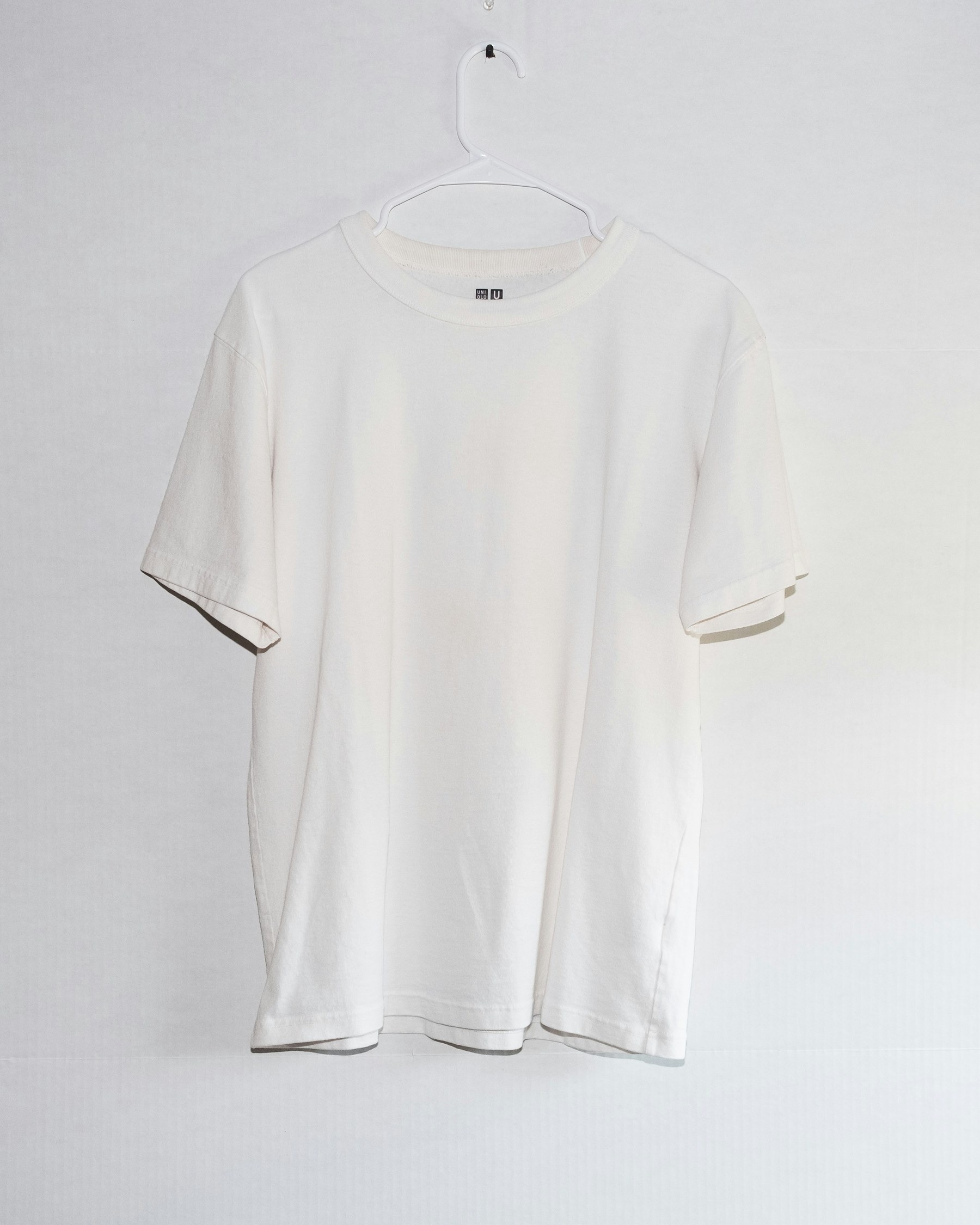
Thirsty: T-shirt
A cotton t-shirt carries about 2,700 litres of water, which is roughly what one person drinks in three years. Most of it fell on a cotton field or was pumped onto one, and in Central Asia the pumping was enough to turn the fourth largest lake on Earth into a desert.
On the northern edge of what used to be the Aral Sea there is a town called Moynaq, and in Moynaq there is a row of fishing boats lying on their sides in the sand. They were not wrecked. They were moored, in the 1980s, in a harbour that had been drying out for twenty years, and when the water finally left they stayed where they were. The sea is now about a hundred kilometres away, across a plain of salt and dust that was, within living memory, its bed.
The Aral Sea was drained to grow cotton. That is most of the explanation, though not all of it, and it makes the sea the clearest picture anywhere of what a supply chain can do to a map. A cotton t-shirt is the cheapest, most ordinary garment in the world, and the water inside it is the subject of this article.
Three years of drinking water
By the Water Footprint Network's method, a cotton t-shirt carries about 2,700 litres of water: the rain the cotton plant took up, the irrigation applied to it, and the clean water it would take to dilute the pollution from the field and the factory, added up across the supply chain.
The number is easier to hold onto as time. A person drinks about two and a half litres of water a day, which is roughly 900 litres a year. One t-shirt is three years of one person's drinking water.
| Stage | Litres | Share |
|---|---|---|
| Growing the cotton | 2,300 | 85% |
| Dyeing and finishing | 300 | 11% |
| Spinning, sewing, transport | 100 | 4% |
The split is approximate; the total is the citable figure. As with every crop based product on this site, the field takes nearly all of it and the factory is a distant second. A t-shirt is about a quarter of a kilogram of cotton, and cotton fabric runs at around 10,000 litres per kilogram in the global average, which is where the 2,700 comes from.
Why cotton is thirsty
Cotton is a plant of hot, dry summers. It needs a long growing season, well over a hundred and fifty days without frost, and a great deal of sun, and in that heat a field in full leaf pumps water out of the soil and into the air continuously. The plant is also grown for its fibre rather than its seed or fruit, and the fibre is a small part of what the plant builds in a season, so every litre the crop transpires is charged to a small harvest.
It is a demanding crop in other ways. Cotton takes more fertiliser and more insecticide per hectare than most field crops, and what washes off the field into rivers and groundwater has to be counted. That is the grey water in the footprint, and for cotton it is a larger share than for coffee or cocoa.
None of this would matter much if cotton grew where the rain falls. Some of it does. A great deal of it does not, and that is the difference between cotton and the coffee of the previous article.
The grey water
Cotton's footprint has a larger grey share than most crops on this site, and it is worth pausing on what that means, because grey water is the part of the method that people find hardest to picture.
Grey water describes a volume that would be needed rather than one that was used: the amount of clean water it would take to dilute the pollution a crop causes back down to an accepted standard. For cotton the pollution is mostly fertiliser and insecticide. The crop is attacked by a long list of pests, the bollworm above all, and for most of the twentieth century it was grown under heavier insecticide use than almost any other field crop. Estimates from the late 1990s put cotton at around a sixth of the world's insecticide use on a small fraction of its farmland. Genetically modified varieties, which produce their own toxin against the bollworm, have reduced spraying in the countries that adopted them, and organic cotton avoids synthetic chemicals altogether, but cotton remains a demanding crop for the water around it.
What runs off a cotton field ends up in the same rivers and aquifers that the irrigation came from, and in the Aral Sea basin the salts and chemicals washed off decades of cotton farming are part of the dust that now blows off the dry seabed. The grey share of the footprint is the method's way of counting that damage, and for cotton it is a reminder that the water a crop takes is only half the story of what it does to a river.
The problem is where it grows
Coffee is mostly rain fed, in the wet tropics, and its footprint is overwhelmingly green. Cotton is different. It likes dry heat, which means it is often grown in places that are dry, and in dry places it has to be irrigated. Much of the world's cotton is farmed on pumped water, from rivers and aquifers, in regions that have little to spare: the Indus basin in Pakistan, the plains of northern India, the Central Valley of California, the deserts of Central Asia.
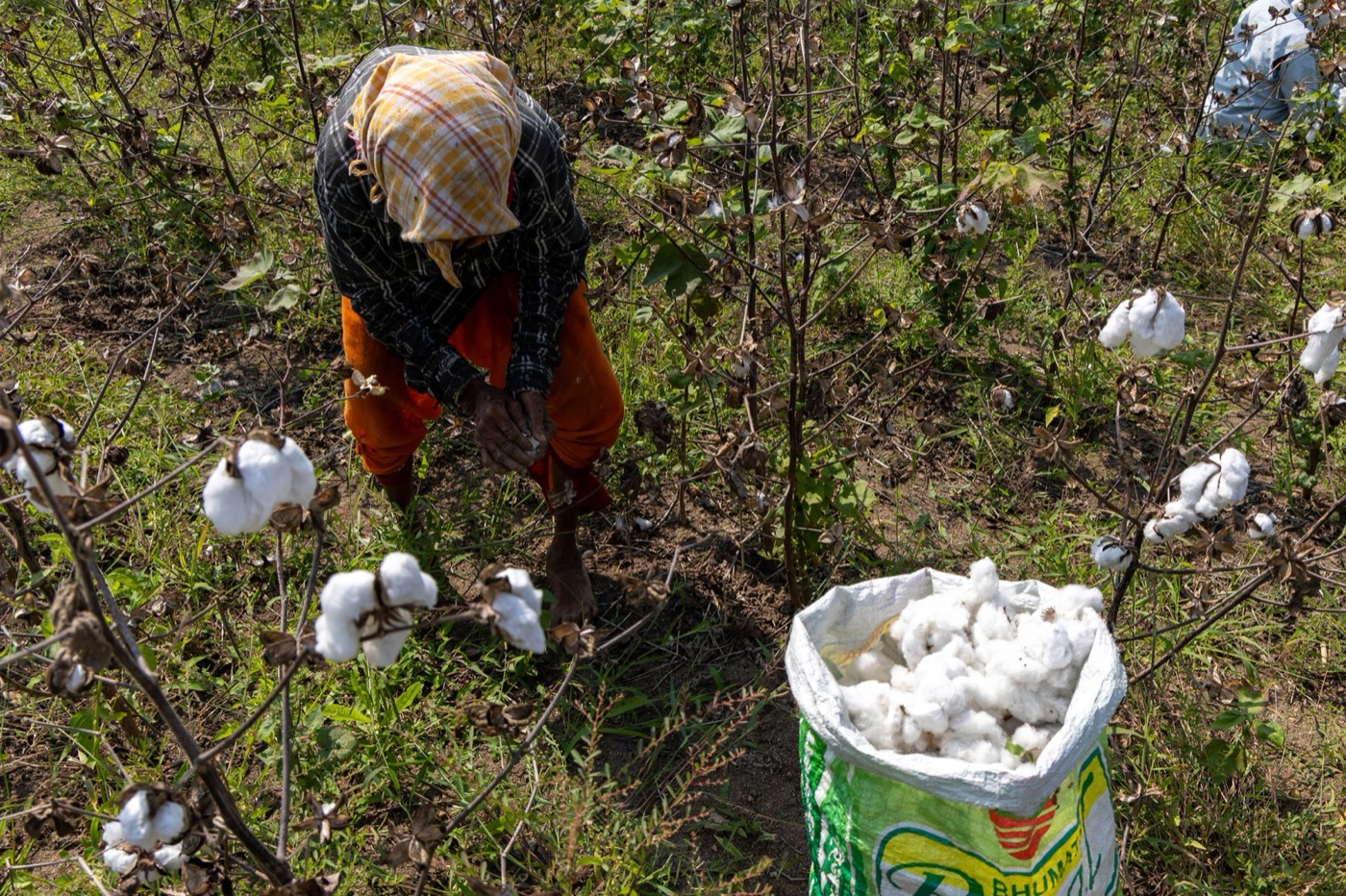
In the footprint, that shows up as a large blue share, and blue water is the kind that is missing from a river afterwards. Rain that falls on a cotton field in a wet region was never going to fill a tap. A river diverted onto a cotton field in a desert was going somewhere else, and in the Aral Sea basin, where it was going was the sea.
The insider number
The Aral Sea, on the border of Kazakhstan and Uzbekistan, was in 1960 the fourth largest lake in the world, larger than any of the Great Lakes but Superior, with a fishing fleet that landed tens of thousands of tonnes a year. It was fed by two rivers, the Amu Darya and the Syr Darya, flowing down from the mountains to the south and east across a desert.
From the 1960s the Soviet government diverted those rivers, through thousands of kilometres of canals, to irrigate cotton across the desert of Uzbekistan and Kazakhstan. The plan worked, in its own terms. Uzbekistan became one of the largest cotton producers on Earth. The rivers, by the time they reached the sea, were carrying a fraction of their flow, and the sea began to shrink.
| The Aral Sea | |
|---|---|
| Size in 1960 | The fourth largest lake in the world |
| Volume lost since | About 90 percent |
| What the rivers were diverted for | Cotton, above all |
| Distance from Moynaq's harbour to the water today | Around a hundred kilometres |
By the 2000s roughly 90 percent of the sea's volume was gone. What remained had split into separate lakes, several times saltier than the sea had been, and the fishery was finished. The exposed bed, some tens of thousands of square kilometres of it, became a source of salt and pesticide laden dust storms that reach the towns around it and beyond. A dam finished in 2005 has partly restored the small northern lake in Kazakhstan. The larger southern basin is not coming back.
It is the clearest picture anywhere of what a supply chain can do to a map, and it is worth being precise about what it shows. It does not show that cotton is wrong. It shows that growing a thirsty crop in a desert on a diverted river has a cost, and that the cost is paid a long way from the shop where the shirt was sold.
The fine print
The 2,700 litres is a global average, and for cotton the range around the average is wider than for almost any other crop. Rain fed cotton in a wet region and irrigated cotton from a desert can arrive at the same mill, be woven into the same fabric, and carry entirely different real costs. The label will not say which one is in the shirt, and in most cases the brand does not know either, because cotton is traded and blended long before it is spun.
Organic cotton, which is grown without synthetic fertiliser and insecticide, reduces the grey water in the footprint. It does not by itself reduce the blue water, because organic cotton can be irrigated in a desert as easily as any other kind. The question that matters most for a t-shirt is where the cotton grew and whether the water it used was rain, and that is a question the industry is only beginning to be able to answer.
What the buyer controls
The practical conclusion is the same as for jeans, and it has the same unusual feature: it requires buying nothing. The cheapest water saving in a wardrobe is a longer life. Wear a shirt for twice as long and its water per wear drops by half; the 2,700 litres were spent in the field before the shirt existed, and every extra year in use spreads them thinner. The second cheapest is to wash cooler and less often, which spares water and the shirt both.
Where the cotton grew is out of the buyer's hands. Where the water went afterwards, at the mill, is not out of anyone's, and the dye house that turned the cotton into a coloured shirt has a treatment plant beside it, or should have. What happens there is a story of its own in the Plain Water series.
Sources
- Water Footprint Network, product gallery: cotton. Global average water footprint of cotton fabric about 10,000 L/kg; a 250 g cotton t-shirt about 2,700 litres, green, blue and grey.
- Chapagain, A.K., Hoekstra, A.Y., Savenije, H.H.G. and Gautam, R. (2006). The water footprint of cotton consumption. Ecological Economics 60. Cotton's share of the Aral Sea basin's water use.
- UNEP (2014). The Aral Sea: a lake that is dying. Global Environmental Alert Service. Loss of roughly 90 percent of the lake's volume since 1960.
- Micklin, P. (2007). The Aral Sea disaster. Annual Review of Earth and Planetary Sciences 35.
- WWF (1999). The impact of cotton on freshwater resources and ecosystems. Cotton's share of world insecticide use.
- Stage split (cotton, dyeing and finishing, other) is approximate and illustrative; the total is the citable figure.
- Photographs: t-shirts by Jonathan Mattson, Unsplash, and from the project's own set; inline: Woman picking cotton in Raichur, Karnataka by Nanditha Gogate, WELL Labs (CC BY-SA) via Wikimedia Commons.