Thirsty: Milk
A litre of milk takes about 1,020 litres of water to produce, and the cow drinks almost none of it. The water is in the grass and grain she eats every day, which is also what decides whether dairy or a plant milk is the heavier choice, and why the answer depends on the farm behind the carton.
A dairy cow drinks a great deal of water, eighty or a hundred litres a day in hot weather, and it is natural to assume that this is where the water in milk comes from. It is a small part of it. A litre of milk carries a water footprint of about a thousand litres, and almost all of that was used before the cow drank anything, by the grass, the hay and the grain that kept her producing. Milk is the beef story again, told by a different animal, and it is the product where the comparison with alternatives has become a public argument.
A thousand litres
By the Water Footprint Network's method, milk comes to about 1,020 litres of water per litre in the global average, counting the rain the feed crops took up, the irrigation applied to them, and the clean water it would take to dilute the pollution from the field and the farm.
| Stage | Litres | Share |
|---|---|---|
| Growing the feed | 980 | 96% |
| The cow's drinking water | 25 | 2.5% |
| Farm and dairy | 15 | 1.5% |
The split is approximate; the total is the citable figure. As with beef, the feed is nearly everything. The dairy itself, where the milk is cooled, pasteurised, bottled and where the pipework is cleaned between every batch, adds a little, and the article on the food industry explains why that cleaning is more than people expect. But the water in a glass of milk was, overwhelmingly, drunk by a plant.
The cow is a converter
A dairy cow is a machine for turning a field into milk. She eats somewhere between fifteen and twenty five kilograms of dry feed a day, grass in summer, silage and hay in winter, with grain to keep her yield up, and gives back around twenty five litres of milk. Every kilogram of that feed was a crop that spent a season transpiring water, and the method charges the water to the milk.
What makes milk different from beef is the arithmetic of yield. A beef animal eats for years and is slaughtered once, and a few hundred kilograms of meat carry all of it. A dairy cow eats every day and gives milk every day, for years, and the water is spread across thousands of litres. That is why milk, at a thousand litres per litre, sits far below beef at fifteen thousand per kilogram, though it comes from the same kind of animal eating the same kind of feed.
| Water per gram of protein, global averages | Litres |
|---|---|
| Beef | about 112 |
| Milk | about 31 |
| Eggs | about 29 |
| Pulses | about 19 |
Per gram of protein, which is a fairer way to compare foods than per kilogram, milk performs about as well as eggs and far better than beef. It is one of the better deals in a fridge, and that is worth holding onto before the next section.
Inside the dairy
The dairy's own share of the footprint is small, and it is worth a paragraph for the same reason the brewery was: it is the part of the chain that is measured, published and managed.
Milk arrives at a dairy warm from the cow and has to be cooled within hours, then pasteurised, heated briefly to kill pathogens, then cooled again, standardised for fat, and packed. Almost none of that uses water in the product. It uses water around the product: in the cooling, in the steam that heats the pasteuriser, and above all in cleaning. Milk is food for bacteria as much as for people, and every pipe, tank and filler it touches has to be washed and sanitised between batches with hot water, caustic and acid pumped through the system in a cycle the industry calls cleaning in place. In a large dairy that cleaning can use more water than the volume of milk processed, and the effluent it produces, carrying milk residues, has a chemical oxygen demand hundreds of times that of sewage, which is why a dairy's treatment plant is sized like a small town's.
Cheese and butter concentrate the footprint further. It takes roughly ten litres of milk to make a kilogram of hard cheese, so cheese carries around 3,000 litres of water per kilogram, and the whey left behind, once a waste that dairies struggled to dispose of, is now dried into protein powder or digested for biogas. Milk powder, which is milk with the water removed, runs to several thousand litres per kilogram for the same reason: the water in the footprint was never the water in the milk.
Alfalfa, and water that travels
One feed crop deserves its own mention, because it is where the water in milk becomes a political question. Alfalfa, a deep rooted legume cut several times a year for hay, is the highest quality forage a dairy cow can eat, and it is thirsty: a field of alfalfa in a hot, dry climate can use more water per hectare than almost any other crop. It is grown at scale in exactly such climates, in California's Imperial Valley, in Arizona, in the deserts of the Middle East, because it grows all year where there is sun and pumped water.
The water in hay travels with it. In the last decade, dairy companies from Saudi Arabia and the Emirates, whose own aquifers had been pumped almost dry growing alfalfa at home, bought and leased farmland in Arizona and California to grow it there and ship it across the Pacific to their herds. The milk is produced in the Gulf; the water was drawn from the Colorado basin. This is what the trade calls virtual water, and alfalfa is its clearest case: a crop that exists to feed cows, grown where the water is scarce, exported as hay to where it is scarcer still. When the water in a carton of milk is traced far enough back, it sometimes turns out to have been in a river on another continent.
Milk against the alternatives
No footprint on this site gets asked about more than milk's, because the question always comes with a second one: what about the alternatives? The answer depends on what is counted, and it is worth being careful.
The largest global study of food's environmental impacts, published in Science in 2018, compared dairy milk with the plant milks using freshwater withdrawals, which means irrigation and processing water, with rain not counted. On that measure dairy is the heaviest per litre. Almond milk comes next, and by a wide margin over the rest. Oat and soy sit far below both.
| Per litre of milk, irrigation and processing water | Litres |
|---|---|
| Dairy milk | 628 |
| Almond milk | 371 |
| Rice milk | 270 |
| Oat milk | 48 |
| Soy milk | 28 |
These figures are not the same kind of number as the 1,020 litres above, because they leave out rain, and they should not be compared with it. Within the table, though, the order is fairly stable across studies, and it says something clear: dairy and almond are the two options that draw on rivers and wells, and oat and soy are the two that largely do not.
Why almond sits so high
The almond figure surprises people, because a nut seems an unlikely water villain, and the explanation is geography rather than botany. About 80 percent of the world's almonds grow in California's Central Valley, one of the driest large farming regions on Earth, on trees that need water all summer and get almost none from the sky. The water is pumped, from rivers that have been fought over for a century and from an aquifer that has been falling for decades, and it is water that other users in the same valley wanted. An almond orchard in a wet climate would have a footprint that was mostly green. There are very few of them.
Oats and soy, by contrast, are mostly grown on rain in temperate climates, in Scandinavia, Canada, the American Midwest, and their blue share is small. The crop's address decides its footprint, as it does for every product on this site, and almonds happen to have a bad one.
Same milk, different rivers
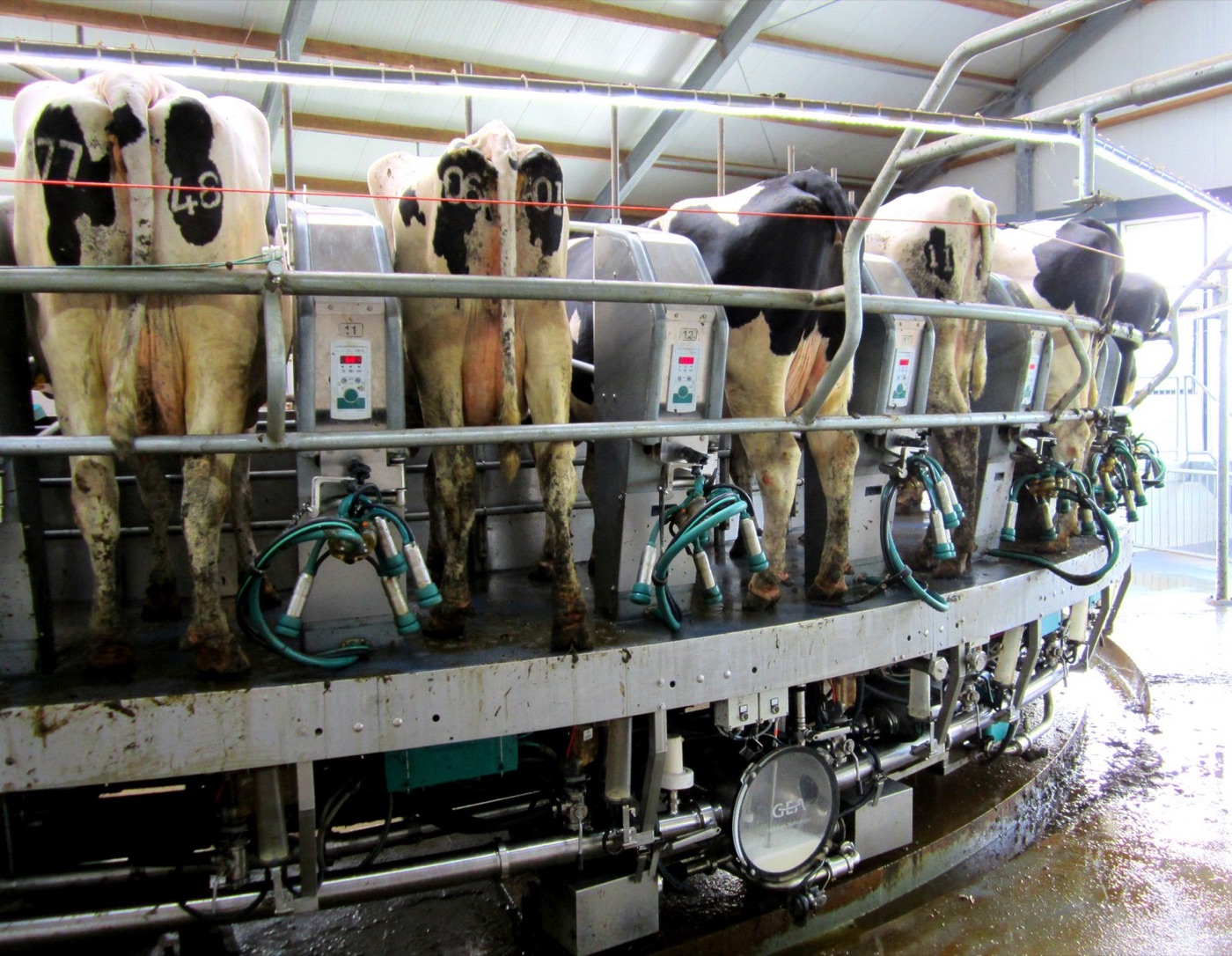
The same logic applies within dairy, and it applies with more force, because dairy farming is so varied. About 85 percent of milk's global footprint is green water, rain on pasture and feed crops, and a carton from cows grazing the wet grass of Ireland or New Zealand's west coast is close to all rain. A carton from a herd in a dry region, kept indoors and fed on irrigated maize and alfalfa, draws on rivers and wells for a large part of its feed, and its blue footprint can be many times the average. In the driest dairy regions, alfalfa, a thirsty crop grown to feed cows, is among the largest single users of irrigation water.
For dairy and for plant milks alike, then, the farm behind the carton sets the real cost, and the average conceals it. A rain fed dairy herd and a Californian almond orchard are at opposite ends of the same question, and the label on the carton, as usual, does not say which end it came from.
Reading the number
Nobody needs to give up milk on account of water, and the protein table above is the reason. What the number offers is the same thing every footprint here offers: a way of seeing the thousand litres behind the one in the glass, and then the second question. Was it rain on grass, or a river in a dry valley? For milk, more than for most foods, both answers are common, and the difference between them is larger than the difference between dairy and any of its alternatives.
Sources
- Mekonnen, M.M. and Hoekstra, A.Y. (2012). A global assessment of the water footprint of farm animal products. Ecosystems 15. Milk, global average, about 1,020 L/L, roughly 85 percent green; water per gram of protein for milk, eggs and beef.
- Poore, J. and Nemecek, T. (2018). Reducing food's environmental impacts through producers and consumers. Science 360. Freshwater withdrawals per litre of dairy, almond, rice, oat and soy milk.
- Almond Board of California and USDA: California produces around 80 percent of the world's almonds.
- Reporting on Gulf dairy companies farming alfalfa in Arizona and California for export (Almarai, from 2014), and on alfalfa water use in the Colorado basin.
- Stage split (feed, drinking water, farm and dairy) is approximate and illustrative; the total is the citable figure.
- Photographs: milk by Engin Akyurt, cattle by Wolfgang Hasselmann and Quaritsch Photography, all Unsplash; inline: Dairy Campus Ljouwert15 by Ieneach fan 'e Esk (CC BY-SA) via Wikimedia Commons.