Thirsty: Palm Oil
Palm oil is in about half the packaged products in a supermarket, and it is the least thirsty vegetable oil there is, grown almost entirely on rain in the wettest places on Earth. Its water problem is the other way round: what the mills send into the rivers of Sumatra and Borneo, and what the plantations did to the peat swamps that held the water in the first place.
Read the ingredients on a packet of biscuits, a jar of spread, a bar of soap or a tube of lipstick, and somewhere in the list is palm oil, or one of the fifty names it goes by. It is the most used vegetable oil in the world, about a third of all of it, and it comes from a tree that grows within ten degrees of the equator, in Indonesia and Malaysia above all, where it rains most weeks of the year. It has the worst reputation of any crop on the shelf, for the forests and the orangutans and the fires, and it has, by the measure this site uses, the smallest water footprint of any oil in the aisle.
This article is about that contradiction. Palm oil's water lies where a footprint never looks: downstream of the mill and underneath the plantation.
The most productive oil crop
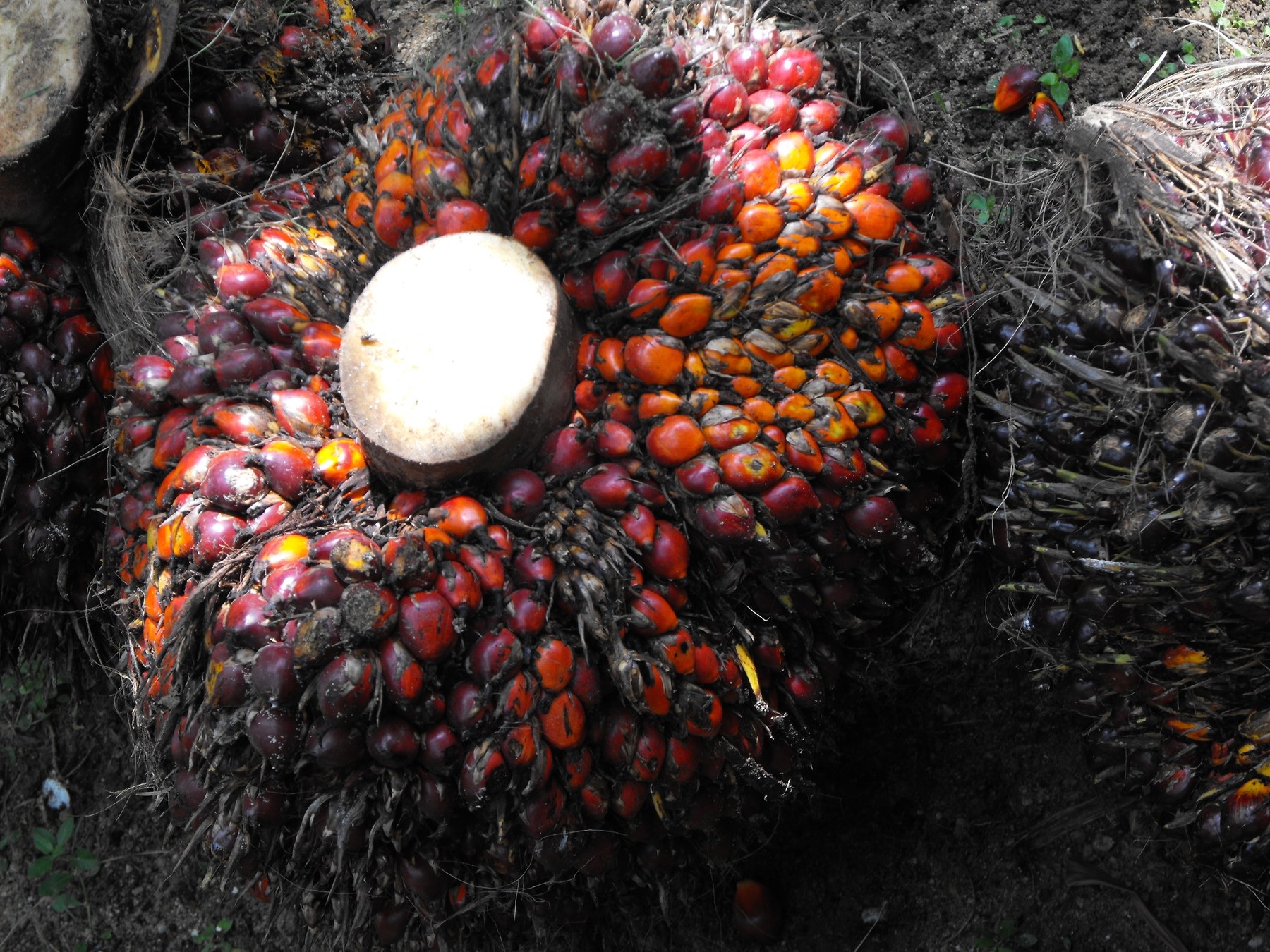
The oil palm is a tree of the West African coast, brought to Southeast Asia in the nineteenth century, that bears bunches of red fruit the size of a plum all year round. Each fruit has an oily flesh, which gives palm oil, and a kernel, which gives a second oil. A hectare of mature palms yields around four tonnes of oil a year, which is five to ten times what a hectare of soy, rapeseed or sunflower gives, and that yield is the whole reason the crop exists at the scale it does. It supplies about thirty five percent of the world's vegetable oil from about eight percent of the land given to oil crops.
The yield is also the reason for the small water footprint. A footprint is water per kilogram of product, and a tree that produces four tonnes to the hectare, on rain that would have fallen on the forest it replaced, spends less water per kilogram than any annual oilseed.
| Water in a kilogram of oil, global averages | Litres | Of which blue, irrigated |
|---|---|---|
| Palm oil | About 5,000 | Almost none |
| Rapeseed oil | About 7,600 | A little |
| Sunflower oil | About 6,800 | A little |
| Soybean oil | About 4,200 | Some, in Brazil and the United States |
| Olive oil | About 14,500 | A large share, in Spain and Greece |
The palm's water is green, rain taken from the soil by a tree in a climate with two to three metres of it a year, and the plantation regions of Sumatra, Borneo and the Malay peninsula are among the wettest inhabited places on Earth. Almost nothing is pumped. On the footprint alone, palm oil is the oil to choose.
What comes out of the mill
The water story begins where the footprint ends, at the mill. The fruit bunches have to be processed within a day of cutting, so every plantation has a mill nearby, and the mill uses water at every step: the bunches are sterilised with steam, the fruit is stripped and mashed, the oil is pressed out and then separated from the water and fibre in a clarifier, and everything that is not oil leaves as a liquid called palm oil mill effluent.
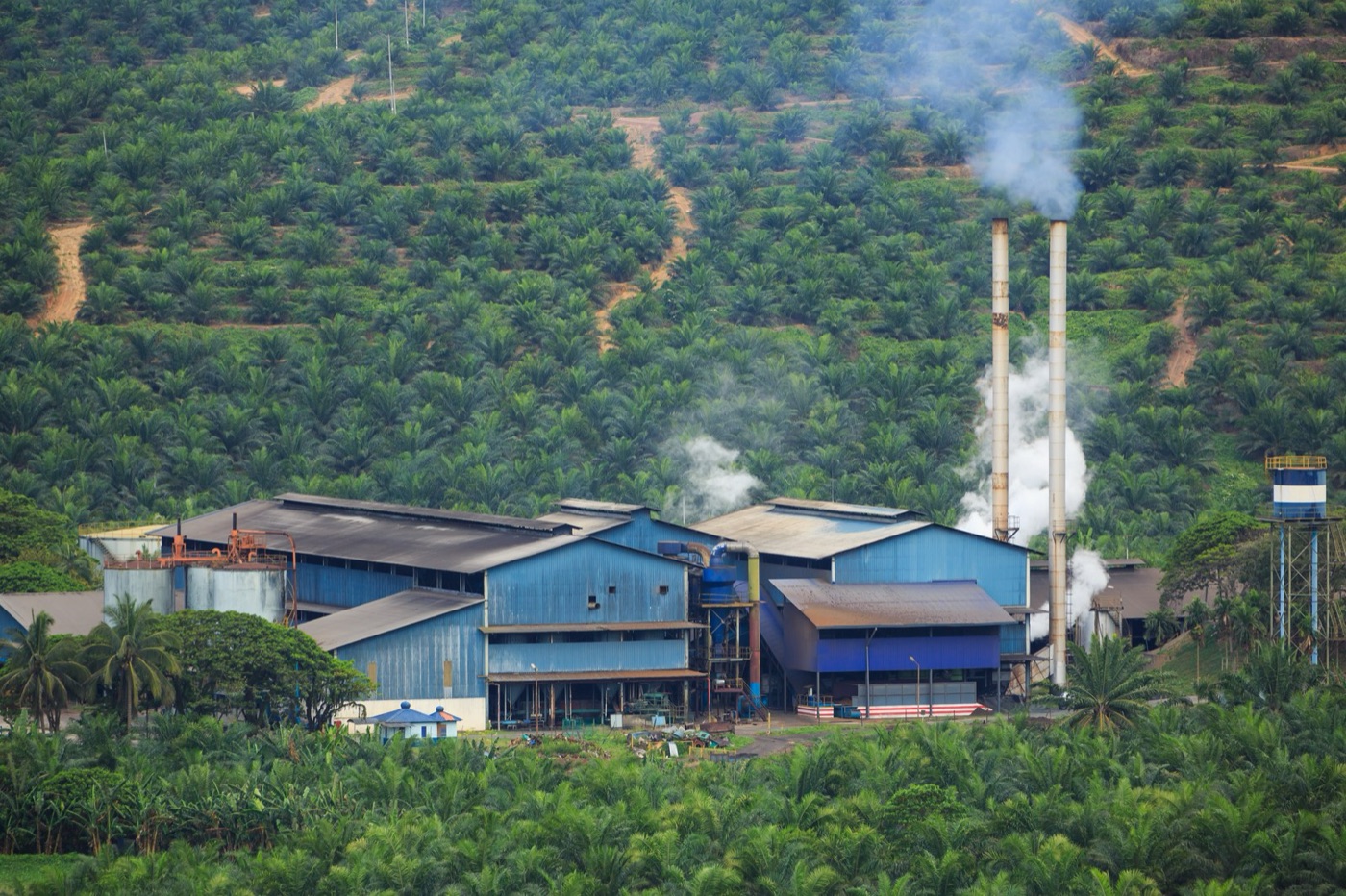
It is one of the strongest wastewaters in any food industry. It comes out hot, at eighty or ninety degrees, thick with oil, fibre, sugar and fine solids, at a biochemical oxygen demand of around 25,000 milligrams per litre, a hundred times a city's sewage and several times the effluent of a brewery or a dairy. A mill produces about two and a half tonnes of it for every tonne of oil, and the industry in Indonesia and Malaysia makes some seventy million tonnes of oil a year.
| Palm oil mill effluent | |
|---|---|
| Volume | About 2.5 tonnes per tonne of oil |
| Temperature | 80 to 90 degrees |
| BOD | Around 25,000 milligrams per litre, a hundred times sewage |
| COD | Around 50,000 |
| Oil and grease | Several thousand milligrams per litre |
| Standard treatment | Open ponds: cooling, anaerobic, then facultative, over 60 to 100 days |
| What goes wrong | Ponds overloaded or bypassed in the wet season; the river turns black |
The treatment, where it is done, is the oldest on this site: a chain of large earth ponds in which the effluent cools, ferments without air for a month or two while bacteria eat the sugars and oil, and then settles in shallower ponds open to the air before it is discharged or, at the better mills, sprayed back on the plantation as fertiliser. It works, when the ponds are large enough, dredged, and not overflowing, and it releases methane to the air in quantities that make the mill's ponds a larger climate item than its trucks. The newer mills cover the anaerobic pond and burn the methane for power, which is the biogas the sludge article describes, and a minority do.
Where the ponds are too small, or the season too wet, or the inspector too far away, the effluent goes to the river, and in the districts of Sumatra and Kalimantan where mills stand on every tributary, the rivers run brown and then black, the fish die, and the villages downstream, which drink and wash in them, are the ones who notice. Malaysia set a discharge standard for the effluent in 1977, one of the first industrial standards in the region, and it is met at most Malaysian mills. Indonesia, with twice the production and a weaker inspectorate, is where the rivers show it.
The swamp underneath
The larger water story is under the trees. A third of the oil palm planted in Indonesia and Malaysia since 1990 went onto peat swamp forest, the waterlogged lowlands along the coasts of Sumatra and Borneo where dead vegetation has accumulated for thousands of years into peat up to ten metres deep. Peat holds water; a peat swamp is a sponge that absorbs the monsoon and releases it through the dry season, keeping the rivers running and the lowlands wet. Oil palms will not grow in it, so the plantations drained it, with canals every few hundred metres that lower the water table by a metre or more.
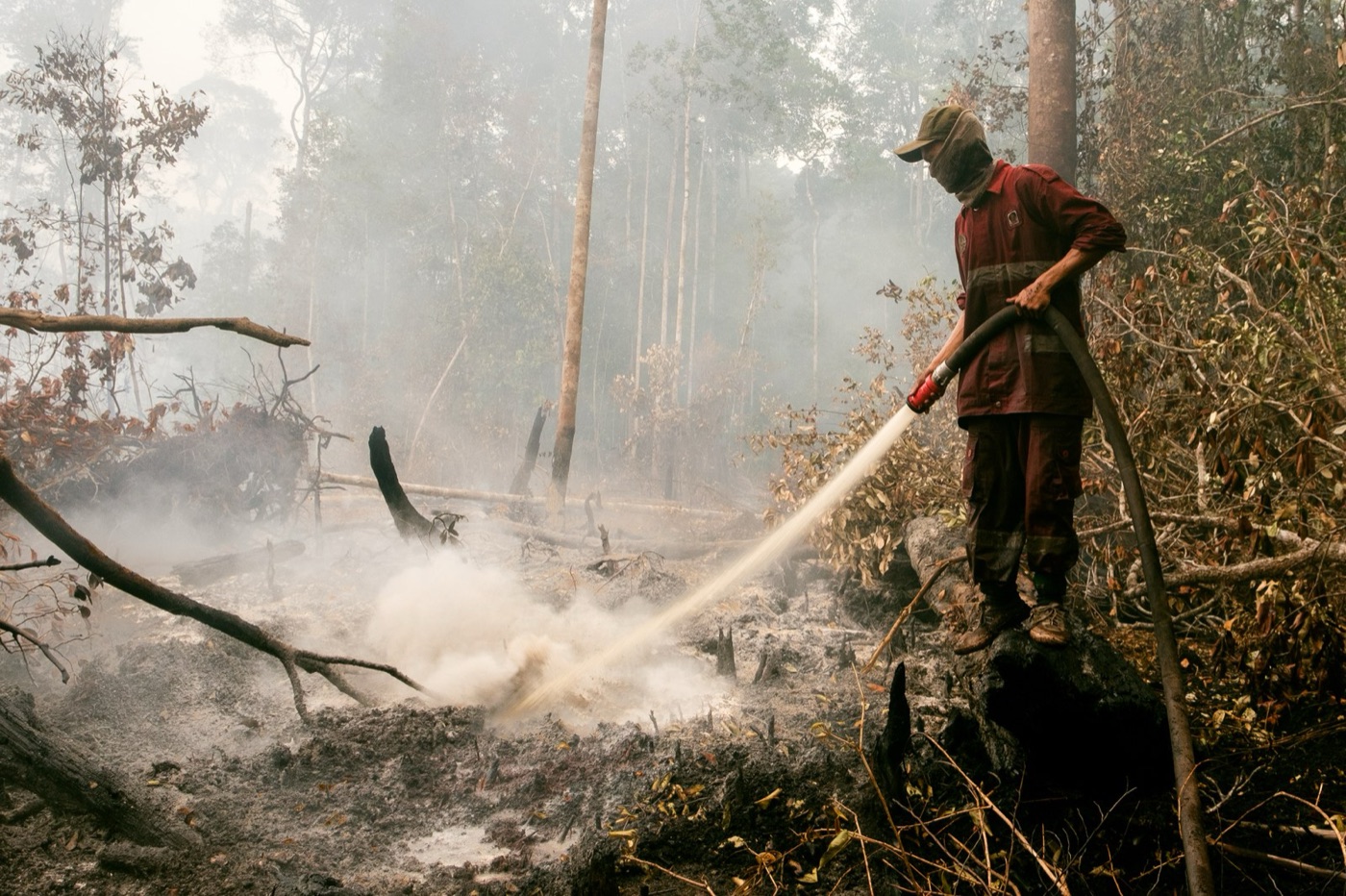
Drained peat does three things. It sinks, as the peat dries, oxidises and compacts, by several centimetres a year, so that plantations planted in the 1990s now lie below the rivers they drained into and flood in the wet season. It burns: dry peat is fuel, and the fires that cover Sumatra, Borneo, Singapore and Kuala Lumpur in smoke every dry year are peat fires, most of them on land cleared or drained for plantations, and they are the largest source of the region's carbon and of its worst air. And it stops holding the water, so that the rivers below run higher in the floods and lower in the droughts than they did, which is the story of the Chennai and São Paulo articles in a rainforest.
The industry's certification scheme has banned new planting on peat since 2018 and requires the existing plantations to manage their water tables, and the Indonesian government has restored some of the worst burned areas by blocking the canals. The peat already drained is a few million hectares, and it will keep sinking and burning for decades.
| Palm oil's water, beyond the footprint | |
|---|---|
| Footprint per kilogram | About 5,000 litres, nearly all rain: the smallest of the oils |
| Mill effluent | Among the strongest food wastewaters; rivers blackened where untreated |
| Peat | A third of new plantations since 1990 on drained swamp; sinking, burning, no longer storing water |
| Fresh water pumped | Almost none |
The smallholders
About forty percent of the oil palm in Indonesia and Malaysia is grown by smallholders, families with a few hectares who sell their fruit to a nearby mill, and they are the part of the industry that the certification schemes reach least. A smallholder cannot afford an effluent pond, because a smallholder has no mill; the mill is the estate's or a trader's, and its ponds are its owner's concern. What the smallholder decides is the land: whether the plot was forest or peat, whether the stream through it kept its trees, and whether the fertiliser stays on the field. The programmes that have worked have paid smallholders for yield rather than for area, since a well managed hectare of mature palms gives twice the fruit of a poor one and there is no reason to clear the next, and have mapped the peat so that it can be left alone. The oil in the biscuit came, as often as not, from a plot like that, and whether it was a good one is the question the label is trying to answer.
What to make of it
Palm oil is the clearest case on this site of a footprint being right and beside the point. The number says that the oil uses less water per kilogram than any alternative, and that is true and it matters: replacing palm with rapeseed or sunflower would take five times the land and rather more water, some of it irrigated. What the number does not measure is the river below the mill and the swamp beneath the plantation, and those are where palm oil's water damage is, in the places with more rain than anywhere else.
The practical position, which the environmental groups that once called for boycotts have mostly arrived at, is certified oil from mills that treat their effluent and plantations that stayed off the peat, rather than no oil at all. It is less satisfying than a boycott and it is the only answer that does not move the problem to another crop.
5,000 litres a kilogram, all of it rain, and a river below the mill that used to be clear.
Sources
- Mekonnen, M.M. and Hoekstra, A.Y. (2011). The green, blue and grey water footprint of crops and derived crop products. Value of Water Research Report 47. Palm oil about 5,000 litres per kilogram, olive oil about 14,500, rapeseed about 4,300 per kilogram of seed.
- USDA Foreign Agricultural Service, Oilseeds: World Markets and Trade: palm oil about 35 percent of world vegetable oil supply from about 8 percent of the oil crop land.
- Malaysian Palm Oil Board and Department of Environment, palm oil mill effluent characteristics: BOD 25,000 mg/L, and the discharge standards.
- Hooijer, A. et al. (2010). Current and future CO2 emissions from drained peatlands in Southeast Asia. Biogeosciences 7.
- Roundtable on Sustainable Palm Oil, Principles and Criteria 2018, on peat, riparian buffers and effluent.
- Photographs: opener: Palm Fruit Longthroat Memoirs by Yemisi Ogbe (CC BY-SA) via Wikimedia Commons; inline: District-Kunak Sabah IOI-Baturong-Palm-Oil-Mill-03 by CEphoto, Uwe Aranas (CC BY-SA) via Wikimedia Commons; inline: Marking the Fire by DenY Krisbiyantoro (CC BY-SA) via Wikimedia Commons.