Thirsty Places: Amman
The capital of one of the most water scarce countries on Earth, where the taps run one day a week by design, the rooftops carry the tanks that make it work, and the newest water arrives by pipeline from a fossil aquifer three hundred kilometres to the south that will never refill. Where Amman's water comes from, why the rota is permanent, what Disi is and how long it lasts, what a million refugees did to the arithmetic, why half the water is lost or stolen, and what the pipe from the Red Sea is for.
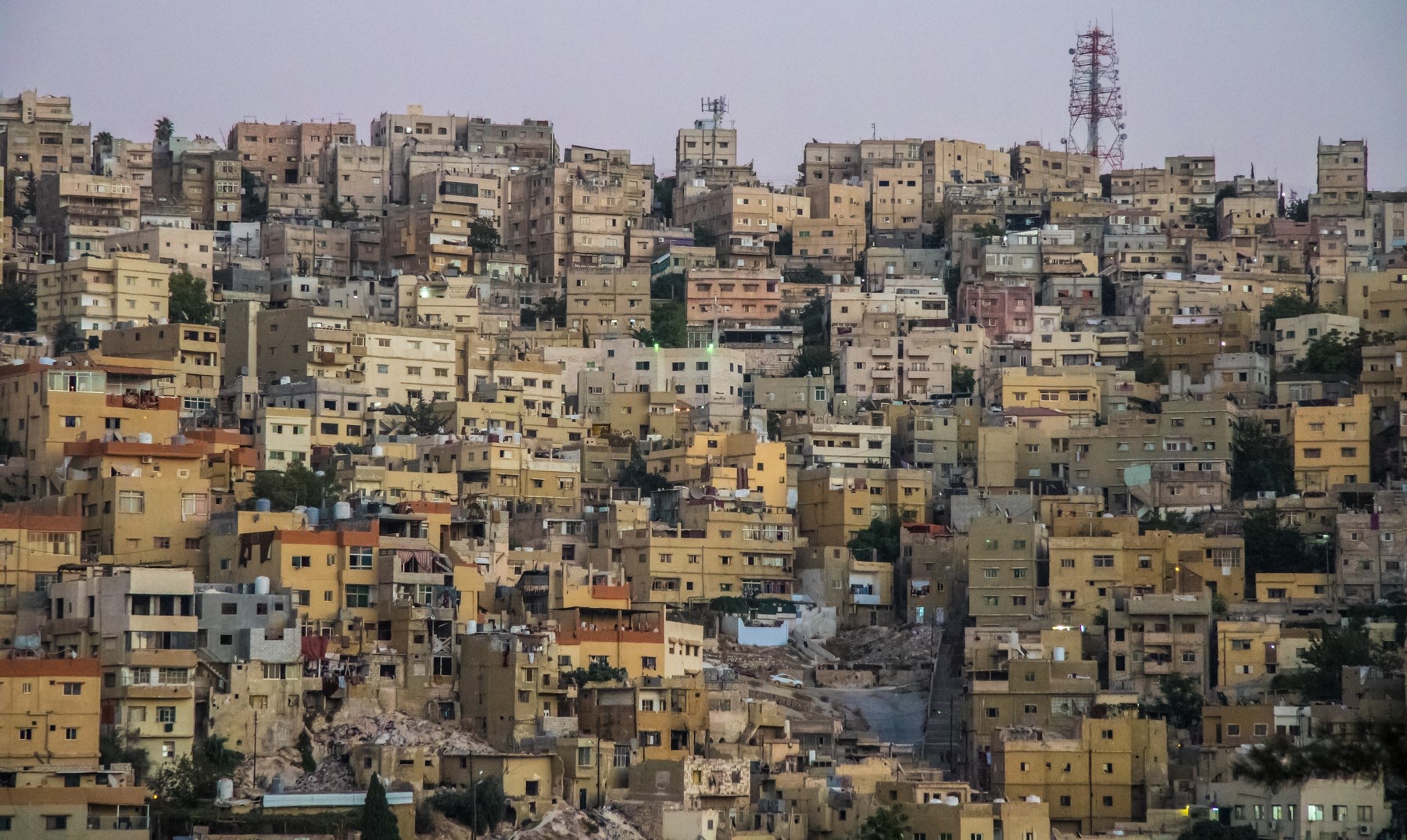
In Amman the water comes one day a week. Each district of the city has its delivery day, the utility pressurises the pipes for it, and the tanks on every roof fill and are drawn down through the six days until the next; a household that runs its tank dry on a Thursday waits until its day. It has been the system since the 1980s, it is not a drought measure and it is not an emergency, and it is how a city of four million lives in a country with about a hundred cubic metres of water per person per year, which is a tenth of the level that the international agencies call scarcity and among the lowest figures on Earth. Every building in the city carries a row of black plastic tanks on its roof, and the skyline is made of them.
This article is about where Amman's water comes from and why the rota is permanent, what the fossil aquifer under the southern desert is and how long it lasts, what a million refugees did to the arithmetic, why half the water is lost, and what the pipe from the Red Sea is meant to do.
The plateau
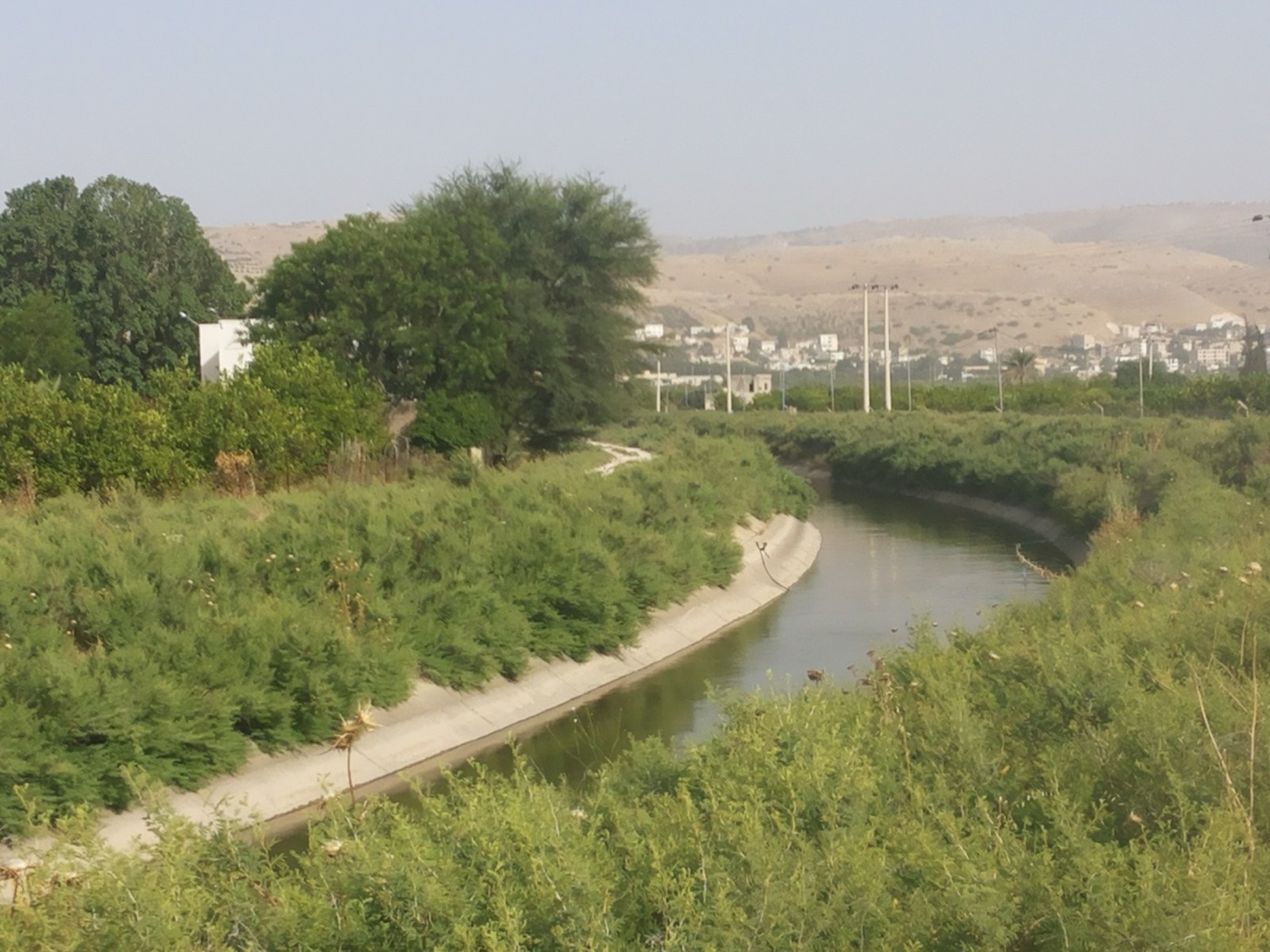
Amman sits on a plateau at nine hundred metres, east of the Jordan valley and west of the desert, in a country whose rain falls in a strip along the western hills and almost nowhere else, and whose rivers, the Jordan and the Yarmouk, are shared with neighbours who take most of them upstream. The city drew, for its first century, on springs and wells in the wadis around it and on the Zarqa river, which now carries its sewage; then on wells in the plateau's aquifers, which have been pumped below their recharge since the 1970s and fall by a metre or more a year; then on the King Abdullah canal, which takes the Yarmouk and the side wadis down the Jordan valley for the farms and is pumped, in part, a thousand metres up the escarpment to the city's treatment works at Zai, at a cost in electricity that is a large share of the utility's budget. And since 2013, on Disi.
The rain that does fall on the city, in a wet winter, runs off the plateau into the wadis and to the Dead Sea, which the Israel article on this site describes as a lake that has lost a third of its area because the rivers that fed it were taken first.
| Amman's water | |
|---|---|
| People | About 4 million in the city and its region |
| Water per person, Jordan | About 100 cubic metres a year; scarcity is defined at 1,000 |
| Supply | About 24 to 48 hours a week, by district rota |
| Sources | Plateau wells, falling; the King Abdullah canal pumped up from the valley; the Disi pipeline |
| Non revenue water | About 50 percent |
| Next source | Desalination at Aqaba, pumped 450 kilometres north |
Disi
Under the southern desert of Jordan and the north of Saudi Arabia lies a sandstone aquifer that filled with rain in the wetter climate of the last ice age and has received almost nothing since, and in 2013 the government finished a project to tap it: fifty five wells in the desert near the Saudi border, a pipeline of three hundred and twenty five kilometres north to the capital, and a delivery of a hundred million cubic metres a year, about a third of Amman's supply. The water is old, tens of thousands of years, and it carries, as fossil sandstone waters do, a level of natural radium above the drinking limit, which the utility dilutes by blending with other sources. It is the groundwater article's fossil water case in its purest form: a stock, not a flow, spent at a rate the engineers put at fifty years to the end of the useful part, with Saudi Arabia pumping the same aquifer from its side for irrigation at several times Jordan's rate.
Disi was the answer for a generation, and the generation is a short one. The pipeline gave the city its first increase in supply in decades and it did not change the rota, because the demand had grown to meet it before it arrived.
The refugees
Jordan has taken in the refugees of every war around it, and since 2011 the war in Syria has added, by the government's count, well over a million people to a country of ten million, most of them in Amman, Irbid, Zarqa and Mafraq, in the north where the water was already shortest. The demand rose by about a fifth in three years. The rota in the northern cities went from two days a week to one, the wells in the north fell faster, and the refugee camps, at Zaatari above all, were supplied by tanker until boreholes and a network were built for them, at a cost the aid agencies paid and the aquifer bore. The refugees did not create Jordan's water problem. They arrived at the point on the curve where the arithmetic had no margin, and the margin was taken from everyone.
| What changed the arithmetic | |
|---|---|
| Population, 1950 | Under half a million in the whole country |
| Population, 2024 | About 11 million, including refugees |
| Syrian refugees since 2011 | Well over a million by the government's count |
| Demand increase | About a fifth in three years, in the driest region |
| Rota in the north | From two days a week to one |
Half the water
Of the water that enters Amman's pipes, about half is not paid for. Some of it leaks from a network that was built fast in the 1970s and 1980s and is pressurised and depressurised every week by the rota, which the leaks article on this site describes as the surest way to break a pipe; some of it is taken through illegal connections, by households, by farms on the city's edge and, in the cases that reach the courts, by organised groups tapping the mains for tankers; and some is delivered to customers whose meters are broken or read wrong. The utility's programme to cut it has been running for twenty years, with results in the districts where the pipes have been replaced and the meters fitted, and the national figure has barely moved, because the network grows as fast as it is fixed. Half of a supply that is a tenth of scarcity is a large number, and it is the cheapest water Jordan could find.
The rota and the tank
The rota has consequences of its own. A pipe that is empty six days a week draws in, through its cracks, whatever is in the ground around it, and the first water of delivery day carries it; a tank on a roof in an Amman summer is warm, and the water in it, chlorinated a week ago at the works, has lost its residual by the fourth day, which is the Legionella and filter jug articles' conditions on every building in the city. Households that can afford it filter, and most drink bottled water, so that the utility's water is for washing and the water that is drunk comes from the shops. The tanks are also the equaliser: a wealthy household has a large tank and a pump and does not notice the rota, a poor one has a small tank and runs dry, and the water that the rota rations fairly on paper is rationed by tank size in practice.
The sea
The last source is the sea. The plan for a canal from the Red Sea to the Dead Sea, which would have desalinated on the way and refilled the Dead Sea with the brine, was studied for two decades with Israel and the Palestinians and abandoned in 2021. Its replacement is Jordan's alone: a desalination plant at Aqaba on the Red Sea, the country's only coast, and a pipeline of four hundred and fifty kilometres north and a thousand metres up to Amman, delivering three hundred million cubic metres a year, which is more than the city uses now, at a cost of several billion dollars and the electricity of a small country. It is under contract, financed by the development banks and the Gulf, and due in the early 2030s. It is the desalination article's last resort, in the country that has run out of every other kind, and it will supply, when it comes, a city that has grown to need it.
The farms in the valley
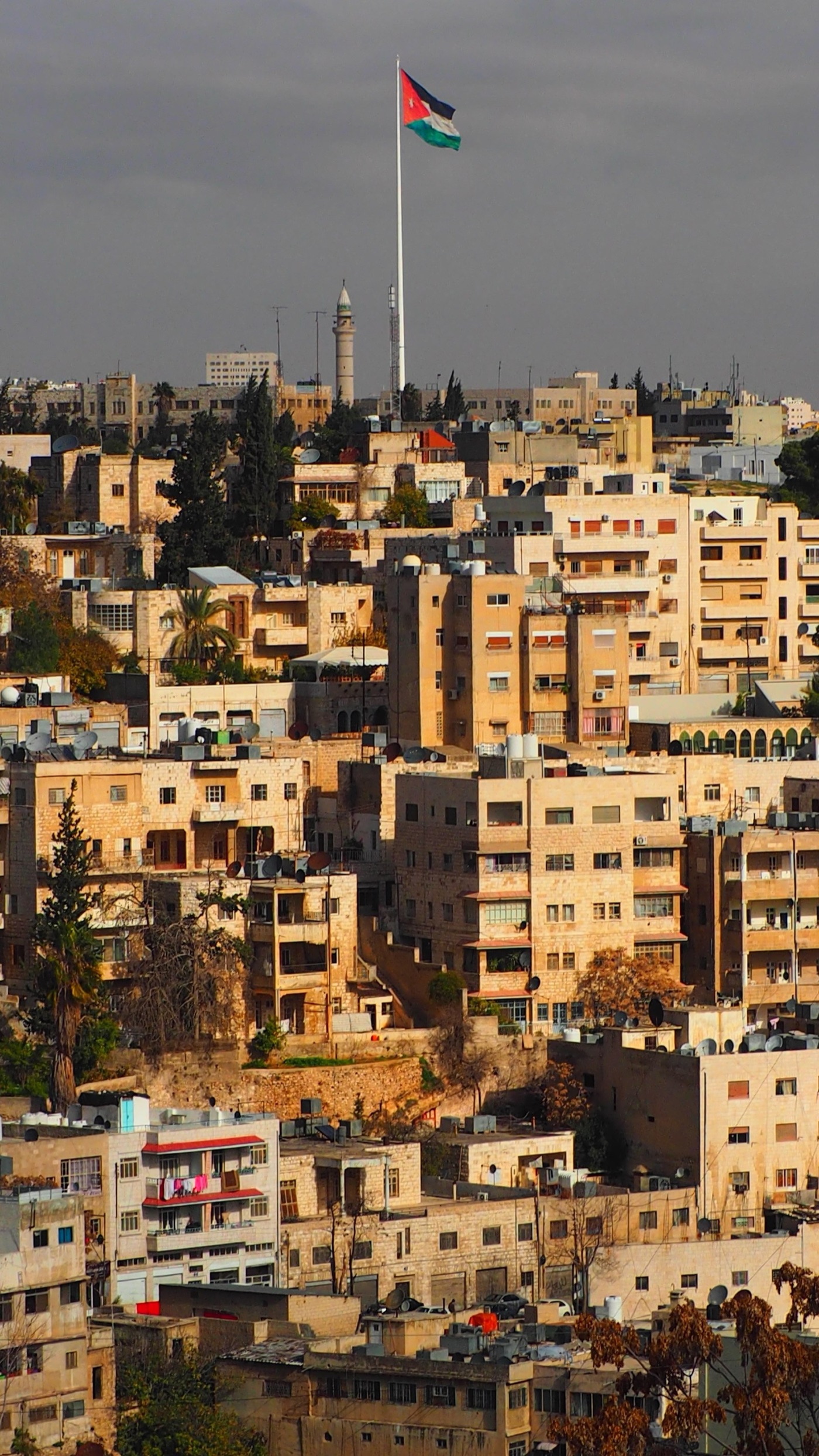
The Jordan valley below the city is the country's farmland, a strip of irrigated land along the river a few hundred metres below sea level that grows the tomatoes, bananas and citrus of the winter export trade on the water of the King Abdullah canal, and it takes about half of the country's water for a few percent of its economy. The argument in every water strategy since the 1990s has been whether that water should go to the city, and the answer has been the political one: the farms are the valley's people and the tribes' land, the water rights are old, and the treated sewage of Amman, pumped back down the escarpment from the works at As Samra, has been the compromise, so that the city's wastewater irrigates the valley's crops and the valley's canal water goes up to the city. As Samra now treats most of the capital's sewage to a standard that the farms accept, and the arrangement is the largest reuse of wastewater for agriculture in the region, which is the greywater and the Israel articles' pattern on this site at a country's scale.
What it teaches
Amman is the city on this site where scarcity is the design rather than the crisis. The rota is permanent, the tanks are the architecture, the aquifers are falling, the fossil water is being spent on a fifty year clock, half the supply is lost, and the next source is the sea at the far end of the country. The city works, day by day, because four million people have organised their lives around a delivery day, and because Jordan has been living on a tenth of scarcity for so long that the arithmetic is simply how things are. The pipe from Aqaba will double the supply. The tanks will stay on the roofs.
One day a week, a tank on every roof, and water that fell as rain thirty thousand years ago in a pipe from the desert.
Sources
- Ministry of Water and Irrigation, Jordan, National Water Strategy 2023 to 2040: about 100 cubic metres per person per year; supply rota; non revenue water about 50 percent.
- Miyahuna (Jordan Water Company, Amman), annual reports: supply schedule by district; rooftop storage; sources by share.
- Disi Water Conveyance Project documents (2013): 55 wells, 325 kilometres of pipeline, 100 million cubic metres a year; Disi aquifer fossil age and radium content.
- Aqaba Amman Water Desalination and Conveyance Project (AAWDC), Government of Jordan and financiers (2023 onward): 300 million cubic metres a year, about 450 kilometres of pipeline.
- UNHCR and Government of Jordan, Syrian refugee population and its effect on water demand in Amman, Irbid, Zarqa and Mafraq.
- Photographs: opener: Dusk- Amman Cityscape by andryn2006 (CC BY-SA) via Wikimedia Commons; inline: King Abudulla I canal JO by Freedom's Falcon (Public domain) via Wikimedia Commons; inline: Amman Cityscape by Fares Nimri (CC BY-SA) via Wikimedia Commons.