Thirsty Places: Chennai
In June 2019 the four reservoirs of India's sixth largest city held almost nothing, and water arrived by train from two hundred kilometres away. Four years earlier the same city had been under water. What happened to Chennai, why a city with a monsoon runs dry, what the rain barrels on every roof are for, and what the trains and the desalination plants did and did not solve.
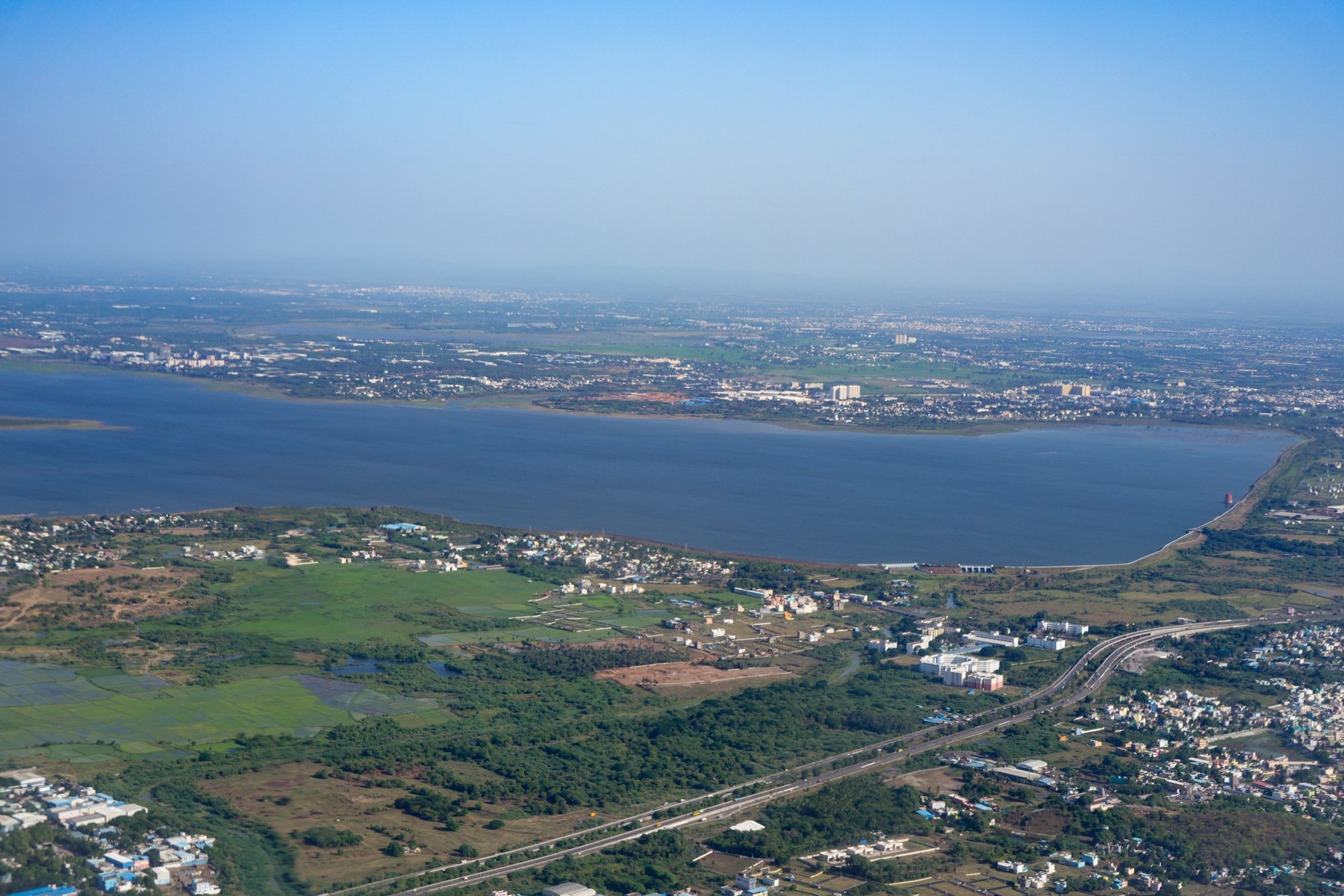
On 19 June 2019 the largest of Chennai's four reservoirs, the Chembarambakkam lake, was a cracked plain of mud with a few puddles in the middle. Photographs of it went around the world, alongside satellite images showing the lake as a blue shape in 2018 and a brown one a year later. The city of ten million people had, by the water board's own figures, about a tenth of one percent of its reservoir capacity left, and water was arriving by rail: trains of fifty tanker wagons, 2.5 million litres each, from a river two hundred kilometres inland, unloading at a siding in the suburbs several times a day.
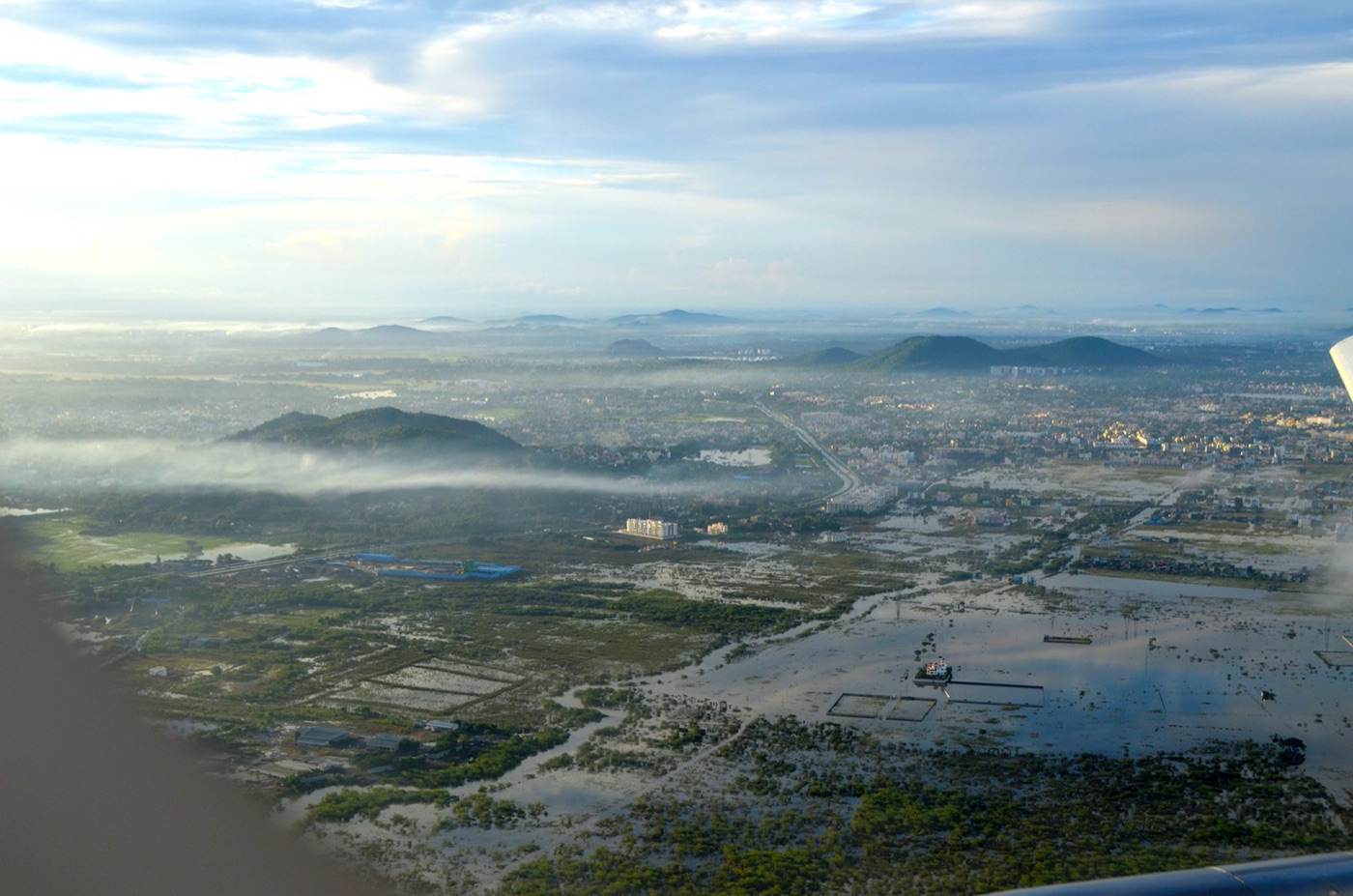
Four years earlier, in December 2015, the same city had been under water. The north east monsoon dropped more rain in a day than the city normally saw in a month, the same Chembarambakkam lake overflowed, its gates were opened, and the river below it put whole districts two metres deep. Several hundred people died. Chennai, in the space of four years, had both too much water and none, and the two are the same story. This article is about that story, because it is the one most of the world's cities in the monsoon belt are living.
A city with a monsoon
Chennai gets about 1,400 millimetres of rain a year, more than London or Paris, and most of it falls between October and December from the north east monsoon, which arrives off the Bay of Bengal in storms and cyclones. The city has no large river. It has a flat coastal plain, a few small rivers that are dry for most of the year, and, until the twentieth century, a landscape of hundreds of shallow lakes and tanks, built over centuries to catch the monsoon and hold it, and a great marsh to the south that absorbed whatever they could not.
The city's water has always been a matter of catching the six weeks of rain and making it last twelve months. The four reservoirs to the west and north of the city do that at scale, holding a little over 11,000 million cubic feet, about 320 million cubic metres, when full. When the monsoon is good they fill and the city is supplied. When it fails, they empty, and the city turns to the ground beneath it.
| Chennai's water | |
|---|---|
| Rainfall | About 1,400 millimetres a year, mostly in six weeks |
| Reservoir capacity, four lakes | About 320 million cubic metres |
| Reservoir storage, 19 June 2019 | About a tenth of one percent |
| Daily demand | Around 1,200 million litres |
| Supply during the crisis | Around half of that, from wells, tankers, desalination and trains |
| Water per train | 2.5 million litres, fifty wagons |
What went wrong
Three things went wrong at once, and only one of them was the weather.
The first was the rain. The north east monsoon failed, or fell short, in 2016, 2017 and 2018, and the reservoirs were not refilled. A three year failure is unusual and not unprecedented, and a city built around the monsoon has to be able to survive one.
The second was the ground. Chennai, like every Indian city, had spent the previous thirty years pumping its aquifer. Every apartment block and most houses have a borewell, because the piped supply is intermittent, and in the dry years the borewells ran day and night. By 2019 the water table under much of the city had dropped below the reach of the wells, and the government think tank NITI Aayog had already named Chennai among the cities expected to run out of groundwater by 2020. The wells were the city's buffer, and the buffer had been spent before the drought arrived.
The third was the land. The tanks and lakes that once held the monsoon had been built over. Of the several hundred water bodies in the metropolitan area in the 1980s, a large share had been filled for housing, roads and industry by 2019, and the Pallikaranai marsh, which absorbed the floods of the southern city, had shrunk to a tenth of its size, with an IT corridor, a rubbish dump and a highway on the rest. What was left could neither hold the flood of 2015 nor recharge the aquifer for 2019. The city had removed its own storage.
Day Zero
The crisis of the summer of 2019 looked like Cape Town's a year earlier, described in its own article, and it played out differently, because Chennai never had a single municipal tap to turn off. Most of the city already lived on tankers, borewells and a piped supply that came for a few hours a day. What happened in June was that all three failed together. The water board cut its piped supply by more than half. Private tankers, filling from farm wells outside the city, raised their prices several times over and queued for hours at the wells. Hotels and IT companies sent staff home to work, restaurants shut, hospitals rationed, and in the poorer neighbourhoods women queued through the night at the tanker points. The trains from Jolarpettai, a junction on the Palar river two hundred kilometres away, began in July and ran for several months, and the state opened abandoned quarries as reservoirs and dug new wells wherever a hydrologist could point.
The monsoon arrived, late and heavy, in November. The reservoirs refilled through the winter, the trains stopped, and by the next summer the crisis was over, in the way that a crisis is over when it stops being visible.
The tankers
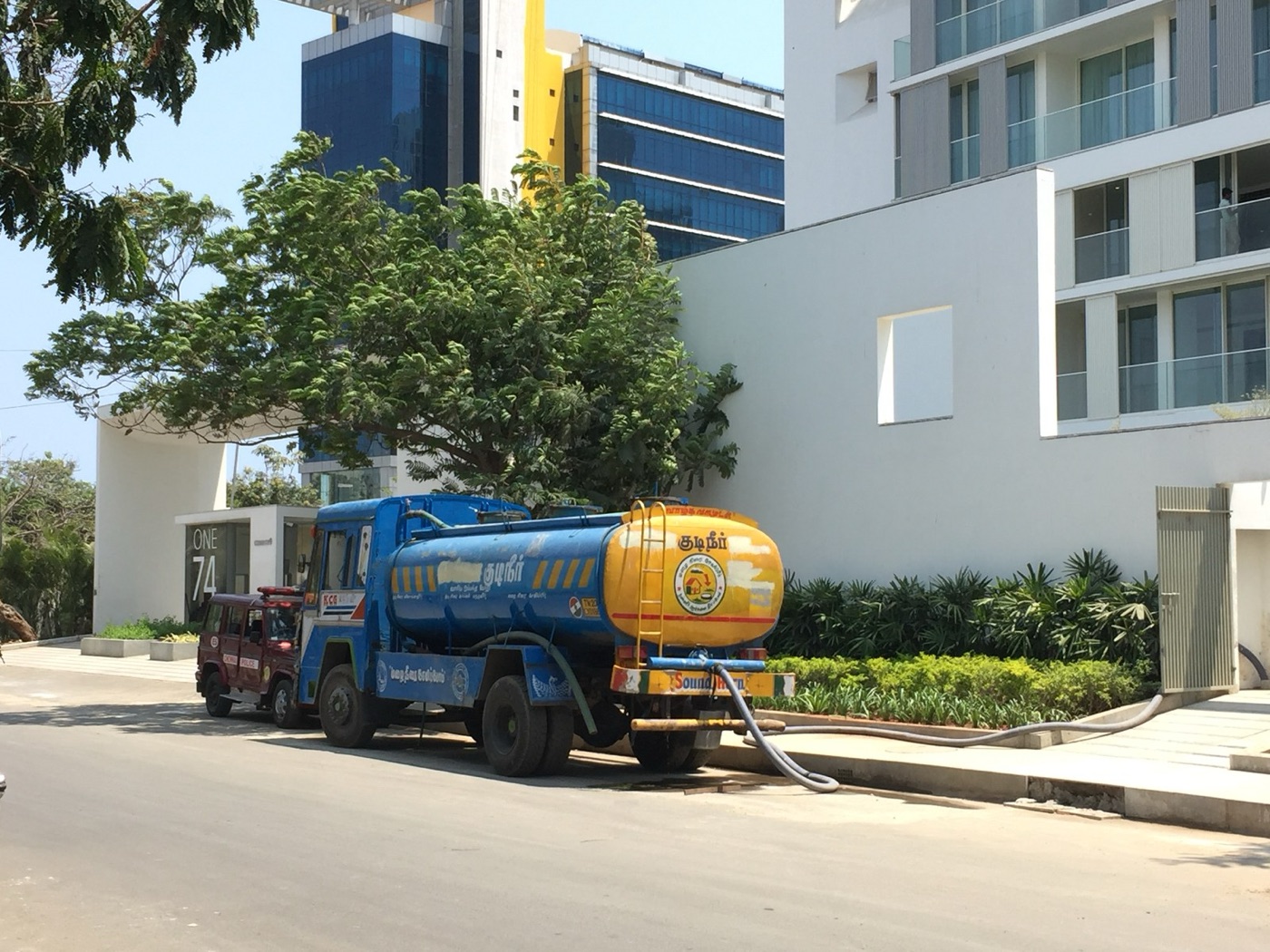
The tanker is Chennai's second water system, and it was there long before the crisis. Several thousand private tankers, most of them small lorries with a steel tank on the back, fill from farm wells in the villages ringing the city, where the farmers sell the water under their fields by the load, and they deliver to apartment blocks, hotels, hospitals and the households that can pay. In a normal year they supply a large share of the city's water, unmetered and unregulated, and in June 2019 they were the only supply for whole districts. The price of a load rose from a few hundred rupees to several thousand, the queues at the village wells ran to hours, and the villages, watching their own wells fall, began to block the lorries. The water board runs tankers of its own, free, to the neighbourhoods that cannot pay, and they are booked online and arrive, in a crisis, days late. The tanker economy is the part of Chennai's water that the reservoirs and the desalination plants do not show, and it is the reason a dry year is a rise in prices rather than a tap running dry.
The barrels on the roof
The most interesting thing about Chennai's water is the thing that made the recovery possible, and it dates from a previous drought.
In 2003, after two dry years, the government of Tamil Nadu made rainwater harvesting compulsory on every building in the state, existing as well as new, with a deadline of a few months and the threat of disconnection for buildings that did not comply. The structures are simple: gutters and pipes that carry roof runoff to a recharge pit or a well, so that the monsoon soaks into the ground beneath the building instead of running off to the sea. Within a couple of years a large share of the city's buildings had them, and studies of the aquifer in the years that followed found the water table under the city several metres higher, and the water less salty, than it had been before the rule.
The pits do nothing in a drought. They work in the monsoon, and what they did in the winter of 2019 was to turn a heavy rain into a recharged aquifer faster than the city had any right to expect. Chennai's borewells, dry in June, had water by the following spring. The rule is the largest rainwater harvesting programme in the world, it cost the state almost nothing, and it is the piece of Chennai's water that other monsoon cities have copied most.
| Chennai's answers | |
|---|---|
| Rainwater harvesting, compulsory since 2003 | Recharges the aquifer in the monsoon; the largest programme of its kind |
| Desalination, Minjur 2010 and Nemmeli 2013 | 100 million litres a day each, a fifth of supply in 2019 |
| Desalination, under construction | 150 million litres a day at Nemmeli, 400 at Perur |
| Treated sewage for industry | Reclaimed water piped to the industrial estates |
| Lake restoration | Desilting and fencing the remaining tanks |
| Water trains, 2019 | The emergency, not the plan |
The plants
The other piece of the plan is the sea. Chennai built two seawater reverse osmosis plants on the coast north and south of the city, at Minjur in 2010 and Nemmeli in 2013, each of 100 million litres a day, and through the summer of 2019 they were the only source in the city that did not depend on rain, supplying about a fifth of what the city received. A third plant, of 150 million litres a day, has since been added at Nemmeli, and a fourth, of 400, is under construction at Perur to the south. When it is finished the city will be able to draw about a third of its normal demand from the sea, at the cost in energy and brine that the desalination article describes. The plants are the insurance against the monsoon failing three years in a row again, which, in a warming Bay of Bengal, it will.
The city has also begun, late, to do what Singapore and Windhoek did decades ago: to treat its sewage to a standard where industry can use it, and to pipe the reclaimed water to the industrial estates that were, in 2019, buying tankers of groundwater at any price.
What it teaches
Chennai is the picture of a city that had enough water and threw its storage away. The rain that flooded it in 2015 and the rain that failed it in 2019 were the same rain, and the lakes and marshes and aquifer that would have held one and released the other had been built over and pumped out. The rainwater rule of 2003 was the first attempt to rebuild the storage, one roof at a time, and it worked. The desalination plants are the second, and they are the more expensive kind of storage, the kind a city buys when it has spent the free kind.
Every monsoon city in Asia is somewhere on the same road. Chennai's lesson is that the road has a turn in it, and that the turn is a rule about roofs.
Sources
- Chennai Metropolitan Water Supply and Sewerage Board (Metro Water): reservoir levels June 2019, supply figures, and the Minjur and Nemmeli desalination plants.
- Government of Tamil Nadu, Ordinance and Municipal Laws (Second Amendment) Act 2003, making rainwater harvesting compulsory in all buildings.
- Indian Railways and reporting by The Hindu and Reuters, June and July 2019: water trains from Jolarpettai, 50 wagons of 50,000 litres each.
- NITI Aayog (2018). Composite Water Management Index, naming Chennai among the cities expected to run out of groundwater.
- Care Earth Trust and Anna University studies on the loss of Chennai's wetlands, including the Pallikaranai marsh.
- Photographs: opener: East Chembarambakkam Lake SE Aerial Jul25 A7CR 06036 by Timothy A. Gonsalves (CC BY-SA) via Wikimedia Commons; inline: Private Water Tanker in Chennai (15 March 2017) by InformationForHumans (CC BY-SA) via Wikimedia Commons; inline: Aerial view of Chennai during floods - 2 by Veethika (CC BY-SA) via Wikimedia Commons.