Thirsty Places: Orange County
The largest water reuse plant in the world sits in a suburb of Los Angeles and turns the sewage of two and a half million people into drinking water, by way of the ground. How Orange County got there, what the plant does, why the sea was the reason it was built, and what it learned from the city next door that failed.
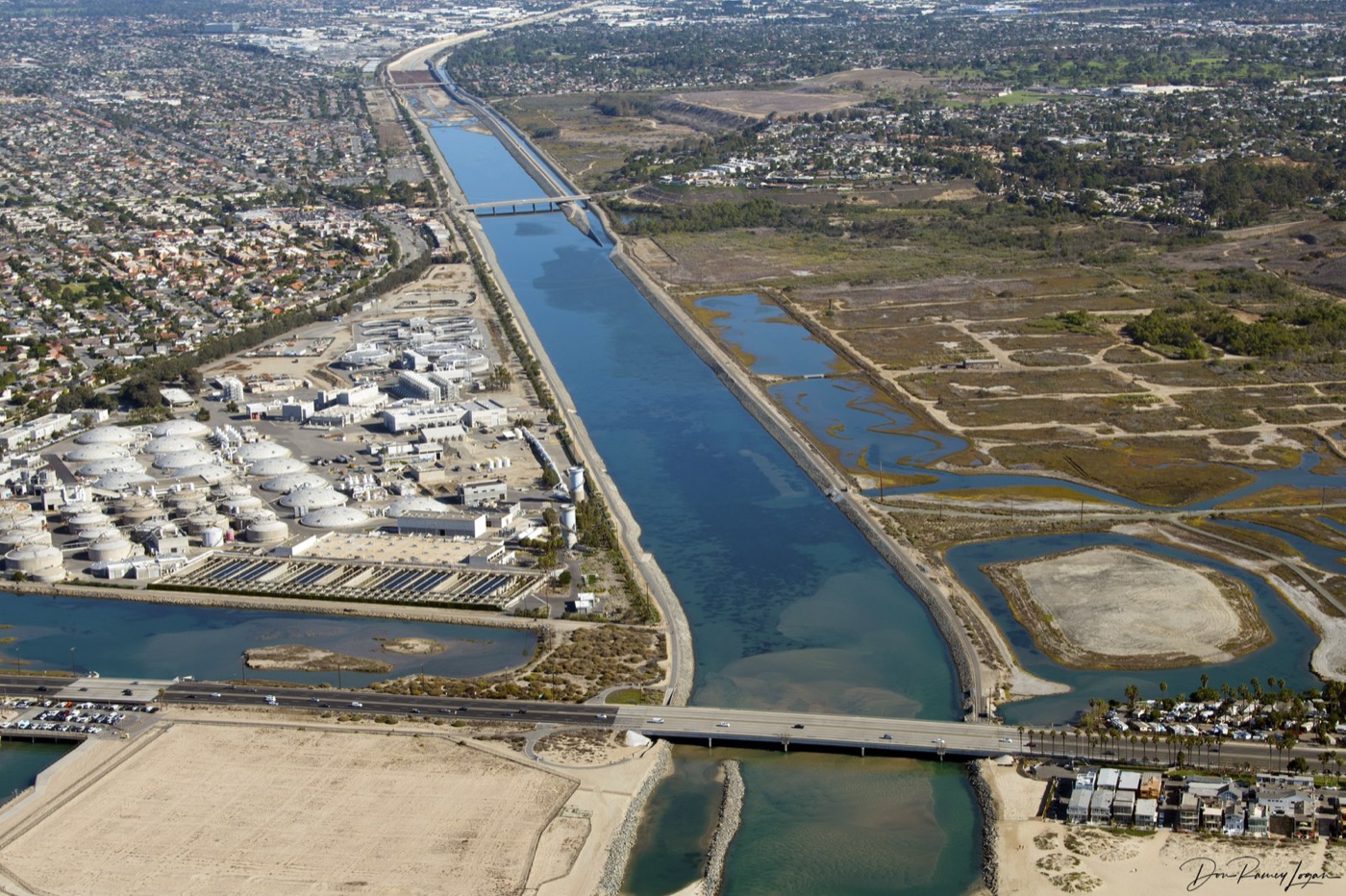
Drive south from Los Angeles on the freeway and Orange County is an unbroken plain of suburbs, freeways and the occasional oil pump, between the mountains and the Pacific, with two and a half million people living on it. There is no river worth the name. There is a rainy season of a few weeks. And under the plain there is a large aquifer, a basin of sand and gravel that the county has drunk from for a century and that, by the 1970s, was being pumped so hard that the sea was moving into it.
The largest water reuse plant in the world was built to solve that problem, and it now supplies a million people with water that was, the day before, the county's sewage. This article is about how Orange County got there, and why the city next door did not.
The sea in the wells
An aquifer on a coast is held in place by pressure. Fresh water in the sand pushes seaward, seawater pushes landward, and the boundary between them sits somewhere under the beach as long as the fresh water is pumped no faster than the rain refills it. Pump faster, and the boundary moves inland. Orange County's wells, drawing on the basin for orchards and then for suburbs, pulled the water table below sea level in the 1950s, and by the 1960s seawater was found in wells several kilometres from the coast, ruining them.
The county's water district tried the obvious answer first, which was to inject fresh water into a line of wells along the coast, to hold up a wall of pressure that the sea could not cross. The fresh water was imported from the Colorado River and northern California, and it was expensive. In 1976 the district built Water Factory 21, a plant that took the effluent of the county's sewage works, treated it with reverse osmosis, one of the first large uses of the membranes described elsewhere on this site, and injected it into the barrier instead. It worked, it held the sea, and it taught the district two things: that reverse osmosis could turn sewage into water cleaner than the aquifer's, and that the county's people did not mind, because the water went into the ground.
The plant
The Groundwater Replenishment System, which replaced Water Factory 21 in 2008, is that idea at a scale nobody had attempted. It stands beside the county's main sewage works in Fountain Valley, takes the works' treated effluent, which would otherwise go to the sea through an outfall, and passes it through three stages.
| Stage | What it does |
|---|---|
| Microfiltration | Hollow fibre membranes hold back bacteria, protozoa and suspended solids |
| Reverse osmosis | Tight membranes hold back salts, viruses, pharmaceuticals and nearly all dissolved organics |
| Ultraviolet light with hydrogen peroxide | Breaks down any small organic molecule that passed the membranes, and disinfects |
| Stabilisation | Lime restores the minerals the membranes removed |
The chain is the NEWater chain of the Singapore article, with one addition: the peroxide, which under ultraviolet light forms radicals that destroy the few small molecules, industrial solvents among them, that reverse osmosis lets through. The product water is purer than anything in the aquifer, and it is not sent to a tap. About a third is pumped into the seawater barrier along the coast, doing Water Factory 21's job. The rest is piped twenty kilometres inland to a set of shallow basins in the city of Anaheim, where it is spread over the sand and left to soak down through it into the aquifer, over weeks, from which the county's wells draw it out months later, along with the rain and the river water that recharge the basin, and treat it once more at ordinary drinking water plants before it reaches a house.
| The Groundwater Replenishment System | |
|---|---|
| Opened | 2008, at 70 million gallons a day |
| Expanded | 2015 to 100, 2023 to 130 million gallons a day, about 490,000 cubic metres |
| Supplies | About a million people, through the aquifer |
| Where the water goes | A third to the seawater barrier, two thirds to recharge basins in Anaheim |
| Time underground | Months, before it is pumped |
The buffer, on purpose
The Windhoek article on this site described direct potable reuse, where reclaimed water goes straight to the mains, and called the reservoir or the aquifer that other cities put in between an environmental buffer, serving a real purpose and a psychological one. Orange County is the model of the indirect kind, and its engineers are candid that the aquifer serves both.
The real purpose is a margin. Water that spends months in sand is filtered again, its temperature and chemistry evened out, and any failure at the plant has months in which to be caught before the water reaches a well. The psychological purpose is the one that decided the project. The county's residents had accepted, since 1976, that treated sewage went into the ground and held back the sea. Water that came out of the ground was, to them, groundwater, whatever had been put in. The district built its public case on that, and it built it slowly.
San Diego, and the three words
The reason the case was built slowly is a hundred kilometres south. In the 1990s the city of San Diego designed a reuse project technically similar to Orange County's, treating sewage effluent to a high standard and adding it to a drinking water reservoir. It was sound, it was needed, and it was killed. A campaign against it coined the phrase toilet to tap, the newspapers ran it, a candidate for mayor ran on it, and the city council abandoned the plan in 1999. The engineers had answers for every question about safety and none for the phrase.
Orange County's water district watched, and spent the next decade doing what San Diego had not. It ran more than a thousand briefings, to city councils, churches, schools, environmental groups and the county's newspapers, before a shovel went into the ground. It named the project for the groundwater it replenished rather than for the water it started from. It built a visitor centre and ran tours. It published its monitoring. It let the public see the membranes. By the time the plant opened in 2008 there was no campaign against it, because there was nobody left in the county who had not been told, in detail, what it was. San Diego, meanwhile, returned to reuse a decade later, with a programme called Pure Water that will, by the 2030s, supply nearly half the city's water, and it began that programme with outreach rather than engineering.
| Two cities, one plant | |
|---|---|
| San Diego, 1990s | Designed first, explained afterwards; killed by three words in 1999 |
| Orange County, 2008 | Explained for a decade, then built; no opposition at opening |
| San Diego, 2019 onwards | Pure Water, begun with outreach; under construction |
The river that could not be relied on
The county's imported water deserves a paragraph, because it is the reason the reuse plant was worth building at its scale. Southern California has drawn on the Colorado River since the 1930s, through an aqueduct across the desert, under an allocation agreed among seven states in a wet decade a century ago. The river has not delivered that allocation for most of this century. The reservoirs behind the Hoover and Glen Canyon dams fell to record lows in the drought of the 2020s, the states were ordered to cut their draw, and the water that Orange County had once imported cheaply became the water it could least count on. A plant that turns the county's own sewage into a supply is a plant whose feed grows with the county and does not depend on snow in the Rockies, and in a region where every other source is shared with someone else, that independence is the plant's real product.
What it costs, and what it saved
The reclaimed water costs more than the water the county used to import from the Colorado River, and less than desalinating the sea, and, since the Colorado's allocations have been cut in every drought of the last two decades, it is the only one of the three whose supply the county controls. The effluent that feeds the plant used to go to the ocean; now it goes to the aquifer, and the ocean outfall runs at a fraction of its old flow. The sea has not moved inland since 1976. And a county of two and a half million people on a coastal plain with no river has, for the first time in its history, a water supply that grows with its population, because the supply is the population.
The number on the bottle
Visitors to the plant are given a bottle of the product water at the end of the tour, and its label carries the plant's monitoring results, which is the district's way of saying what Singapore says with its visitor centre: look. The water is tested for hundreds of compounds at concentrations far below any drinking water standard, the results are published, and the district has spent twenty years answering, in public, the question that every reuse plant is asked, which is what happens to the pharmaceuticals, the hormones and the industrial chemicals in a city's sewage. The answer is the reverse osmosis stage, which removes nearly all of them, and the ultraviolet and peroxide stage, which was added for the few that pass. The bottle is the argument, and the district has found that people who have drunk from it stop asking.
What it teaches
Orange County is the case the world's utilities cite when they build indirect reuse, as Windhoek is the case for direct, and Singapore for the public conversation. The lesson from the county is the buffer: that an aquifer between the plant and the tap buys a real margin of safety and a psychological one, and that a utility which starts by putting water into the ground has a decade of public trust to build on before it proposes anything else. And the lesson from the county line is the campaign. The plant that works in Orange County and the plant that died in San Diego were the same plant. One of them was explained first.
Sources
- Orange County Water District, Groundwater Replenishment System: history, treatment process, the 2008 opening at 70 million gallons a day, expansions in 2015 to 100 and in 2023 to 130 million gallons a day.
- Orange County Water District, Water Factory 21 (1976), the seawater intrusion barrier and its reverse osmosis pilot.
- US National Research Council (2012). Water Reuse: Potential for Expanding the Nation's Water Supply. Orange County as the leading indirect potable reuse case.
- Reporting on San Diego's 1990s repurified water project and its cancellation after the toilet to tap campaign, and on Pure Water San Diego, under construction since 2019.
- Photographs: opener, Huntington Beach Pier at sunset by TeKappa (CC BY-SA) via Wikimedia Commons; inline: Santa Ana River Channel by Don Ramey Logan by Don Ramey Logan (CC BY) via Wikimedia Commons; inline: Santa Ana River Mouth2 by Basar (CC BY-SA) via Wikimedia Commons.