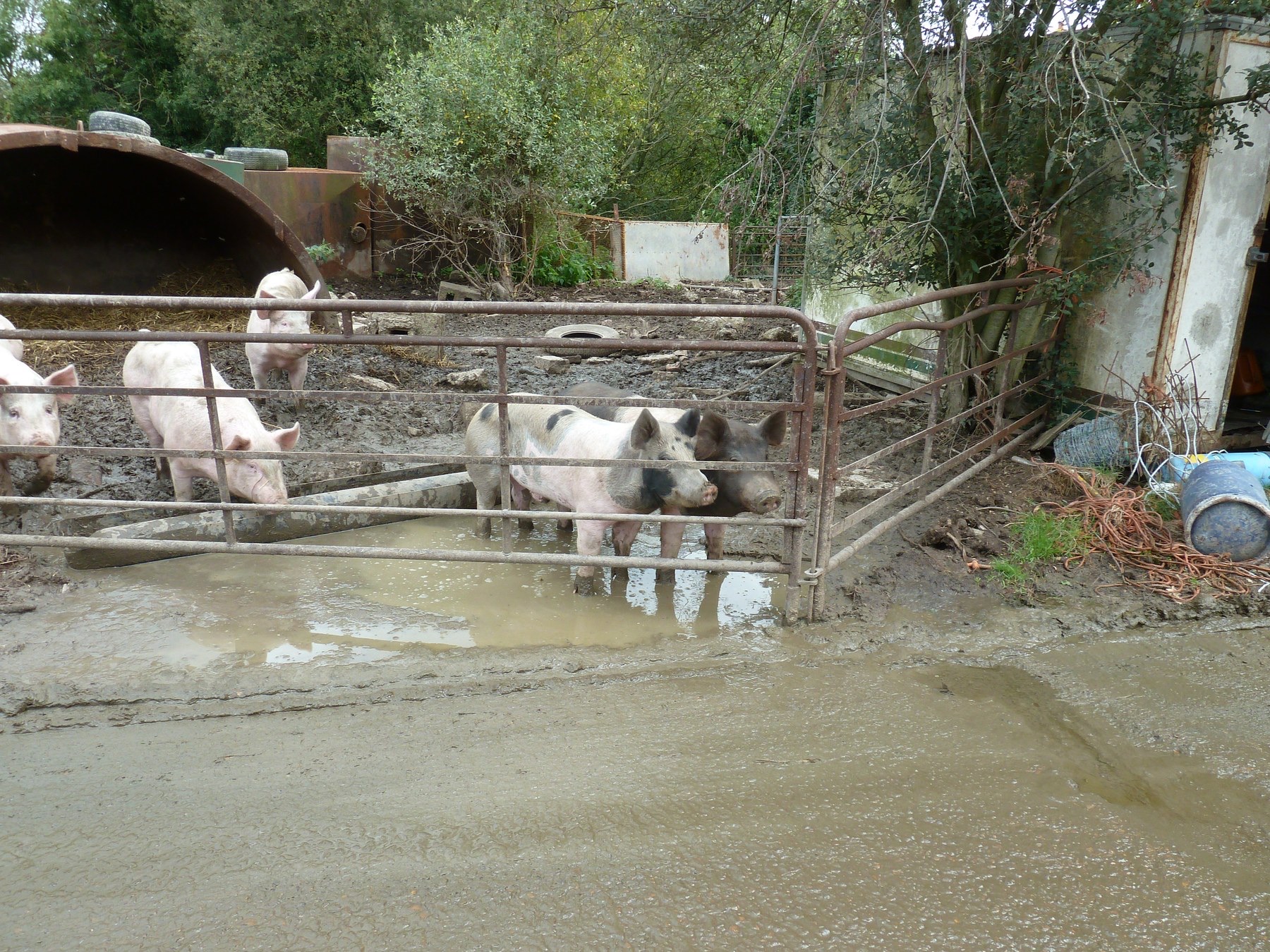
Thirsty: Pork
Half the pigs on Earth live in China, most of the rest in Europe and the Americas, and nearly all of them eat grain. A kilogram of pork carries about six thousand litres of water, between chicken and beef, and the part of it that the neighbours notice is the lagoon behind the barn. What a pig's water is made of, why the number sits where it does, and what a million pigs do to a river.
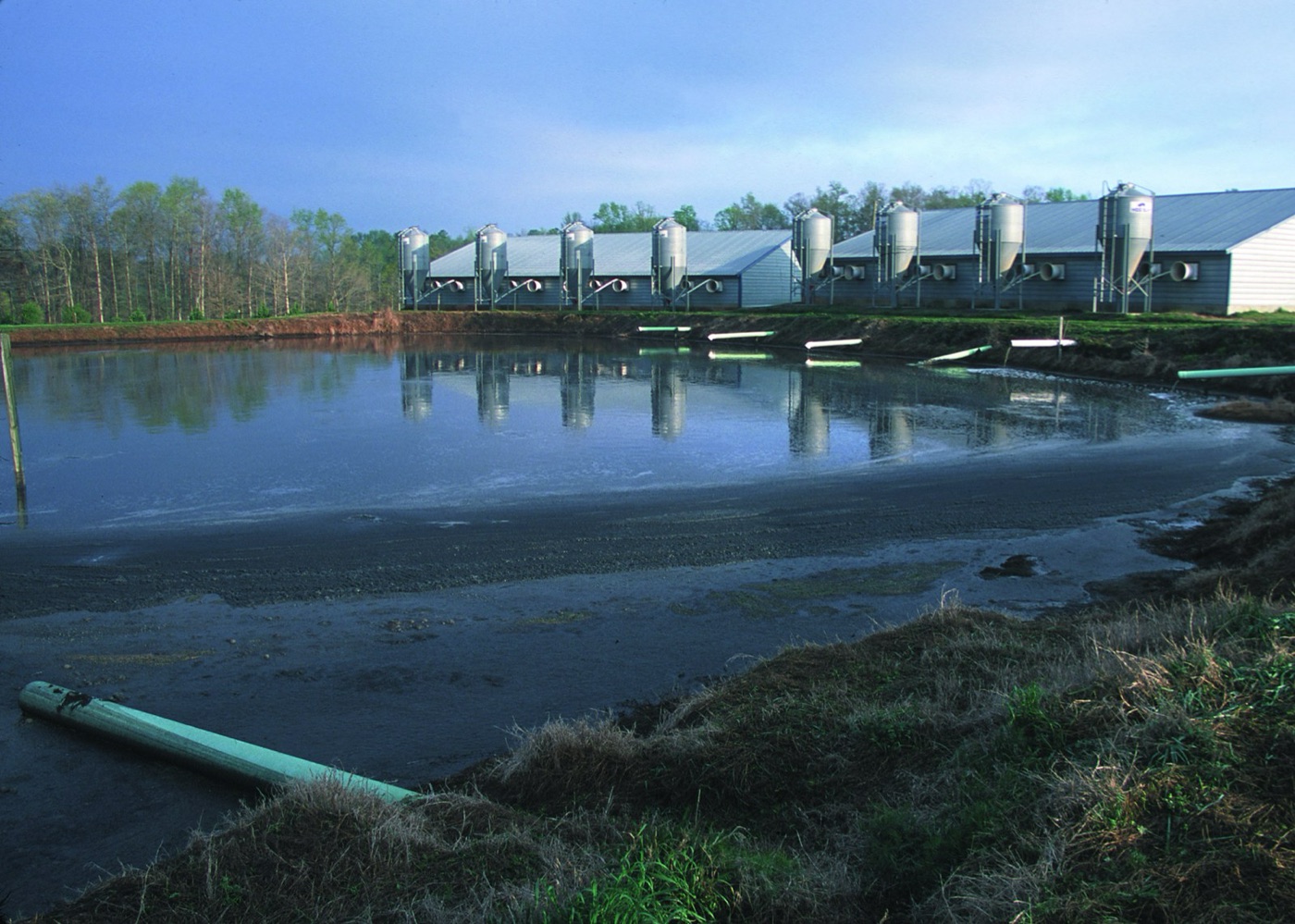
A pig farm in eastern North Carolina is a row of long, low, metal sheds beside a rectangular pond that is pink. The pink is bacteria, growing in the slurry of several thousand pigs, and the pond is a lagoon, the standard way of storing pig manure in the largest pork producing region of the United States. From the air the county is dotted with them. From the ground the smell reaches for a kilometre. And in the water footprint of a kilogram of pork, the lagoon appears as a few hundred litres of grey water, folded into a number that is mostly rain on a field of maize.
This article is about that number, about six thousand litres a kilogram, why it sits between chicken and beef, and about the part of it that the neighbours notice.
The world's other meat
Pork was, until chicken overtook it around 2020, the most eaten meat on Earth, and it still is in the country that eats most of it. China raises about half the pigs in the world, some four hundred million at any time, and eats nearly all of them. The European Union, the United States and Brazil raise most of the rest. It is a meat of the temperate grain belts, because a pig eats what a person eats, and it is raised where the grain is or where it can be shipped.
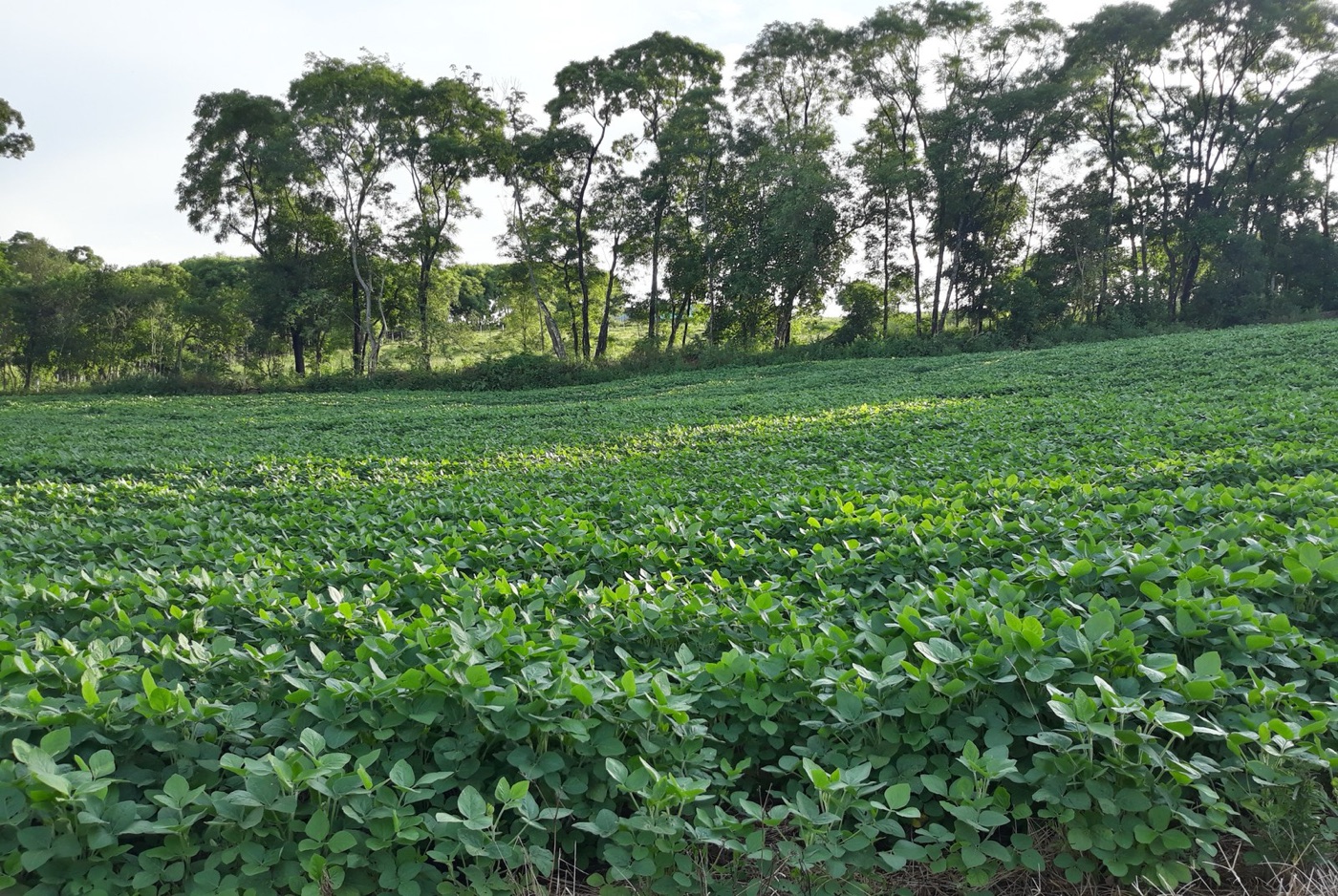
The modern pig is bred, like the chicken, to grow fast on formulated feed. A piglet weaned at a few weeks reaches a slaughter weight of around 120 kilograms in about six months, and it eats about three kilograms of feed for every kilogram it gains, which is roughly twice the chicken's ratio and half the cow's. The feed is maize, wheat or barley for energy and soy meal for protein, and in China, increasingly, imported soy and maize from the Americas.
| Water in a kilogram of pork, global average | Litres |
|---|---|
| Green water, rain on the feed crops | About 4,900 |
| Blue water, irrigation and what the pigs drink and are washed with | About 460 |
| Grey water, diluting the fertiliser and the manure | About 620 |
| Total | About 5,988 |
The shape is the same as every animal product on this site. The feed is where the water is. The animal's own drinking, about five to ten litres a day for a growing pig, and the water used to wash the sheds, add up to a few hundred litres per kilogram of meat, which is real and local and a small share.
Between chicken and beef
The order of the meats is the order of feed conversion. A chicken turns 1.7 kilograms of feed into a kilogram of bird, a pig needs 3, and a beef animal 6 to 10, and the water follows. Pork carries about 40 percent more water than chicken and about 40 percent as much as beef.
| Water per kilogram, global averages | Litres |
|---|---|
| Chicken | About 4,300 |
| Pork | About 6,000 |
| Beef | About 15,400 |
| Wheat, for comparison | About 1,800 |
Two things about pork's place in that table are worth saying. The first is that, unlike the cow, the pig eats nothing that a person could not, so the whole of its footprint is grain that was fed to an animal rather than to a person, and the argument that rescues rain fed beef does not apply. The second is that the pig is a remarkable converter of waste. For most of history pigs ate what households threw away, and in parts of Asia and Europe they still do, and a pig fed on food waste has a footprint near zero, because the water in the waste was spent whether the pig ate it or not. The industrial pig eats grain because grain is cheap, uniform and safe, and food waste is none of those, and the swine fever outbreaks of the last decade have made feeding waste illegal in much of the world.
Where the water was spent
Pork's map is the map of grain. An American pig eats Iowa maize and Illinois soy, grown mostly on rain. A Danish or Dutch pig eats European wheat and barley and imported Brazilian soy. A Chinese pig, and there are more of those than any other, eats a ration whose maize is increasingly Chinese and whose soy is overwhelmingly imported, from Brazil and the United States, so that the water in Chinese pork is, to a surprising degree, rain that fell on the Cerrado and the Midwest. China imports around a hundred million tonnes of soybeans a year, most of it for pigs, and it is the largest single flow of virtual water on the planet, described in the article on the water you cannot see.
The blue share is small everywhere, and largest where the grain is irrigated: the maize of the North China Plain, grown on the falling aquifer the myth article describes, and the maize of the American High Plains, grown on the Ogallala.
The lagoon
The reason pork belongs in this series on its own, rather than as a line in the beef article, is what comes out of the pig.
A growing pig produces about a tonne of manure over its life, as a liquid slurry, and a shed of several thousand pigs produces a river of it. On a traditional farm the slurry went onto the farm's own fields, in quantities the fields could absorb. On a modern one the sheds hold tens of thousands of pigs on a few hectares, the slurry is flushed into an open lagoon where bacteria break some of it down, and the liquid is sprayed onto nearby fields as fertiliser. The nitrogen and phosphorus in it, described in their own articles, are far more than the fields can use, and the surplus reaches the rivers and the groundwater.
In eastern North Carolina, which holds about nine million pigs in a handful of counties, the lagoons number in the thousands, and when hurricanes flooded the region in 1999 and again in 2018, dozens of them overflowed or breached and sent their contents into the rivers. In Brittany, the densest pig region of France, nitrate from slurry has fed blooms of green seaweed on the beaches for thirty years, thick enough to have killed animals and, in a few cases, people, through the hydrogen sulphide it releases as it rots. In the Netherlands, the pig herd has been cut by government buyout because the country cannot dispose of the manure within its nitrogen limits. And in China, where the pig herd was consolidated into enormous farms after the swine fever of 2018, the manure of a single farm of a million pigs is a wastewater problem on the scale of a city's, and the country has built treatment plants for pigs that would not be out of place in the sewage articles on this site.
| Pig manure, and where it goes | |
|---|---|
| Per pig, over its life | About a tonne of slurry |
| Storage | Open lagoons, or covered tanks in Europe |
| Use | Sprayed on fields as fertiliser |
| The problem | More nutrient than the nearby fields can take |
| What it does | Nitrate in wells, algae in rivers and on beaches, ammonia in the air |
| The answers | Fewer pigs per hectare, covered storage, anaerobic digesters, treatment plants |
The footprint method puts all of this into the grey water column, as the volume needed to dilute the nutrient runoff to a safe level, and comes to about 600 litres per kilogram. It is an honest attempt to count it. It does not convey what a lagoon looks like from the next farm.
The water the pig drinks
The blue water in the table, about 460 litres a kilogram, is worth a closer look, because it is the part spent at the farm. A growing pig drinks five to ten litres a day, and a sow with a litter twenty or more, from nipple drinkers that waste a share onto the floor. The sheds are washed between batches with high pressure hoses, at several hundred litres a pen, and in hot climates the pigs are cooled with sprinklers or wet pads, which in a Spanish or Brazilian summer can double the farm's draw. Add the irrigation on the share of the feed that was not rain fed, and the blue water of pork is a few hundred litres, drawn from a well or a mains connection in the district where the sheds stand. It is a small fraction of the footprint and, in a dense pig region on a dry plateau, Aragon, say, or Castilla y León, where a third of Spain's pigs are raised on some of the country's scarcest groundwater, it is the fraction that the regional water authority argues about.
What the industry has done
The better producers have done what the better producers in every industry on this site have done, which is to close the loop. Covered lagoons and tanks capture the methane from the slurry and burn it for power, the anaerobic digestion described in the sludge article, and the Danish and Dutch pig industries now run a large share of their manure through digesters. The digested slurry is separated into a liquid that goes to the fields and a solid that is dried and exported to regions short of phosphorus. Sheds are cleaned with less water and the slurry is kept more concentrated, which makes it cheaper to treat. And in the densest regions the herd has been capped, by nitrogen law in the Netherlands, by moratorium in North Carolina, where no new lagoon has been permitted since 1997.
None of this changes the six thousand litres, which are in the feed. It changes the six hundred that are in the lagoon, and the six hundred are the ones that matter to the river.
What the number says
Pork is the middle meat, in water as in most things: twice the footprint of the grain that fed it and less than half of beef's, spent mostly as rain on maize and soy fields, a share of which grew on the far side of the world from the pig. The choice between pork and chicken saves a third of the water; the choice between pork and beef saves more than half. And the part of the number that is smallest, the manure, is the part that can be seen from the road, which is a pattern this site has met before and will meet again.
5,988 litres, and a pink pond behind the barn.
Sources
- Mekonnen, M.M. and Hoekstra, A.Y. (2012). A global assessment of the water footprint of farm animal products. Ecosystems 15. Pig meat 5,988 litres per kilogram, global average.
- FAO, FAOSTAT: world pig numbers and pork production by country; China's share of the global herd.
- USDA and the Pork Checkoff, feed conversion in modern pig production, about 2.5 to 3.
- North Carolina Department of Environmental Quality and reporting on the 1999 Hurricane Floyd lagoon failures and the 2018 Hurricane Florence breaches.
- European Environment Agency and the French Ministry of Ecology on nitrate pollution and green algae in Brittany.
- Photographs: opener: Pig pen alongside footpath on Bower Farm - geograph.org.uk - 2591969 by Dave Spicer (CC BY-SA) via Wikimedia Commons; inline: Plantação de Soja em Novo Barreiro by Lucas Friederich (CC BY-SA) via Wikimedia Commons; inline: NRCSGA02035 - Georgia (1973)(NRCS Photo Gallery) by Photo by Jeff Vanuga, USDA Natural Resou (public domain) via Wikimedia Commons.