Thirsty: Rice
A flooded paddy looks as if the crop must grow underwater. It does not. Rice grows in moist soil, and the flooding is mostly weed control, a trick thousands of years old. The cost of the trick is that rice takes about a third of all the irrigation water on Earth, and the fix is already spreading through the fields.
A rice paddy in the growing season is a sheet of water with green shoots standing in it, and the sight has persuaded generations of visitors that rice is a water plant, something like a reed, that must grow submerged to grow at all. It is one of the most widespread misconceptions about any crop, and the truth behind it is more interesting than the picture.
Rice grows perfectly well in moist soil. The water is there for a different reason, and the reason is a farming trick so old and so effective that half the world eats because of it.
Twenty five hundred litres
By the Water Footprint Network's method, milled white rice comes to about 2,497 litres of water per kilogram in the global average, counting the rain the crop took up, the irrigation applied to it and the clean water it would take to dilute the pollution from the field.
| Staple | Litres per kilogram |
|---|---|
| Rice | 2,497 |
| Wheat | 1,827 |
| Potatoes | 287 |
Rice sits above wheat, and both sit far above the potato, which is a heavy, wet tuber that grows fast in a cool climate and carries very little water per kilogram. But the number that distinguishes rice from every other crop is the blue share rather than the total. No crop on Earth drinks more irrigation water than rice, and the reason is the paddy.
The flooding is not for thirst
Rice is a grass, like wheat, and like wheat it would grow in a field that was simply kept moist. What sets it apart is that it tolerates standing water. Most plants drown when their roots are submerged, because roots need oxygen and water excludes it. Rice has evolved air channels in its stems that carry oxygen down to the roots, so it can stand in water indefinitely.
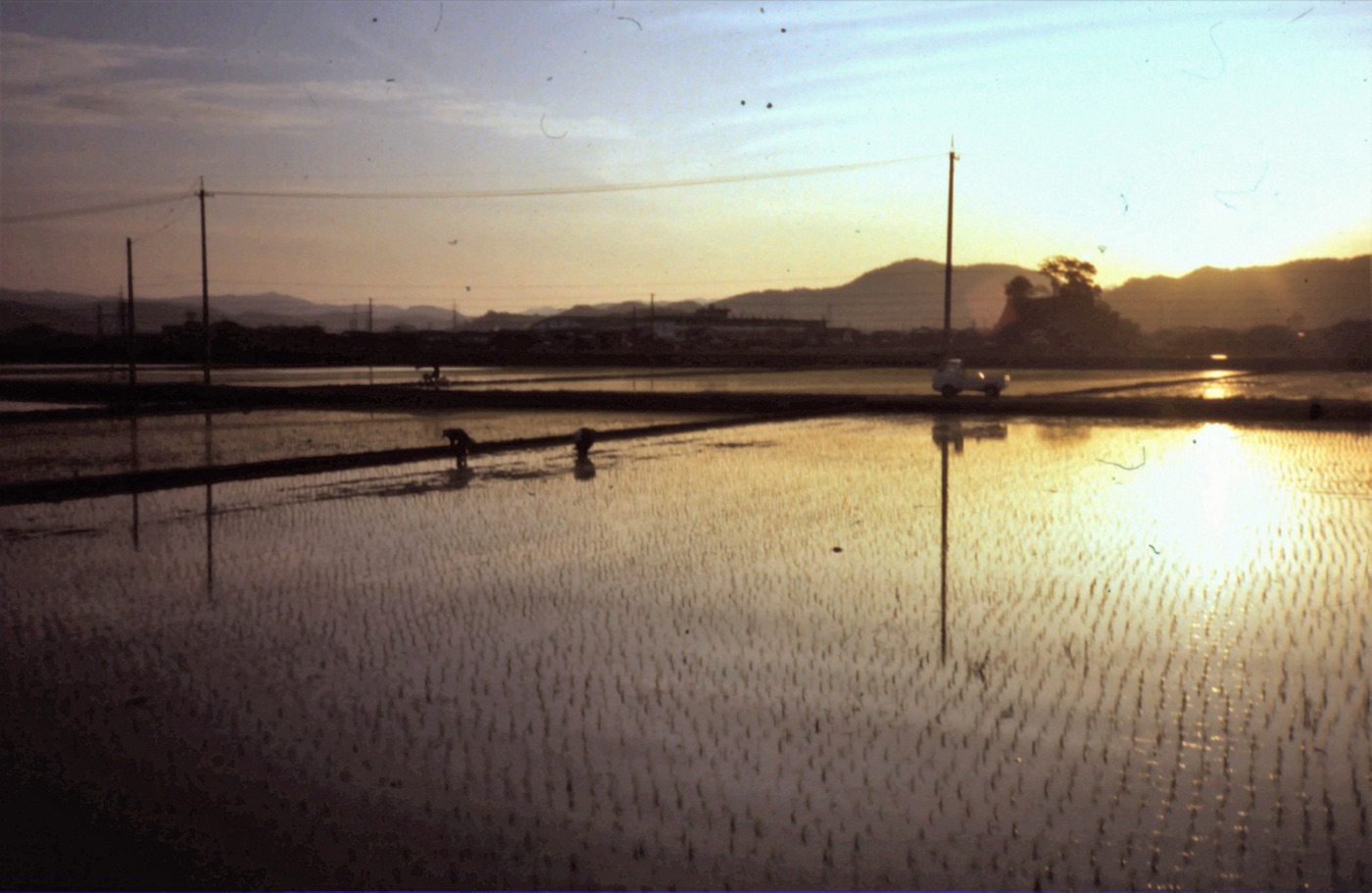
Weeds cannot. Flood a field to a depth of a few centimetres and most weeds drown while the rice stands, and a farmer has weed control for a season without a chemical or a hoe. Farmers in Asia worked this out thousands of years ago, and it is the reason the paddy exists. The flooding also suppresses pests, keeps the soil temperature steady, and makes nutrients more available. But the water is, for the most part, standing rather than being drunk. It sits there, doing a job, and evaporates while it does it.
| What the water in a paddy is doing | |
|---|---|
| Suppressing weeds | The main reason for flooding |
| Suppressing pests and disease | A second benefit |
| Keeping soil temperature and nutrients steady | A third |
| Being drunk by the rice | A smaller share than the picture suggests |
| Evaporating and seeping away | Most of what is lost |
How a paddy is built
A rice paddy is a piece of engineering, and the water in it is managed with more care than the picture of a flooded field suggests.
The field is levelled, because a few centimetres of difference in height means a few centimetres of difference in water depth, and bounded with low earth walls, the bunds, that hold the water in. Before planting it is puddled: flooded and worked with a plough or a rotavator until the soil becomes a fine, sealed mud that holds water and lets little through. The seedlings, raised in a nursery bed, are transplanted by hand or machine into the puddled mud, standing in a few centimetres of water. From then on the farmer's job is to keep the water at the right depth: a little deeper as the plants grow, drained before harvest so the field is firm enough to work.
Across a whole paddy the water is doing several things at once. Some is taken up by the rice, as any crop takes up water. Some evaporates from the open surface, which in a hot climate is a great deal. And some seeps through the floor and the bunds into the ground, which is where the accounting becomes interesting.
What the footprint counts, and what it does not
Rice is the crop where the difference between water used and water lost matters most, and the footprint method counts only part of it.
The method counts consumption: water that evaporated, or was transpired by the plant, or was built into the grain, and so left the local water cycle. It does not count water that seeped through the paddy floor into the aquifer below, because that water is still there and can be pumped again. In a river delta or a monsoon plain, a great deal of the water that floods a paddy goes exactly there, recharging the groundwater that the next field, or the next season, will draw on. A paddy in that setting is a leaky tank in a wet landscape, and its withdrawal from the river can be several times its real consumption.
That is why the figure of a third of the world's irrigation water needs its footnote. It is a third of what is withdrawn and put on fields, and a good part of that comes back. The share that is truly gone, evaporated from the surface and breathed out by the plant, is smaller, though still the largest of any crop. And in a dry region on a falling aquifer, the seepage is cold comfort: what seeps down was pumped up in the first place, and pumping it again costs energy the farmer pays for.
The cost of the trick
The cost of the trick is scale. Rice supplies a large share of the daily calories of about half the world's population, and nearly all of it is grown in flooded paddies across Asia. Add up the water standing in those fields, evaporating from their surfaces and seeping through their floors, and irrigated rice accounts for roughly a third of all the freshwater that people develop for irrigation on Earth. No other crop comes close.
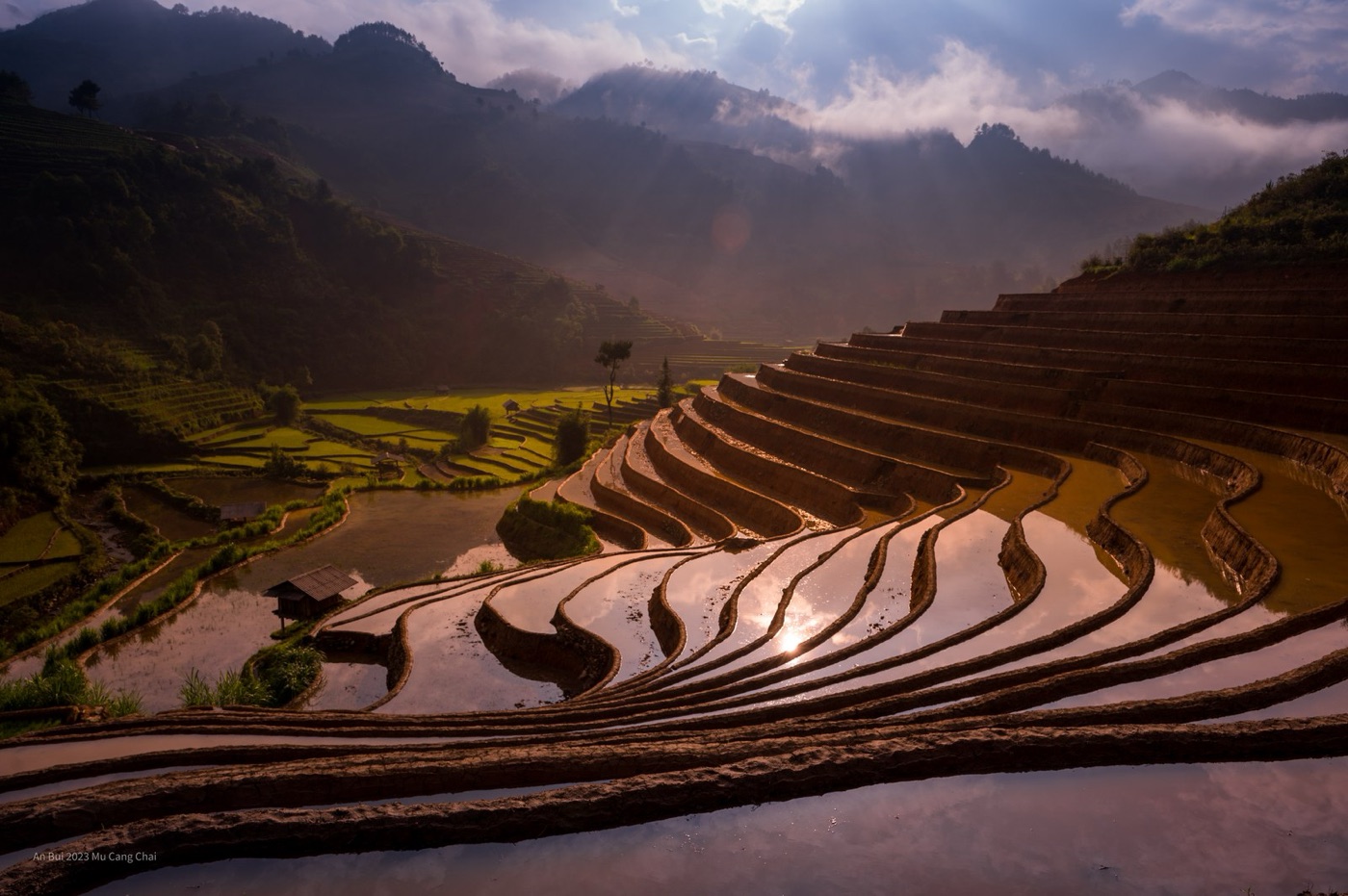
Much of that water is monsoon abundance rather than scarcity. A paddy in Bangladesh or the Mekong delta in the wet season is flooded by rain that had nowhere else to go, and counting it as a cost is honest but not alarming. The concern is the dry season crop, and the places where paddies are flooded from wells. In the Punjab of India and Pakistan, rice is grown in a dry climate on pumped groundwater, in the same falling aquifer that irrigates the region's wheat, and there a flooded paddy is water that a well no longer has.
There is a second cost that the water footprint does not count. A flooded paddy is an oxygen free environment, and the bacteria that live in one produce methane, which is why rice farming is one of agriculture's larger sources of that greenhouse gas. Draining a paddy, as it turns out, helps with both.
The fix is already in the fields
The most interesting thing about rice and water is that the largest single saving available anywhere in farming is low technology, well tested, and spreading.
It is called alternate wetting and drying, and it means exactly that. Instead of keeping the paddy flooded all season, the farmer lets the water drop until the soil surface dries and cracks slightly, usually by watching a simple perforated tube sunk in the field that shows the water level below the surface, and then floods it again. The rice does not mind. The weeds, which were the reason for the flooding, are already suppressed by the time the drying begins. Field trials across Asia by the International Rice Research Institute have found water savings of between 15 and 30 percent with no loss of yield, and methane emissions fall with the water.
| Alternate wetting and drying | |
|---|---|
| What changes | The paddy is allowed to dry for a few days before each flooding |
| Water saved | About a quarter, 15 to 30 percent in trials |
| Yield | Unchanged |
| Methane | Reduced |
| Equipment needed | A perforated tube in the field |
The method has a cost of its own, which is attention. A flooded paddy looks after itself for weeks at a time; a paddy that is wetted and dried has to be watched, and the tube in the field has to be read. Where farms are small and labour is short, that is a real barrier, and extension services across Asia have spent a decade teaching the method village by village.
The method needs a farmer who controls the water on and off their own field, which is not the case everywhere, and it needs pumping costs or water rules that make saving water worthwhile. Where those conditions hold, in Vietnam, the Philippines, Bangladesh and parts of China and India, it is being taken up on a large scale. It is one of the few places where a water problem the size of a continent has a fix that costs almost nothing.
Reading the number
Rice is not a crop to give up, and nobody who depends on it could. What the number shows is the difference between water a plant drinks and water a field uses, and rice is the crop where that difference is largest. The paddy is a tool, an ancient and elegant one, and the water in it is the price of the tool. The interesting news is that the price has turned out to be negotiable.
Sources
- Mekonnen, M.M. and Hoekstra, A.Y. (2011). The green, blue and grey water footprint of crops and derived crop products. Hydrology and Earth System Sciences 15. Milled rice about 2,497 L/kg, wheat about 1,827, potatoes about 287.
- International Rice Research Institute (IRRI). Rice supplies a large share of the calories of about half the world's population; irrigated rice accounts for roughly a third of the world's developed freshwater resources.
- IRRI, alternate wetting and drying: water savings of 15 to 30 percent with no yield loss in field trials across Asia.
- Photographs: rice by Lukasz Rawa, Unsplash; inline: Transplanting rice seedlings by hand into the flooded paddy after mechanical transplanting leaves gaps by Gpwitteveen (CC BY-SA) via Wikimedia Commons; inline: Vietnam rice terrace with water reflection by Vietnam Photo Tours | An Bui (CC BY) via Wikimedia Commons.