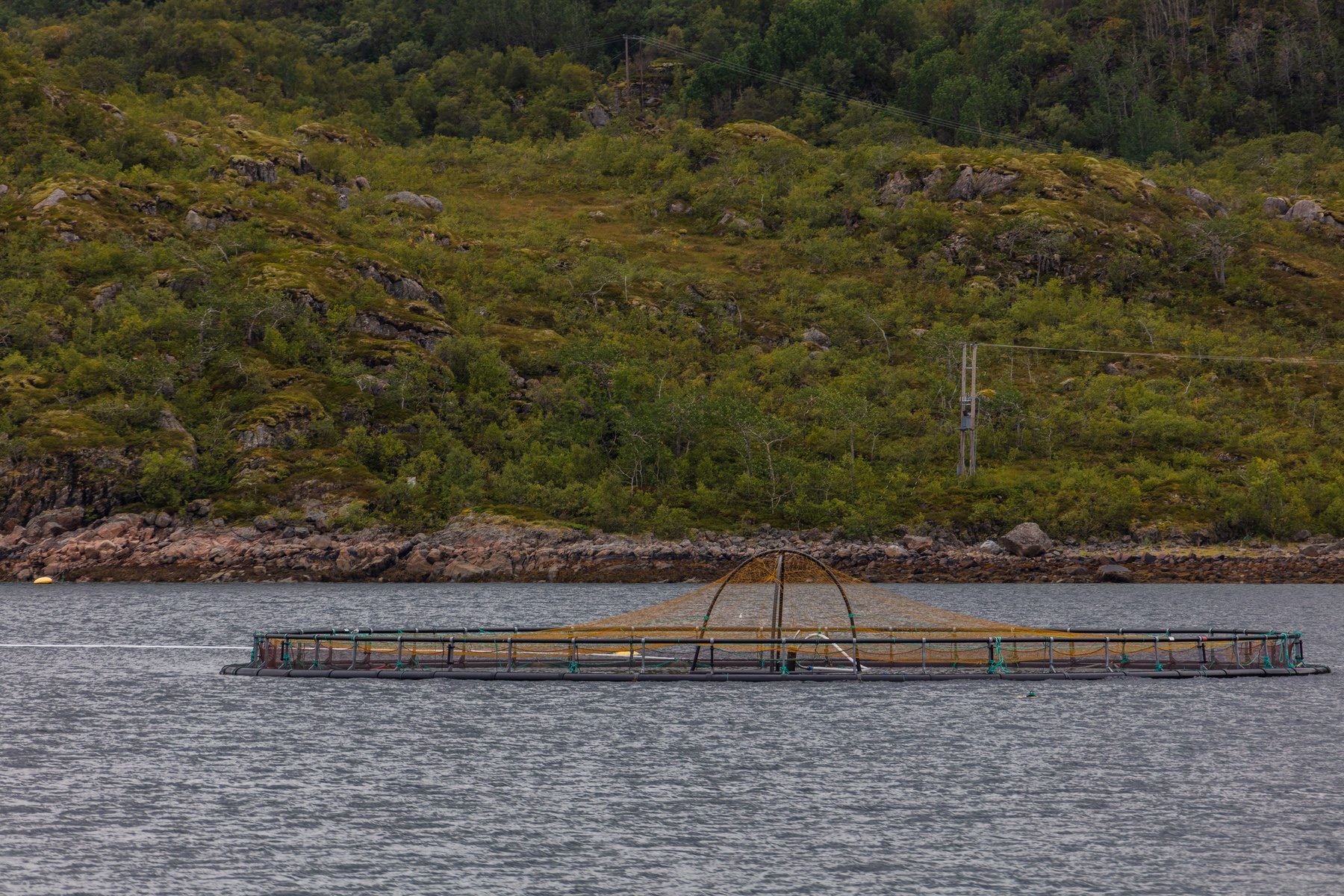
Thirsty: Salmon
A farmed salmon spends its first year in fresh water and its last two in the sea, and the water that matters is neither: it is the water in the soy, the wheat and the fishmeal it was fed. What a salmon farm does with water, why the number per kilogram is close to chicken's, what the sea cages leave on the seabed, why the industry is moving onto land, and what a fish that lives in water has to do with a soybean field in Brazil.
A salmon lives in water and its water footprint is on land. The fish in a cage in a Norwegian fjord swims in seawater that costs nothing and is used up by nobody, and the two thousand or so litres that the footprint method assigns to a kilogram of it are the rain and irrigation that grew the soy, the wheat and the rapeseed in its feed, on fields in Brazil, Europe and Canada that the fish has never seen. Salmon is the animal on this site whose water is furthest from the animal, and the reason it is here is that the distance is instructive.
This article is about what a salmon farm does with fresh water and sea water, where the footprint comes from, what the cages leave behind, and why an industry built on the sea is moving onto land, where the fresh water number will change.
The two lives of a farmed salmon
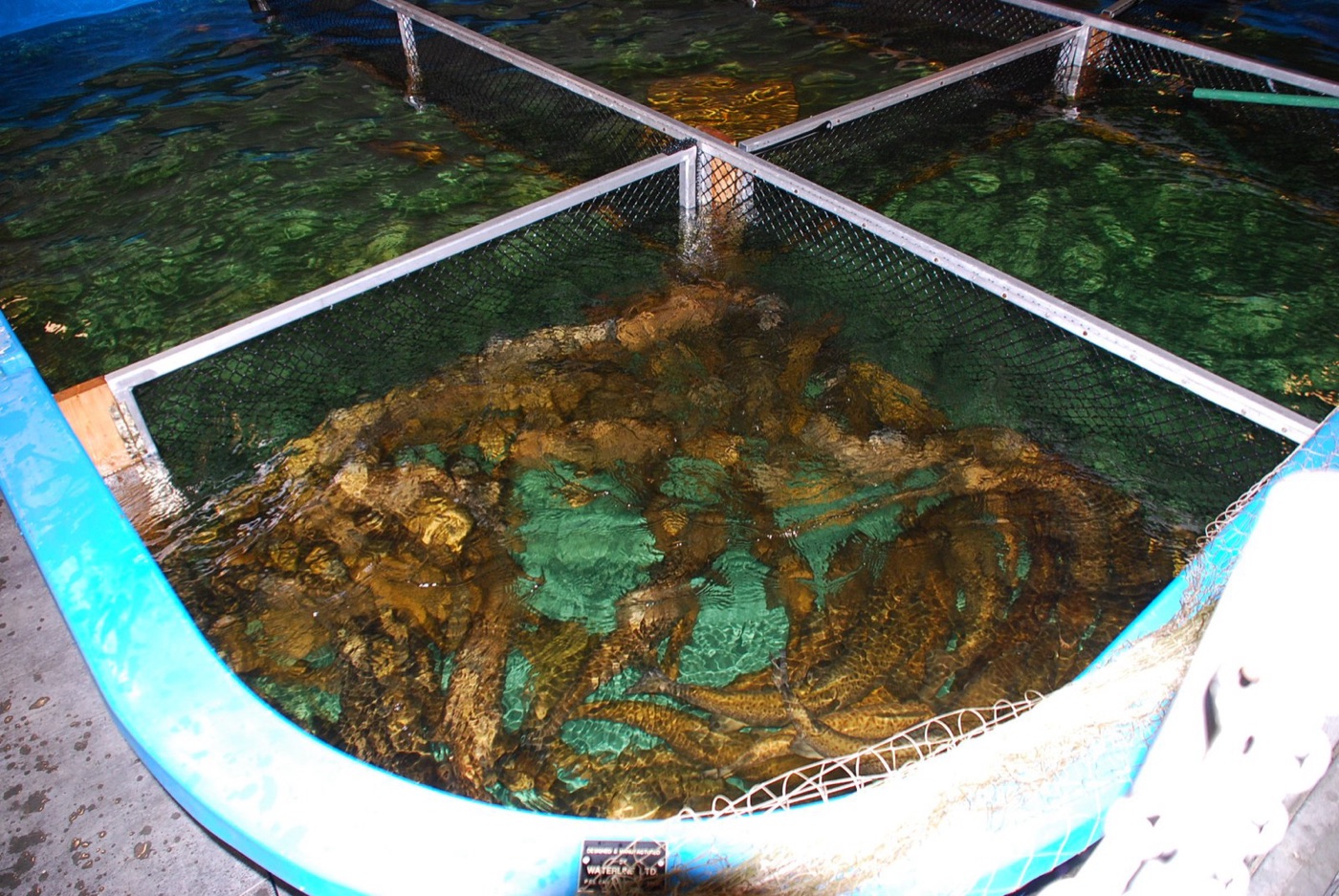
A farmed Atlantic salmon is hatched in fresh water and grown, in tanks at a hatchery fed from a river or a lake, to a smolt of about a hundred grams, which takes most of a year. Then it is put to sea, in a net cage in a sheltered fjord or sea loch, and grown for another year and a half or two to a fish of four or five kilograms. The fresh water phase is where the farm's own water is used: a hatchery of the older, flow through kind passes a river through its tanks, tens of thousands of litres for every kilogram of smolt, and returns it a little warmer and carrying the fish's waste; the newer recirculating hatcheries, which are most of the new ones in Norway, filter and reuse almost all of it and take in a few hundred litres per kilogram to make up what is lost.
At sea, the water is the fjord's, and the farm consumes none of it. What the cages do to the fjord is another question.
| A salmon's water | |
|---|---|
| Hatchery, flow through | Tens of thousands of litres per kilogram of smolt, returned to the river |
| Hatchery, recirculating | A few hundred litres per kilogram, made up for losses |
| Sea cages | Seawater, not consumed |
| Feed | About 1.2 kilograms of pellets per kilogram of fish; about 70 percent plant ingredients |
| Footprint of the feed | Roughly 1,500 to 2,500 litres per kilogram of salmon |
| For comparison | Chicken about 4,300; pork 6,000; beef 15,000 |
The feed
The salmon was, until the 1990s, fed on fish: meal and oil from anchovy, sardine and sand eel caught for the purpose, which had no freshwater footprint and a large one in the sea. As the industry grew past what the forage fisheries could supply, the pellet was reformulated, and a Norwegian salmon's feed is now about seventy percent plant: soy protein concentrate from Brazil, wheat and wheat gluten from Europe, rapeseed oil, sunflower and pea protein, with fishmeal and fish oil at a quarter or less. The plants carry the water of the crop articles on this site, and at a little over a kilogram of feed per kilogram of fish, which is the most efficient conversion of any farmed animal, the fish carries about two thousand litres, most of it rain on the soy fields of Mato Grosso and the wheat fields of the Baltic.
The soy is the part the industry is asked about, and it has answered with certification: the concentrate the Norwegian farms buy is, by their own accounting, from fields that were not forest after 2008. The water in it is green, and it is, as the sunflower article argues, rain that fell on farmland that could grow something else.
What the cages leave
The fjord is not consumed, and it is changed. A cage holding two hundred thousand fish drops feed and faeces onto the seabed below it, and the organic load under a farm is the BOD article's story in salt water: a patch of black, oxygen free sediment that recovers, when the cage is moved, over a year or two. The nitrogen and phosphorus that dissolve feed the algae of the fjord. Sea lice, a parasite that lives on wild salmon at low numbers, breed in the cages at densities the wild fish never offered, and the treatments, which have included hydrogen peroxide baths, pesticides in the feed and, latterly, warm water and lasers, go into the fjord with the fish. Escapes put farmed genes into wild rivers. The Norwegian regulator's traffic light system now limits the industry's growth, fjord by fjord, on the lice count, and the fjords where the farms are densest are red.
None of this is water use. All of it is what the water carries, which is the theme of every industry article on this site.
| What a salmon farm does to the sea | |
|---|---|
| Under the cage | Feed and faeces; black sediment; recovers in a year or two if fallowed |
| In the water | Nitrogen and phosphorus; lice treatments |
| Sea lice | Bred in the cages; the limit on the industry's growth in Norway |
| Escapes | Farmed fish in wild rivers |
| Consumed | None of the seawater |
Onto land
The industry's answer to lice, escapes and the limit on fjord sites is to leave the sea. Land based salmon farms, which grow the fish for its whole life in tanks in a building, have been built in Norway, Denmark, Florida, the American northeast and Japan since the late 2010s, and they promise no lice, no escapes, no seabed and a farm next to the market rather than at the end of a fjord. They also need water and power. A recirculating farm reuses more than ninety five percent of its water, and the few percent it takes in, fresh or salt, is multiplied by a fish that lives for three years in the building; a large plant takes in thousands of cubic metres a day and discharges a concentrated stream that needs the treatment the effluent articles describe. And the pumps, filters and chillers that keep the water moving and clean use electricity at a rate that makes the land based salmon's carbon footprint several times the fjord's.
It is the data centre trade again, and the semiconductor one: keep the water in the building and pay in electricity, or use the open water and pay in what it carries. The land based farms have, so far, struggled to make money, and the fjords still hold nearly all of the fish.
Chile
The second salmon country is Chile, which has no native salmon and grows a million tonnes a year in the fjords of Patagonia, and its story is the Norwegian one with weaker regulation. The industry arrived in the 1980s, grew faster than Norway's, and in 2007 was nearly destroyed by a virus that spread between cages placed too densely in fjords with too little current, killing most of the stock and putting tens of thousands out of work in a region that had no other industry. It rebuilt with rules borrowed from Norway, on spacing, fallowing and the movement of fish, and it has since had the largest algal bloom losses in the industry's history, in 2016, when warm water and the nutrients of the farms and the ocean together killed a fifth of the year's fish, which were dumped at sea. Chile uses more antibiotics per tonne of fish than any other salmon producer, by a wide margin, because the bacterial disease that Norway vaccinates against has no effective vaccine in Chilean waters, and the antibiotics go into the fjord with the feed. The fresh water at the hatcheries is drawn from the lakes of the Lake District, and the lakes carry the hatcheries' phosphorus.
The wild fish
The salmon in the cage is the descendant of the salmon in the river, and the river's fish are the reason the fjord is contested. Norway's wild salmon rivers, which draw anglers who pay a great deal, have lost half their runs since the 1980s, and the government's scientists attribute the largest share of the loss to the lice and the escapes of the farms the fish pass on their way to sea. In Scotland, on the west coast where the farms are, the wild runs have collapsed while the east coast's, with no farms, have held. In British Columbia the government has ordered the open cages out of the wild salmon's migration routes by 2029. The water the farmed fish is made of is on a soybean field; the water it lives in is the wild fish's, and that is where the industry's licence to operate is decided.
What it teaches
Salmon is the animal on this site that separates, most cleanly, the water an animal lives in from the water it is made of. The fjord is free and clean and full of lice; the footprint is on a soybean field a hemisphere away; and the farm's own fresh water is at the hatchery, where it is now recycled, and will be in the tank farms, where it will be recycled harder at a cost in power. The number is close to chicken's and it is honest. The fjord, which the number leaves out, is where the argument about salmon actually happens.
Two thousand litres a kilogram, none of it in the fjord, and most of it on a field the fish never saw.
Sources
- Pahlow, M. et al. (2015). Increasing pressure on freshwater resources due to terrestrial feed ingredients for aquaculture production. Science of the Total Environment 536. Water footprint of aquafeed crops; salmon feed around 1,500 to 2,500 litres per kilogram of fish.
- Norwegian Directorate of Fisheries and SalMar, Mowi annual reports: production about 1.5 million tonnes in Norway; feed conversion ratio about 1.1 to 1.3.
- Ytrestøyl, T., Aas, T.S. and Åsgård, T. (2015). Utilisation of feed resources in production of Atlantic salmon in Norway. Aquaculture 448. Feed composition: about 70 percent plant ingredients.
- Norwegian Institute of Marine Research, risk assessment of Norwegian fish farming: sea lice, escapes, and organic loading under cages.
- Badiola, M. et al. (2018). Energy use in recirculating aquaculture systems. Aquacultural Engineering 81. Water and energy use of land based salmon farms.
- Photographs: opener: Jaulas flotantes de salmón, Svolvær, Lofoten, Noruega, 2019-09-05, DD 54 by Diego Delso (CC BY-SA) via Wikimedia Commons; inline: Atlantic salmon at the Craig Brook National Fish Hatchery (23133898042) by US Fish and Wildlife Service (Public domain) via Wikimedia Commons; inline: Salmon fillet by BrokenSphere (CC BY-SA) via Wikimedia Commons.