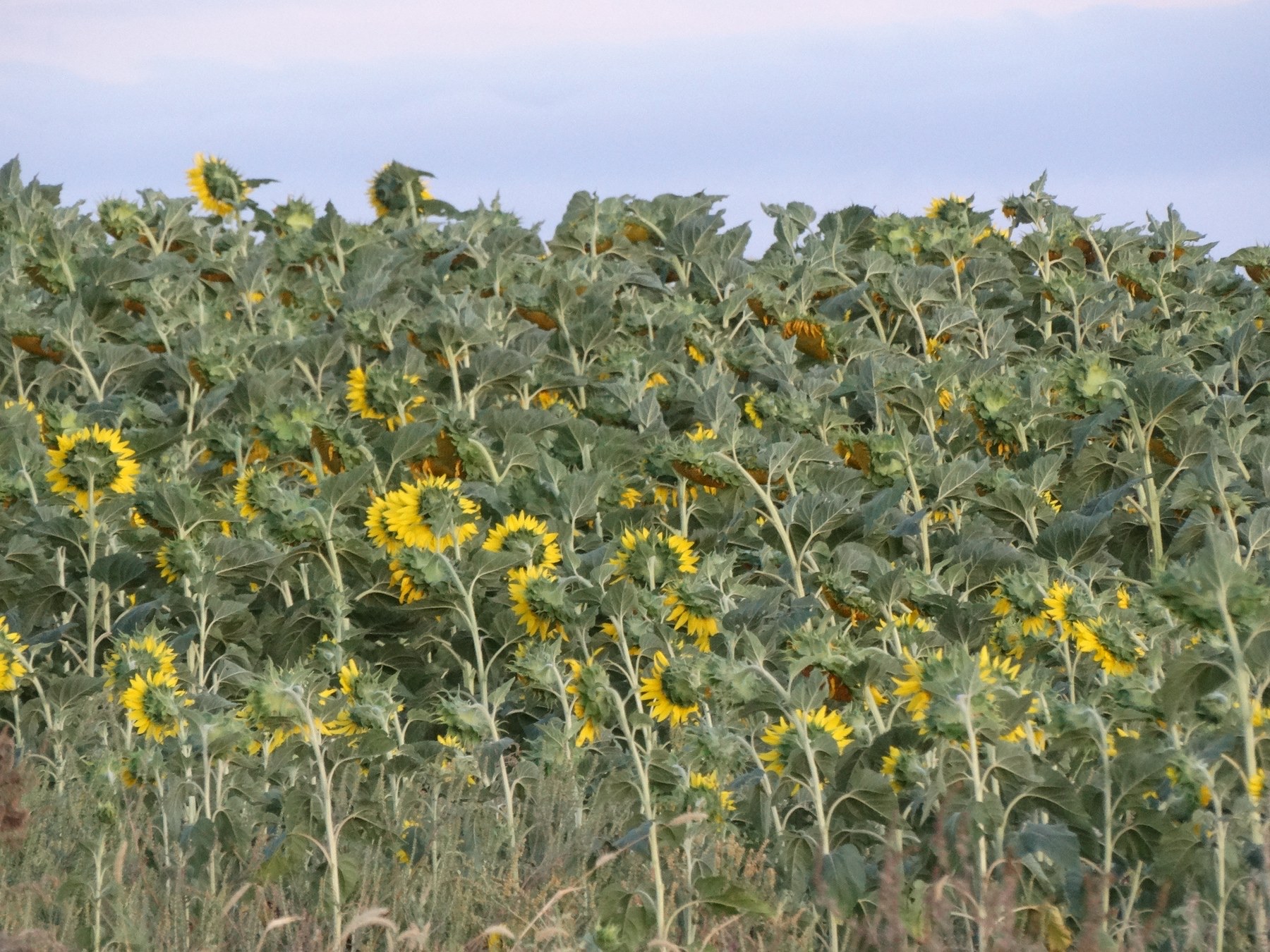
Thirsty: Sunflower Oil
A litre of sunflower oil carries about six thousand litres of water, most of it rain on the black earth of Ukraine and southern Russia, and the war of 2022 showed how much of the world's frying depends on it. Where a sunflower's water goes, why an oil crop carries so much more than the seed, how it compares with olive, rapeseed and palm, what the crushing plant does, and why the crop that follows the sun is one of the least irrigated on this site.
A litre of sunflower oil, on the arithmetic this site uses, carries about six and a half thousand litres of water, which is more than a kilogram of chicken and about the same as a kilogram of pork. It is a large number, and it is one of the least worrying on this site, for the reason the wool article gives: almost all of it is rain, and it fell on land that grows sunflowers because sunflowers are what grows there. The crop is the world's fourth vegetable oil, after palm, soy and rapeseed, and half of the traded supply came, until 2022, from two countries at war with each other.
This article is about where a sunflower's water goes, why an oil carries twice the water of its seed, how it compares with the other oils in the cupboard, what a crushing plant uses, and what a war showed about a crop whose water was never the constraint.
The crop
The sunflower is an American plant, domesticated on the plains of what is now the United States and taken to Europe in the sixteenth century as a curiosity, and it became a crop in Russia, where the Orthodox fast allowed its oil when it forbade most others, and where the black earth of the steppe and the hot dry summer suited it. Ukraine and southern Russia are still its heartland, growing about half of the world's seed between them, with Argentina, Romania, Bulgaria, Turkey, France and Hungary behind. It is a summer crop, sown in spring and harvested in September, and it is grown on rain: a tap root that reaches two metres down lets it draw on water stored in the soil from winter, and it will set seed in a summer that would fail a maize crop.
A hectare gives two to three tonnes of seed, and the seed is about forty five percent oil. The crushing plant recovers most of that and the cake that remains, high in protein, goes to animal feed, so that the water of the field is divided between the oil and the meal in proportion to their value, and the oil takes the larger share.
| Water per kilogram of oil, global averages | Litres | Where the water is |
|---|---|---|
| Rapeseed oil | About 4,300 | Rain, temperate Europe and Canada |
| Palm oil | About 5,000 | Rain, the wet tropics |
| Soybean oil | About 4,200 | Rain, the Americas |
| Sunflower oil | About 6,800 | Rain, the steppe and the dry south |
| Olive oil | About 14,500 | Rain and irrigation, the Mediterranean |
Where the water is
The sunflower's footprint is more than nine tenths green. The crop's need over a season is six hundred to a thousand millimetres, which the steppe's rain and stored soil moisture supply in an ordinary year, and the blue share, irrigation, is a few percent, mostly in the drier fields of Turkey, Spain and the American plains. The grey share, for the fertiliser and the pesticide that run off, is modest, because the sunflower is a lightly fertilised crop that follows a cereal in the rotation and uses what the cereal left. The number is large because the yield of oil per hectare is low compared with palm, which gives four times as much oil from the same land, and not because the plant is thirsty.
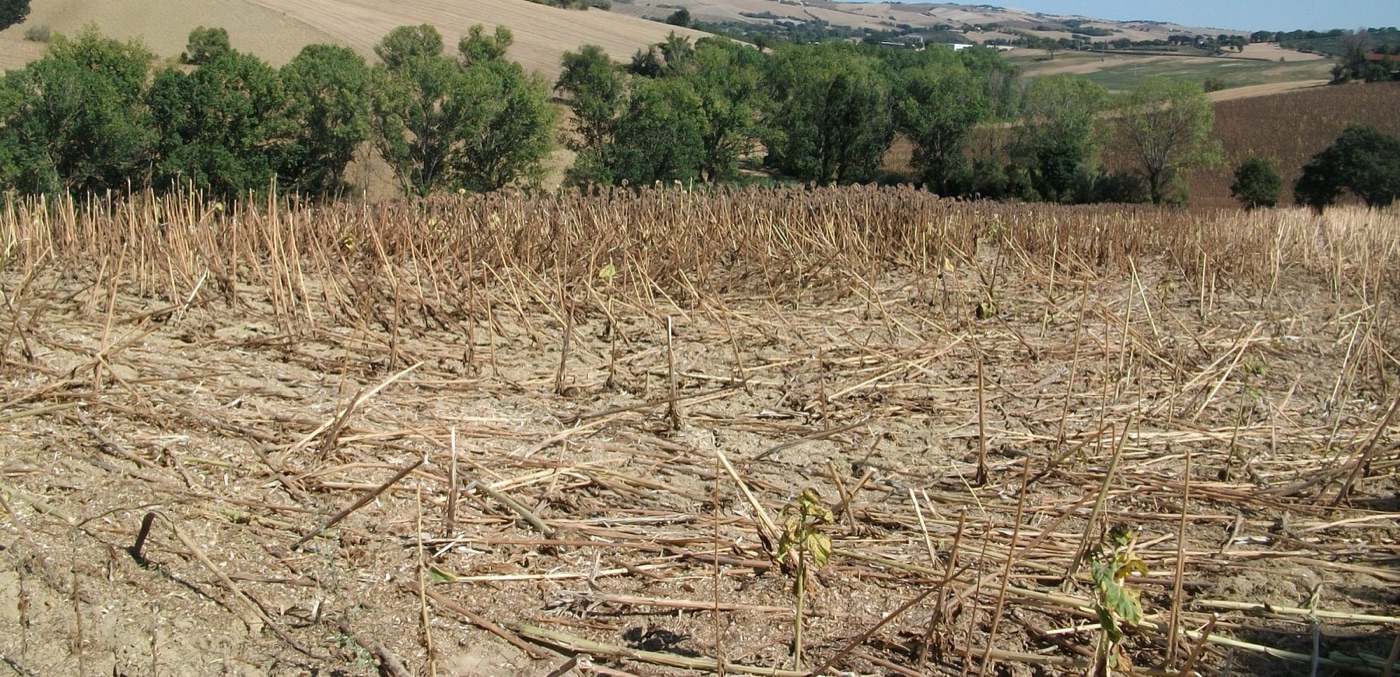
That is the argument the wool article makes and it applies here with one difference. The steppe is farmland, and the rain that grows sunflowers could grow wheat or maize instead, so the green water has an alternative use in a way that the rain on a Welsh hillside does not. The comparison that matters is with the other oils, and on that comparison the sunflower sits in the middle, using rain that falls on the driest of the oil growing regions and asking for almost nothing from a river.
| A kilogram of sunflower oil's water | Litres |
|---|---|
| Green, rain and soil moisture | About 6,200 |
| Blue, irrigation | About 250 |
| Grey, diluting fertiliser and pesticide | About 350 |
| Total | About 6,800 |
The crushing plant
The seed is dried, dehulled, flaked, cooked and pressed, and the cake left by the press is washed with a solvent, usually hexane, to take out the last of the oil, and the solvent is recovered and used again. The plant's water goes into the steam that cooks the flakes and strips the solvent, into cooling, and into the refining of the crude oil, which is washed with water and a little alkali to take out the free fatty acids and the gums, and then bleached and deodorised. It is a few cubic metres of water per tonne of oil, a small fraction of the field's, and the effluent carries the soapstock and the gums, which are sold, and a fatty, high oxygen demand stream that a treatment plant of the kind the food article describes handles without trouble. A crushing plant on the Black Sea coast at Odesa or Mykolaiv, where most of Ukraine's oil was made and shipped, is a modest water user in a country with rivers.
The war
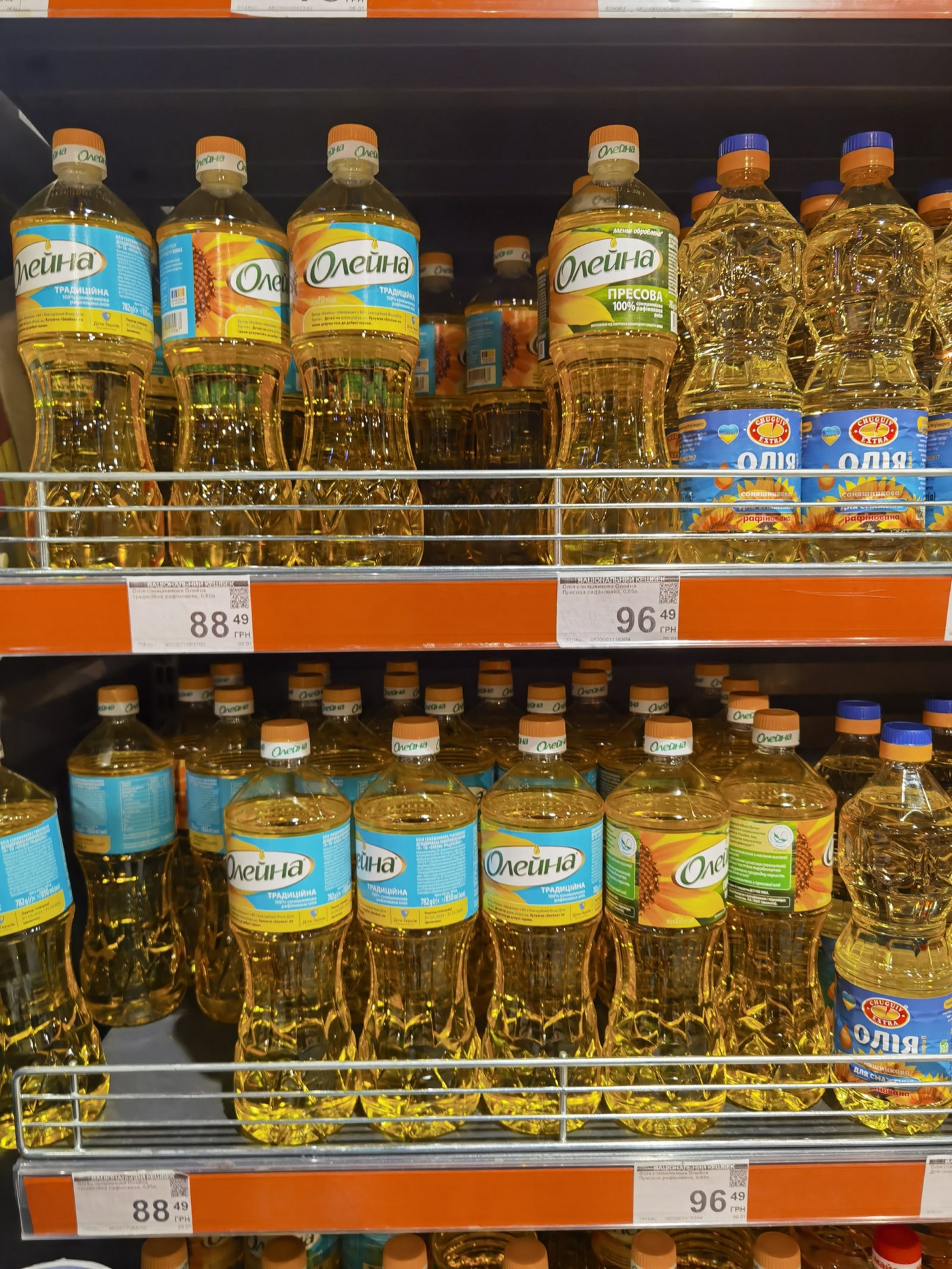
In February 2022 Ukraine and Russia between them supplied more than half of the sunflower oil traded in the world, most of it through the Ukrainian Black Sea ports, and within a month the ports were closed, the crushing plants near the front were shut, and the oil that Europe, India, Turkey and the Middle East fried with was on the wrong side of a blockade. Supermarkets in Britain and Spain limited customers to a bottle or two; India, the largest importer, switched to palm and soy; the price of every vegetable oil rose with it, because the oils substitute for each other in the fryer and the price of one is the price of all.
The water was never the question. The crop was in the ground, the rain had fallen, and the oil was in tanks at a port that ships could not leave. Exports resumed through a negotiated corridor in the summer, then by rail and river through Romania and Poland, and by 2023 Ukraine was shipping most of what it had grown, from a smaller area, with the mines and the front line having taken a share of the fields. The lesson for this site is one it makes elsewhere about virtual water: the water in traded food moves through ports, and a port is a narrower thing than a rain belt.
Sunflower against olive
The oil most often compared with sunflower in the European kitchen is olive, and the comparison runs the other way from the one the cook expects. Olive oil carries about twice the water per litre, and a larger share of it is blue, because the olive grows in the dry Mediterranean summer and the intensive groves of Spain, which make half the world's supply, are irrigated from rivers and aquifers that the Barcelona and Murray Darling articles show are already spoken for. A litre of Spanish olive oil in a dry year is a litre with a river in it. A litre of Ukrainian sunflower oil is a litre of rain on the steppe. The olive is the better oil by most measures a cook cares about; the sunflower is the better one by the measure this site keeps.
The field in a dry year
The sunflower's reputation for drought tolerance holds until it does not. The root finds the water the winter left in the soil, and in a summer with no rain at all the crop draws that store down and sets a smaller head with lighter seed, so that the yield falls by a third or a half and the water per kilogram of oil rises by the same. The droughts of 2012 and 2022 on the steppe did exactly that, and the growers in the drier parts of Spain, Turkey and Argentina who irrigate do so for the difference between a crop and a poor one, with a few hundred millimetres in July, which is the blue share in the table above. Sunflower is also the crop the steppe's farmers plant when the wheat has failed or the market has shifted, and the area swings by millions of hectares from year to year with the price, which is why the footprint, an average, describes no particular field. A wet year on the steppe gives oil at four thousand litres a kilogram; a dry one gives it at nine. The average in the tables, which is what a footprint is, lands between the two and describes neither.
What it teaches
Sunflower oil is the product on this site whose large number hides a small burden and whose supply broke for a reason that had nothing to do with water. The crop follows the sun across the driest farmland in Europe on rain and a deep root, its factory is a light water user, and its water is rarely anyone else's. The war showed the world how much of its frying depended on one coast, and the rain kept falling on the fields behind it.
6,800 litres a kilogram, nearly all of it rain on the steppe, and a port that mattered more than any of it.
Sources
- Mekonnen, M.M. and Hoekstra, A.Y. (2011). The green, blue and grey water footprint of crops and derived crop products. Sunflower seed about 3,366 litres per kilogram; sunflower oil about 6,792; rapeseed oil 4,301; olive oil 14,431; palm oil 4,971.
- FAOSTAT and USDA Foreign Agricultural Service, sunflower seed and oil production and trade: Ukraine and Russia over half of world exports before 2022.
- FAO, Crop water requirements: sunflower 600 to 1,000 millimetres over the season; deep rooting and drought tolerance.
- European Commission, Best Available Techniques for the food, drink and milk industries: oilseed crushing and solvent extraction, water use and effluent.
- Ukrainian Ministry of Agrarian Policy and UkrAgroConsult, sunflower area and yields 2021 to 2023.
- Photographs: opener: Sunflower field in Kosharka by Yakudza (CC BY-SA) via Wikimedia Commons; inline: Harvested sunflower field by CosyCobra (CC BY-SA) via Wikimedia Commons; inline: Sunflower oil bottles in Dnipro 2 by Alex Blokha (CC BY-SA) via Wikimedia Commons.