Thirsty: Tea
A cup of tea carries about 27 litres of water, a fifth of what a cup of coffee does, and almost all of it is monsoon rain on a hillside. Why tea is the gentler drink, what the leaf goes through between the bush and the bag, and why the countries that grow it are the countries where it rains.
The two hot drinks that most of the world starts its day with are made the same way, from a tropical shrub, dried and steeped in water, and they sit at opposite ends of this site's footprint table. A cup of coffee carries about 140 litres, as its article described. A cup of tea carries about 27. The two plants grow in similar places, on similar hillsides, in similar rain, and the difference between the numbers is a lesson in how a footprint is built, and in why the gentler drink is the gentler drink.
Twenty seven litres
By the Water Footprint Network's method, made tea comes to about 8,856 litres of water per kilogram in the global average, counting the rain the bush took up, the irrigation applied where there was any, and the clean water it would take to dilute the pollution from the estate and the factory. A cup uses two to three grams of tea, and three grams of 8,856 litres per kilogram is about 27 litres.
| Drink | Litres per kilogram of the dry product | Grams per cup | Litres per cup |
|---|---|---|---|
| Tea | About 8,900 | 2 to 3 | About 27 |
| Coffee | About 18,900 | About 7 | About 140 |
Two things make the difference. Tea is about half of coffee per kilogram, because a tea bush yields more usable leaf per hectare than a coffee tree yields beans, and because the leaf is picked several times a year rather than harvested once. And a cup of tea uses far less of the product: a teaspoon of leaf or a bag of two grams, against a scoop of seven grams of ground coffee. Half the footprint per kilogram, and a third of the weight per cup, gives a fifth of the water.
Where the leaf grows
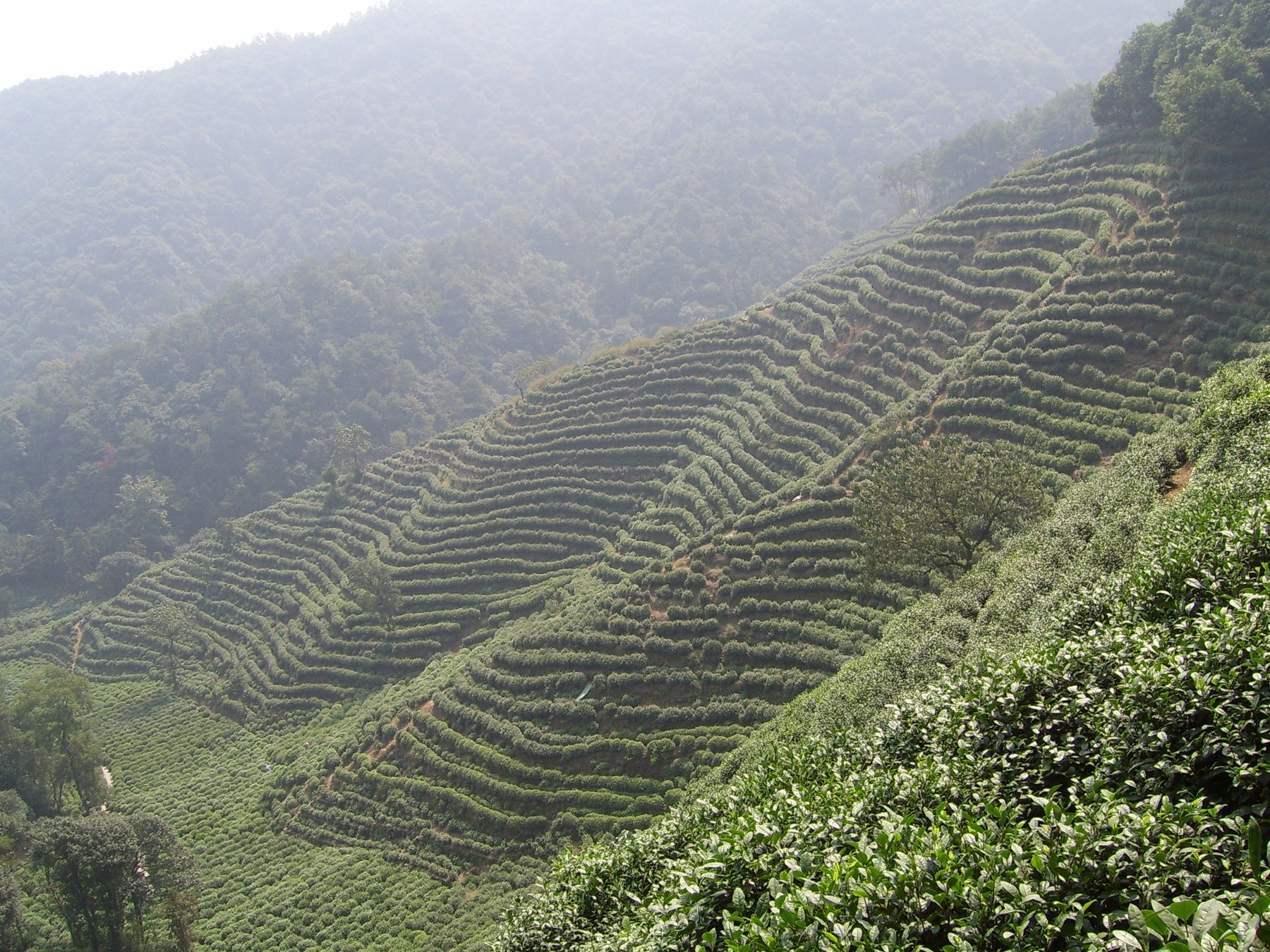
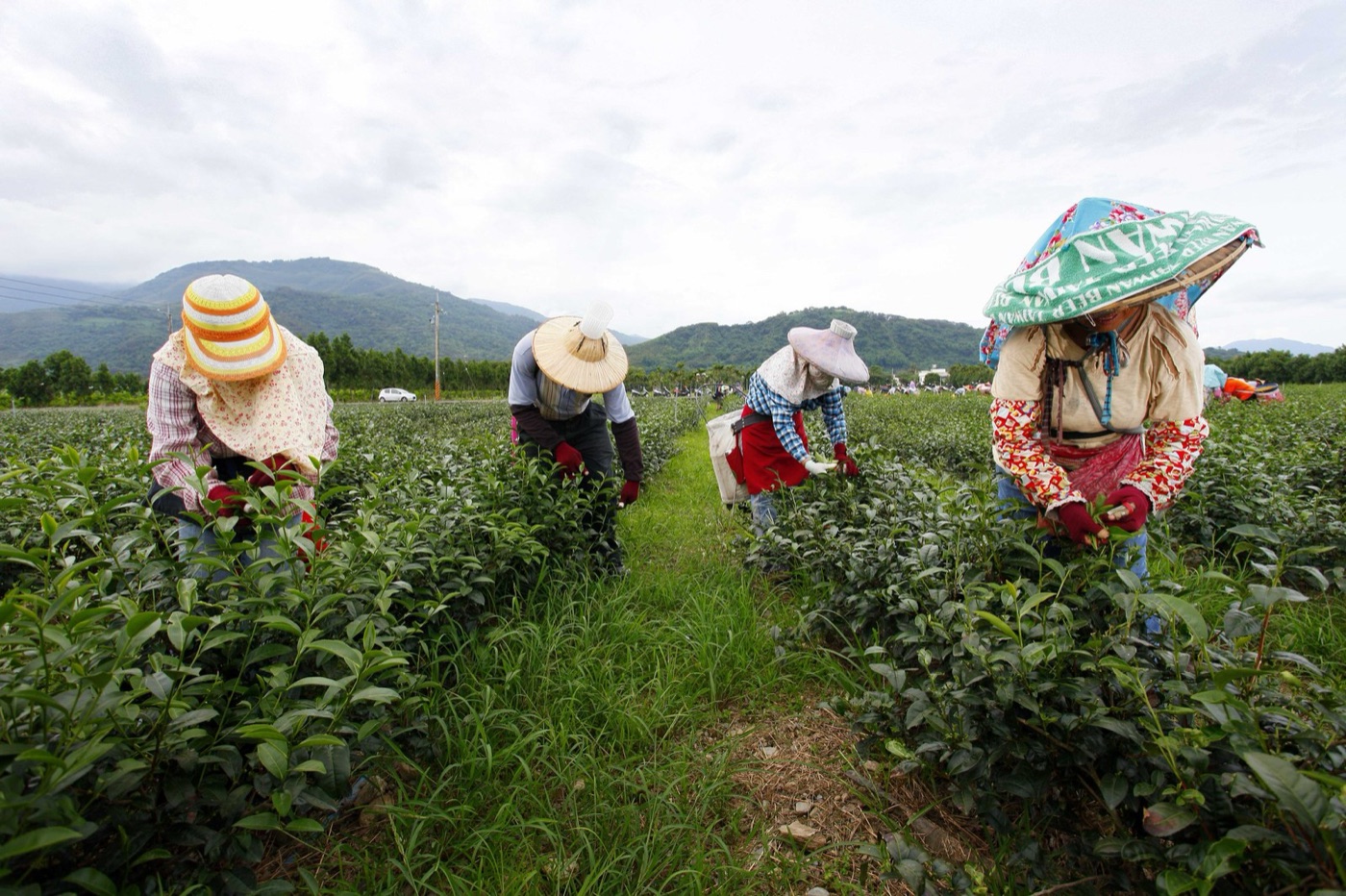
Tea is a camellia, an evergreen shrub kept pruned to waist height so that its young leaves can be picked by hand, and it grows in places with two things: warmth, and a great deal of rain. The great tea regions of the world are, without exception, wet.
Assam, in northeast India, receives some of the heaviest monsoon rain on Earth, on a floodplain along the Brahmaputra, and its estates are flooded in some years rather than dry. Darjeeling and the Nilgiris, in the hills, are cloud country. The highlands of Sri Lanka, the tea country around Kandy and Nuwara Eliya, are wet for most of the year. The highlands of Kenya, west of the Rift Valley around Kericho, receive rain nearly every afternoon and grow tea on smallholdings by the hundred thousand. The hills of Fujian, Yunnan and Zhejiang in southern China, where tea was first cultivated, are in the monsoon belt. Tea grows where it rains because that is the only place it grows well, and its footprint follows: the green share, rain that fell on the hillside and was taken up by the bush, is the great majority of the total, and irrigation is rare.
| Tea region | Country | The water |
|---|---|---|
| Assam and the Brahmaputra plain | India | Monsoon rain, and floods |
| Darjeeling, the Nilgiris | India | Hill and cloud rain |
| The central highlands | Sri Lanka | Highland rain most of the year |
| Kericho and the western highlands | Kenya | Afternoon rain, nearly daily |
| Fujian, Yunnan, Zhejiang | China | Monsoon rain |
That is why tea, like coffee and cocoa, is a large number per kilogram and a small worry. The water fell on a hillside where rain is not the scarce thing, and a cup not drunk in London returns none of it to Assam.
From the bush to the bag
The processing of tea adds almost nothing to the footprint, which is unusual in this series and worth explaining, because the leaf goes through a good deal between the bush and the cup.
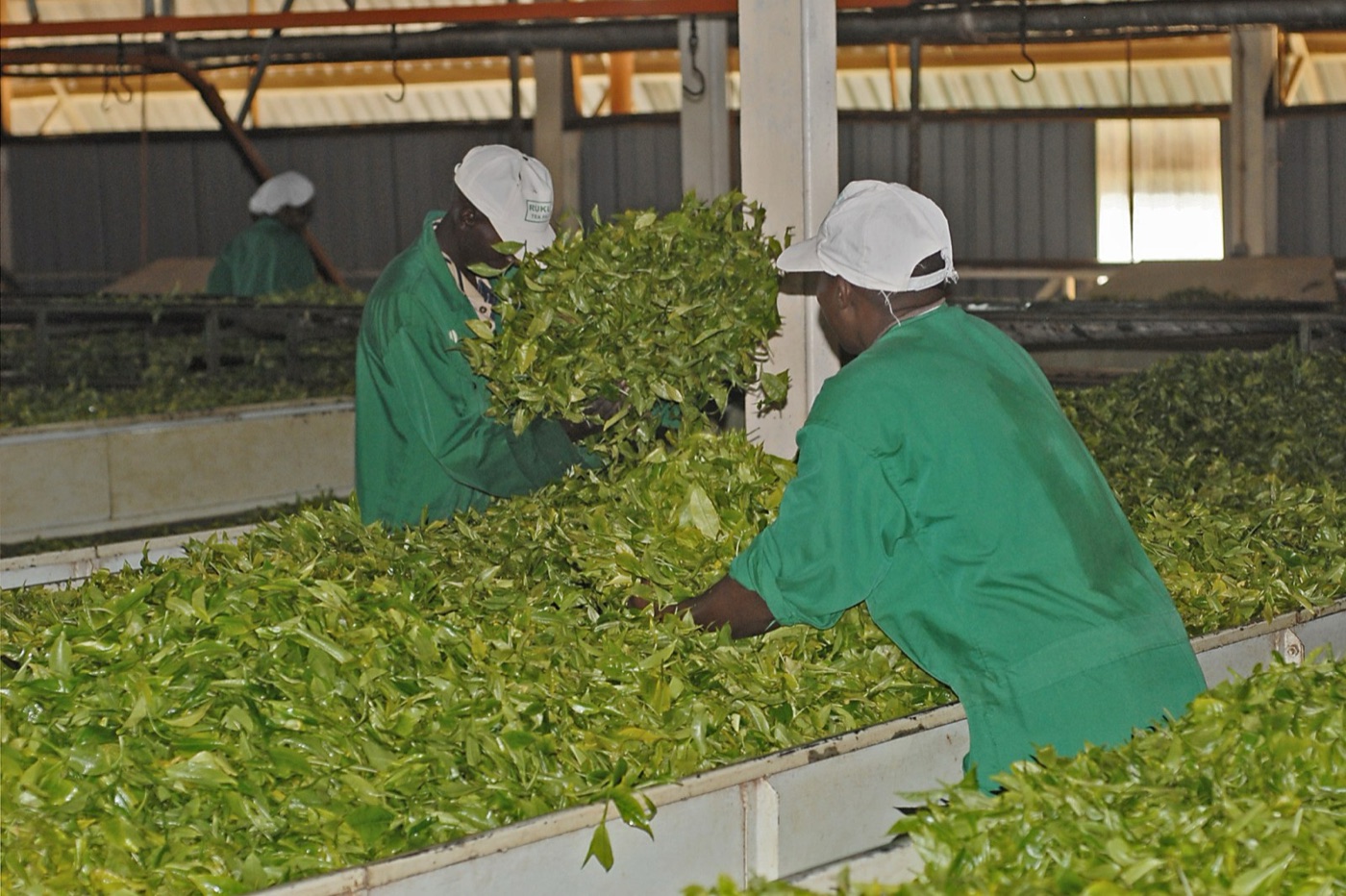
The picked leaf, two leaves and a bud from the tip of each shoot, is withered: spread on racks and left for hours in moving air until it loses a third of its weight and becomes limp. It is then rolled, by machine, which breaks the cells and releases the enzymes and juices inside. For black tea the rolled leaf is left in a cool, humid room to oxidise, the enzymes turning it from green to copper brown over an hour or two, which is the step that produces the colour and much of the flavour; green tea skips it, the leaf being heated first to kill the enzymes. Finally the leaf is dried, in hot air, until it is stable, and sorted into grades.
None of this uses water in the product. The leaf loses water at every step and is never washed, soaked or rinsed, and the factory's own water goes on cleaning and on the boiler that heats the driers. Tea is a crop whose processing is done with air and heat, and the whole of its footprint is, in effect, the bush.
| Stage | What happens | Water |
|---|---|---|
| Plucking | Two leaves and a bud, by hand, several times a year | None |
| Withering | The leaf loses a third of its weight in moving air | None |
| Rolling | Cells broken, juices released | None |
| Oxidising | Enzymes turn the leaf from green to brown, for black tea | None |
| Drying | Hot air, until the leaf is stable | The boiler's water, a small share |
The grey share, and the people
Tea is a plantation crop, and a plantation is a managed landscape with the concerns that come with it. Estates are fertilised, and in some regions heavily, and the runoff from a hillside of tea reaches the streams below it, which is the small grey share of the footprint. Estates in Assam and Sri Lanka were laid out in the nineteenth century by clearing forest, and the tea country of both is a monoculture where forest stood, with the loss of habitat that implies. And tea is picked by hand, by people, most of them women, on wages that have been the subject of argument in every producing country for a century. None of this is a water question, and all of it is part of the cup.
Milk in it
For a large part of the tea drinking world the cup does not end with the leaf, and the milk changes the arithmetic more than the tea does. A splash of milk in a cup of tea is around 30 millilitres, and a litre of milk, as its own article described, carries about 1,020 litres of water. Thirty millilitres is therefore about 30 litres, which is more than the tea itself. A cup of tea with milk carries close to 60 litres, more than double the black cup, and the larger half of it grew the grass that fed a cow rather than the bush that grew the leaf. Sugar adds a few litres more, at around 1,800 litres per kilogram for a spoonful of a few grams. The cup is still a fraction of a coffee's, and the milk is the part of it that came from a field rather than a monsoon.
| The cup | Litres |
|---|---|
| Black tea, 3 grams of leaf | About 27 |
| A splash of milk, 30 millilitres | About 30 |
| A spoon of sugar, 4 grams | About 7 |
| Tea with milk and sugar | About 65 |
The kettle
The only water a tea drinker sees is the quarter litre in the cup, and it is, as with coffee, the least of it. It is, though, the one part of the footprint that the drinker controls, and it is worth a line: a kettle boiled full for one cup heats a litre and a half of water to make a quarter, and the energy in the unused litre and a quarter is the largest avoidable cost of the whole cup, in energy if not in water. Boil what you need. The bush has already done the rest.
Green, black and the rest
Black tea, green tea and oolong are the same leaf, from the same bush, processed differently, and their footprints are the same to within the accuracy of the method, because the bush is the footprint and the factory adds nothing. Herbal teas are another matter: they are not tea at all but the leaves, flowers or roots of other plants, chamomile, mint, rooibos, hibiscus, each with its own crop and its own water, mostly small, mostly rain. Coffee's footprint changes with the roast and the brew only at the margin; tea's changes not at all. The cup is the bush, and the bush is the rain that fell on it.
The estate's own water
A tea estate does use water, and it is worth saying where, since the footprint gives it so little. The factory raises steam for the driers, in a boiler fed from a stream or a well, and cleans its floors and machinery at the end of each shift. Some estates in drier regions, in parts of Kenya, southern India and Malawi, irrigate young plantings and, in dry years, established bush, with sprinklers or drip of the kind the Israel article describes, and there the blue share of the local footprint rises above the global average. And the pickers' villages, on the estate, draw their drinking water from the same streams. None of it changes the number in the cup by more than a litre or two. All of it is the reason the estate has a water manager, in a crop whose water is nearly all rain.
Reading the number
Tea is one of the gentler things in a kitchen, and it is a useful end to the footprint articles for that reason. Twenty seven litres a cup is a real figure and a small one, nearly all of it rain on a wet hillside, with a processing stage that adds nothing and a place that could spare the water. It is the coffee article's lesson at a lower price: the water in a drink is the water a plant drank, months earlier, somewhere else, and the question is always where. For tea, the answer is nearly always the monsoon, and the monsoon was going to fall on Assam anyway.
Sources
- Mekonnen, M.M. and Hoekstra, A.Y. (2011). The green, blue and grey water footprint of crops and derived crop products. Hydrology and Earth System Sciences 15. Made tea about 8,856 L/kg, global average, predominantly green water.
- Water Footprint Network, product gallery: tea, about 27 litres per cup.
- FAO, FAOSTAT. China, India, Kenya and Sri Lanka the largest producers of tea.
- Tea Board of India and the Kenya Tea Development Agency on growing regions and rainfall.
- Photographs: opener, Tea plantation in hangzhou by Shizhao (CC BY) via Wikimedia Commons; inline: Woman worker picking tea leaves at a tea plantation in Luye by LeonardKong (CC BY) via Wikimedia Commons; inline: 2009.12-363-1125ap tea,processing(withering),stirring Rukuriri Tea Factory,tea-zone N of Embu(C Highlands),KE mon14dec2009-1242h by Rik Schuiling / TropCrop-TCS (CC BY-SA) via Wikimedia Commons.