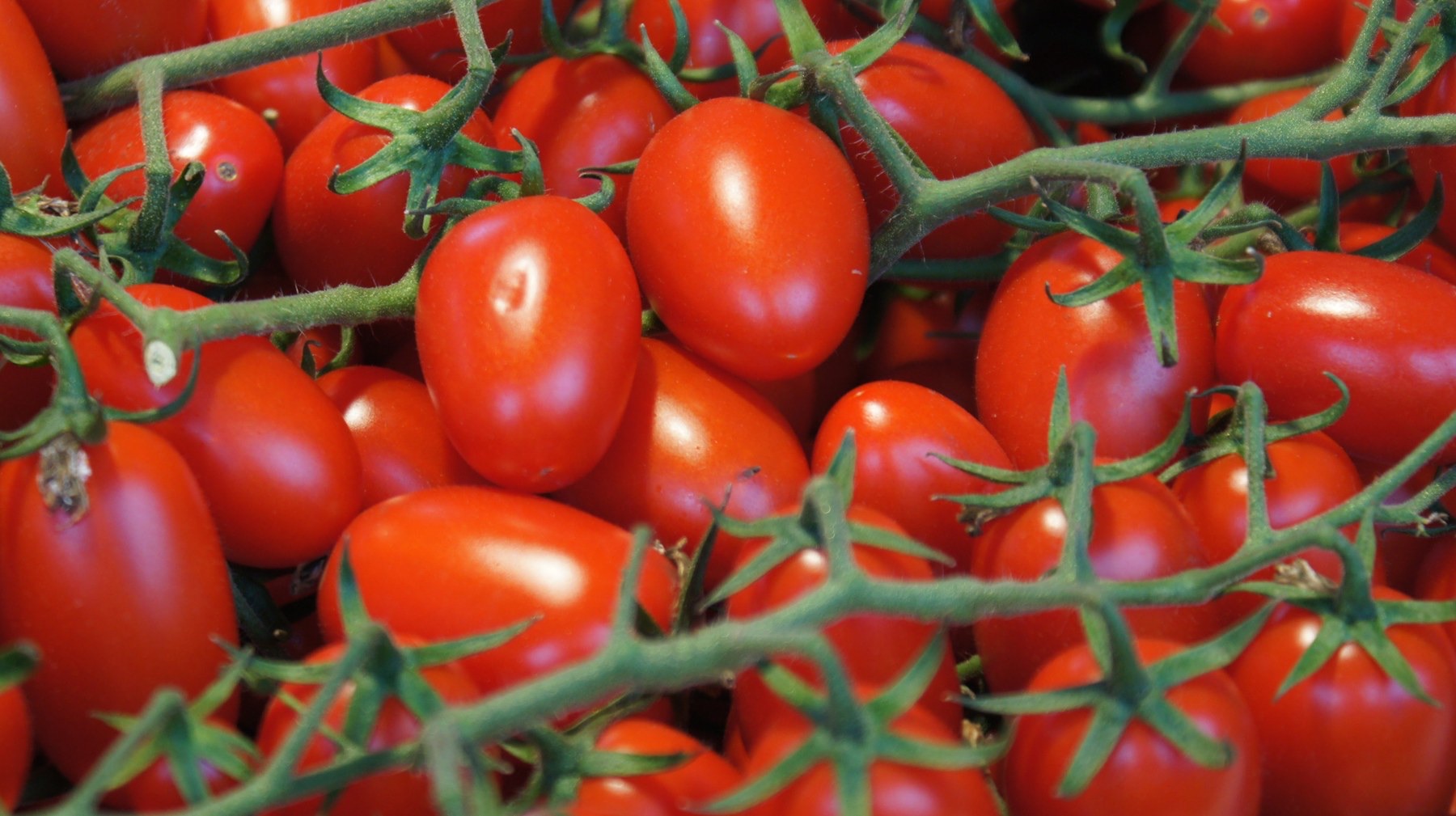
Thirsty: Tomato
A tomato is ninety five percent water and took about two hundred litres to grow, and the difference between a tomato from a Dutch greenhouse and one from a field in Spain or California is the whole of the subject. Where the water in a tomato goes, why the greenhouse uses a fraction of the field, why the field grows most of the world's tomatoes anyway, and what a tin of paste has to do with an aquifer.
A tomato is about ninety five percent water, which is why it is so hard to grow well and so easy to grow badly. The plant is a vine from the Andes that likes heat, sun and a steady supply of water at the root, and it has been bred into the most grown vegetable on Earth, some 190 million tonnes a year, eaten fresh, tinned, dried, pulped into paste and ketchup, and cooked into the sauces of half the world's cuisines. Its water footprint is small, about two hundred litres a kilogram, and the small number hides the largest spread of any crop on this site.
This article is about that spread. A tomato can take twenty litres or five hundred, and the difference is glass.
The number, and its range
The global average, in the footprint studies this site uses, is 214 litres per kilogram, most of it green and blue in roughly equal parts, with a grey share for the fertiliser. That is a modest figure beside the rice, wheat and bread of other articles, and it is modest for a reason that also explains the range: a tomato plant, grown well, converts water into fruit with unusual efficiency, because the fruit is mostly water and the plant is bred to make a great deal of it.
| Water in a kilogram of tomatoes | Litres |
|---|---|
| Global average | About 214 |
| Dutch heated glasshouse, closed, recirculating | About 15 to 20 |
| Spanish plastic greenhouse, Almería, drip irrigated | About 30 to 60 |
| Open field, drip, Italy or California | About 100 to 200 |
| Open field, furrow or flood irrigated, dry region | 300 to 500 and above |
The range is the story of where the water goes. In an open field in a hot climate, a large share of the water applied never reaches a root: it evaporates from the wet soil between the plants, it soaks below the roots, it runs off, and much of what the plant does take it transpires to the air through its leaves in the heat. A field tomato in a dry region is a small fruit on a large plant standing in a lot of sun, and the water that made it went, mostly, into the sky.
The glasshouse
The Dutch grow tomatoes in a country with too little sun and too much rain, and they do it by removing the field. A modern Dutch glasshouse is a sealed building of glass on steel, hectares in extent, in which the plants grow not in soil but in slabs of rockwool fed by drip lines with a precise solution of water and nutrients. The water the plants do not take drains from the slabs into a gutter, is collected, sterilised and sent back to the drip lines; nothing runs off and almost nothing evaporates from the ground, because there is no ground. The air is humid and still, so the plants transpire far less than they would in a Spanish field, and the glass keeps what they do transpire in the building, where much of it condenses and is caught. The rain on the roof is collected in a basin and used as the supply.
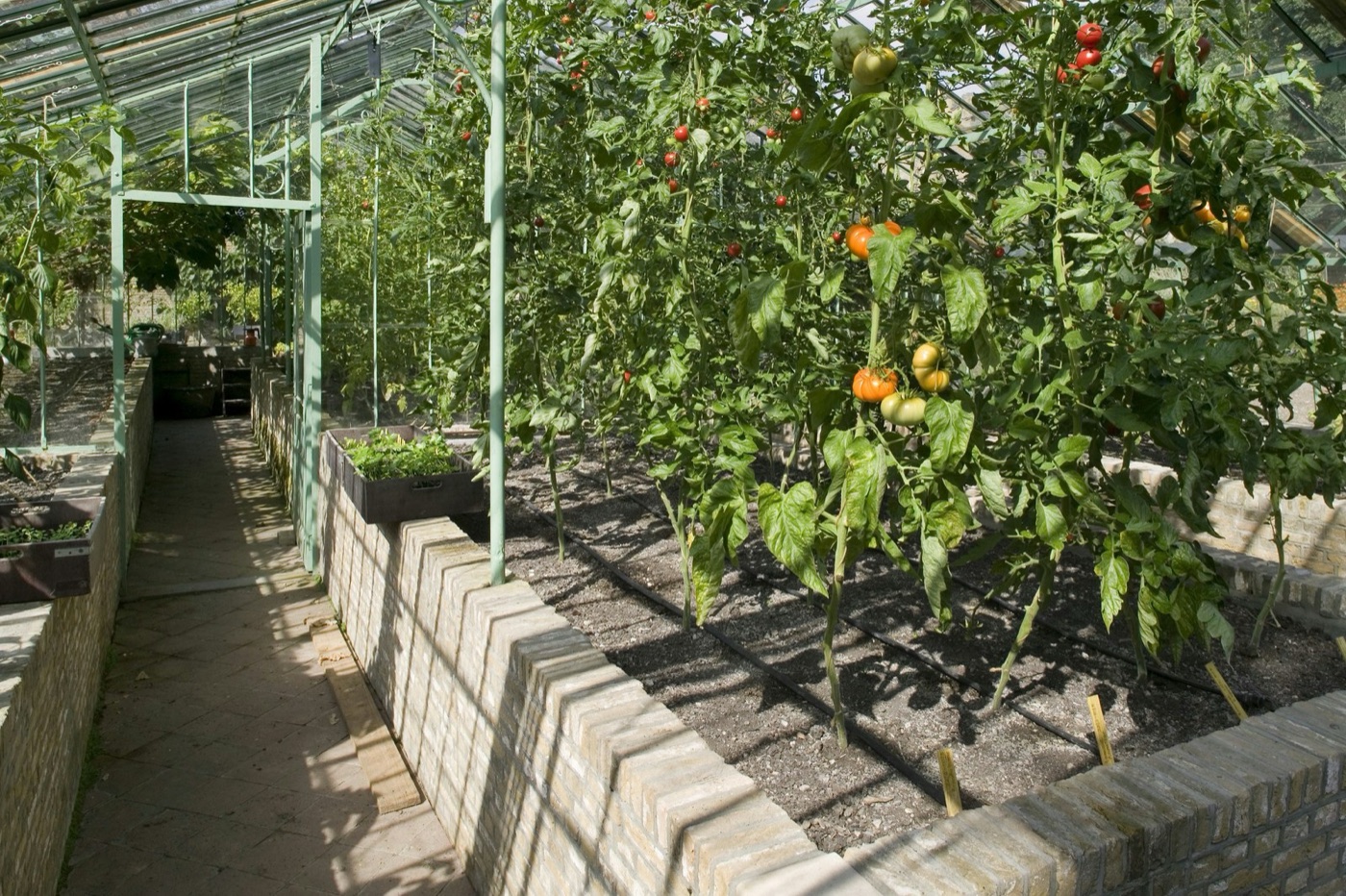
The result is a tomato grown on fifteen to twenty litres a kilogram, a tenth of the world average and a thirtieth of a dry field, at yields of fifty to seventy kilograms per square metre a year, ten times an open field's. The Netherlands, a country the size of a large county, is the world's second largest exporter of tomatoes by value.
The catch is energy. The glasshouse is heated, with gas, for most of the year, and lit in winter, and a Dutch tomato's carbon footprint is several times a Spanish one's. The water saved is paid for in gas. The industry is moving to geothermal heat and to the waste heat of power stations and data centres, and some of the newest glasshouses run close to carbon neutral, but the trade is real and it is the same trade the desalination article describes: water bought with energy.
| Field against glass | Open field, dry region | Dutch glasshouse |
|---|---|---|
| Water per kilogram | 300 to 500 litres | 15 to 20 litres |
| Where it goes | Evaporation, drainage, the plant's transpiration | Recycled; transpiration caught |
| Yield per square metre a year | 5 to 8 kilograms | 50 to 70 kilograms |
| Energy | The sun | Gas, or geothermal, for heat and light |
| Supply | River or aquifer | Rain from the roof, stored |
The field
Most of the world's tomatoes are still grown in fields, because fields are cheap and the tomatoes that go into tins do not have to be beautiful. China grows a third of the world's crop, India a tenth, and Turkey, Egypt, Iran, Italy, Spain and the United States most of the rest, in regions that are, for the most part, hot and dry in the growing season. The processing tomato, the thick skinned variety that is harvested by machine and cooked into paste, ketchup, tinned tomatoes and sauce, is grown almost entirely in fields, and the largest single region for it is California's Central Valley, which grows about a third of the world's paste on a few hundred thousand irrigated acres, on the same canals and wells as the almond article's orchards.
A field tomato's water depends on the method. Drip irrigation, laid under the rows, brings a Californian or Italian crop down to a hundred or two hundred litres a kilogram, and the Central Valley has moved almost entirely to drip in the last twenty years, for water and for yield. Furrow and flood irrigation, still common in Egypt, Turkey, India and parts of China, push it to several hundred. The difference is the same one the Israel article describes, and it is the largest lever in the crop.
Almería
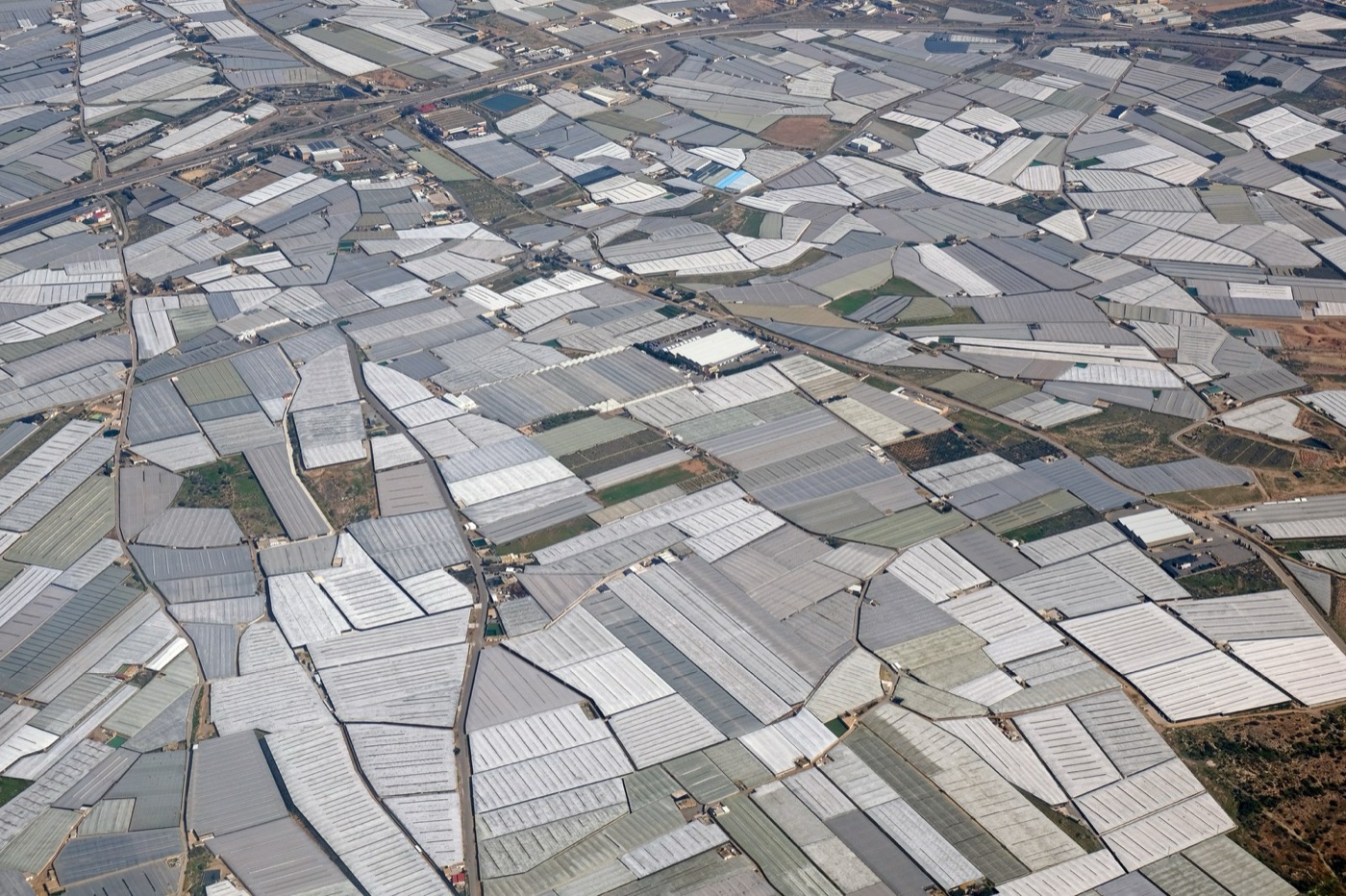
Between the field and the glass is a third way, and it covers a coastal plain in south east Spain so completely that it is visible from orbit as a white smear. Almería grows tomatoes, peppers and cucumbers under thirty thousand hectares of plastic greenhouses, unheated, on one of the driest coasts in Europe, and supplies northern Europe's supermarkets through the winter. The plastic does what the Dutch glass does, less thoroughly: it holds the humidity, stops the wind and cuts the evaporation, and the plants are fed by drip. Water per kilogram is a third or a quarter of an open field's.
The supply is the problem. Almería's greenhouses drew, for forty years, on an aquifer that has fallen and turned saline, and the region now runs on desalination plants and on a transfer from the Tagus that the rest of Spain argues about. It is the almond story with plastic: a crop suited to the climate and unsuited to the water, made possible by an aquifer that is now being replaced by the sea.
Where the tomato is in the year
Season decides more than most people think. A tomato eaten in northern Europe in August can be a field tomato from France, Italy or a garden, grown on the summer's rain and sun with little or no irrigation, and it is the lightest tomato of the year on every count. The same tomato in January is one of three things: a Dutch glasshouse tomato grown on gas or geothermal heat with a tenth of the water; an Almería tomato grown under plastic on desalinated or transferred water; or a tomato flown or trucked from Morocco, Turkey or further, grown in a field with drip on a dry coast. The water and the energy trade against each other, and the tin, which is the fourth option, was picked in the Central Valley the previous September and has been waiting on the shelf. None of this is a reason to avoid the winter tomato. It is a reason to know that the salad in January is an industrial product, whichever route it took.
The tin
The tomato most people eat most of comes from a tin rather than a salad: the paste, the tinned tomato and the sauce, and those come from the processing fields, which are the dry ones. A tin of tomatoes from Italy is San Marzano or Puglia field water; a bottle of ketchup in most of the world is Central Valley water, pumped from the aquifer that the state's groundwater law now limits; a jar of sauce in Britain is often Spanish or Portuguese. The fresh tomato, grown in glass or under plastic close to the market, is the light one. The tin is the heavy one, and the tin is where the volume is.
What to do with it
The tomato is the clearest case on this site of a crop whose water is decided by the method rather than the plant, and the method is visible on the label. A tomato grown under glass or plastic used a tenth of the water of one grown in a dry field, and the best labels say where it grew. In summer, a field tomato from a wet region, or a garden, is the lightest of all, with neither gas nor pumping. In winter, the Dutch or Almería tomato carries little water and some energy, and the tin carries an aquifer. None of it is a reason to eat fewer tomatoes, which are, per kilogram, about the least thirsty food on the site. It is a reason to know which one is on the fork.
214 litres a kilogram, and thirty times more or less depending on the roof.
Sources
- Mekonnen, M.M. and Hoekstra, A.Y. (2011). The green, blue and grey water footprint of crops and derived crop products. Value of Water Research Report 47. Tomatoes 214 litres per kilogram, global average.
- Wageningen University and Research, greenhouse horticulture: water use of 15 to 20 litres per kilogram of tomatoes in closed Dutch glasshouses with recirculation.
- FAOSTAT, tomato production by country: China, India, Turkey, the United States, Egypt, Italy, Iran, Spain.
- California Department of Food and Agriculture and the California Tomato Growers Association, processing tomato acreage and irrigation in the Central Valley.
- Page, G. et al. (2012). Carbon and water footprint tradeoffs in fresh tomato production. Journal of Cleaner Production 32.
- Photographs: opener: Grape tomatoes on the vine at Ljubljana Central Market by domdomegg (CC BY) via Wikimedia Commons; inline: Interieur, overzicht van de rechter zijde van het achterste deel van de kas - Dordrecht - 20404934 - RCE by Chris Booms (CC BY-SA) via Wikimedia Commons; inline: Greenhouses near El Ejido by kallerna (CC BY-SA) via Wikimedia Commons.