Thirsty: Olive Oil
A litre of olive oil carries about fourteen thousand litres of water, the most of any cooking oil, and the tree that makes it is the one that grows where nothing else will. Where an olive's water goes, why the number is so large, what the new hedgerow groves of Spain have changed, what two dry years did to the world's supply and its price, what a mill sends out, and why the oil that was the emblem of dry country farming is becoming an irrigated crop.
A litre of olive oil carries, in the global averages this site uses, about fourteen thousand litres of water, which is the largest number for any cooking oil and more than a kilogram of beef. It is a number that, for most of the three thousand years the tree has been cultivated, described rain on a hillside where nothing else would grow, and it is a number that is becoming, in the country that makes half the world's oil, a draw on a river that has other claimants. The olive is the crop on this site that is moving from the wool article's kind of water to the almond article's, and this is about how.
The tree
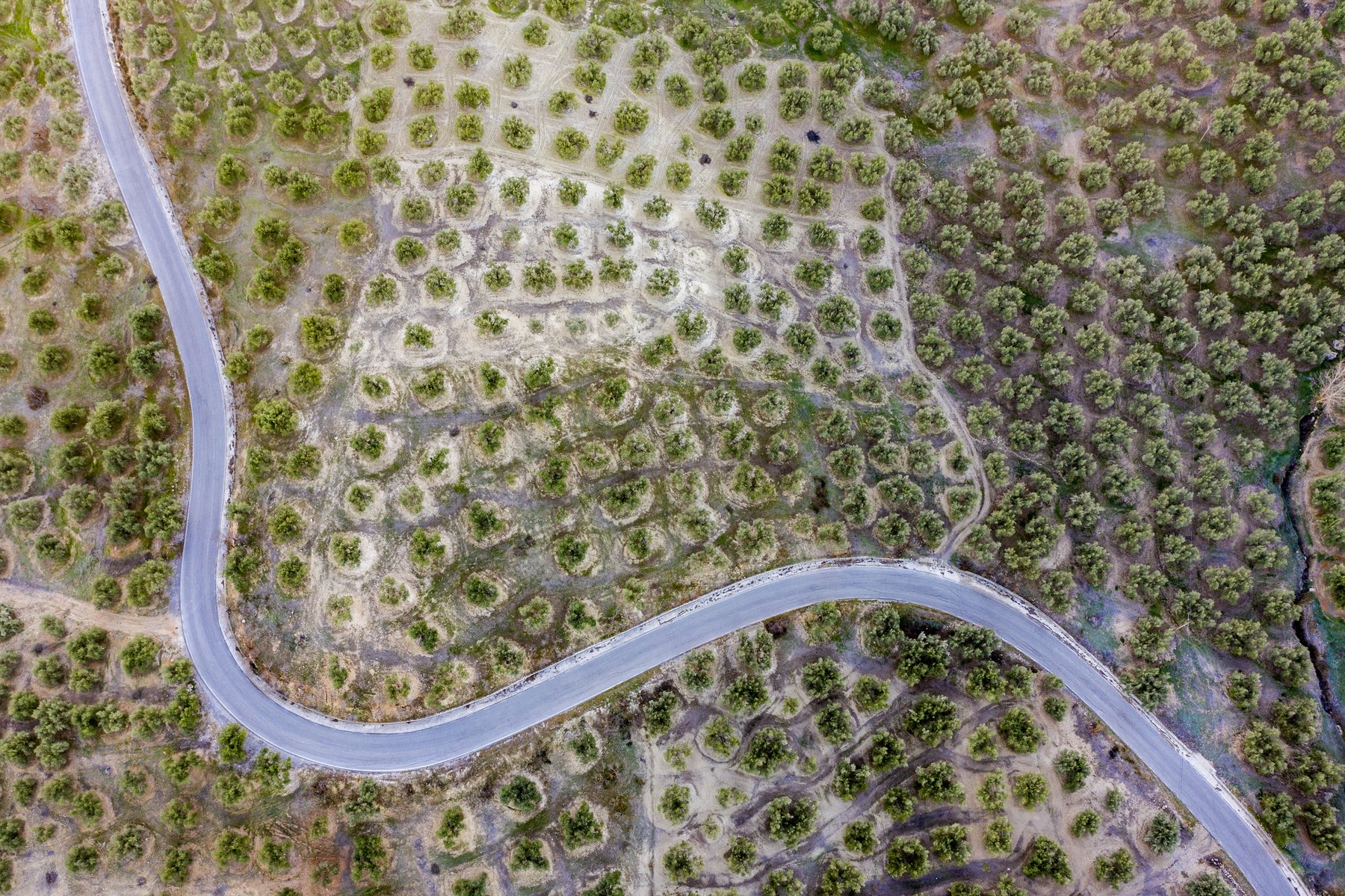
The olive is an evergreen that grows where summers are hot and dry and winters are mild, on soils too thin and stony for a cereal, and it survives drought by shedding fruit rather than leaves and by roots that go deep. A traditional grove has a hundred trees to the hectare, planted by hand and left for a century, and yields two or three tonnes of fruit in a good year and much less in an off year, because the tree bears heavily in alternate years. A kilogram of fruit gives about two hundred grams of oil, and the water the tree took up over the year, which is the rain that fell on the hectare, is divided across those two hundred grams, which is why the oil's number is so much larger than the fruit's and why both are large: the yield of oil per hectare is a few hundred kilograms, against a tonne of sunflower oil or four of palm.
The water is also, for the old groves, almost all green. The rain of Andalusia, Puglia, Crete or the Peloponnese fell on the hillside, the tree used what it could and let the rest go, and nobody else could have had it.
| Water per kilogram | Litres | Where |
|---|---|---|
| Olives, fruit | About 3,000 | Mostly rain; more blue in irrigated groves |
| Olive oil | About 14,500 | The same, divided across a fifth of the weight |
| Sunflower oil, for comparison | About 6,800 | Rain on the steppe |
| Rapeseed oil | About 4,300 | Rain in temperate Europe |
| Palm oil | About 5,000 | Rain in the wet tropics |
Spain
Spain makes about forty five percent of the world's olive oil in a normal year, and most of that comes from Andalusia, and most of Andalusia's from the province of Jaén, where the olive covers more of the land than any crop covers any province in Europe: sixty million trees, in groves that run to every horizon. The old groves are rain fed and yield what the year gives. The groves planted since the 1990s, which are now about a third of the Spanish area and most of the new area in Portugal, Morocco, Tunisia and California, are different. They are hedgerows: dwarf trees at a thousand to two thousand to the hectare, drip irrigated, mechanically harvested by a machine that straddles the row, bearing in their third year and giving several times the oil per hectare of a traditional grove, at a cost of two to four thousand cubic metres of water per hectare per year, drawn from the Guadalquivir's reservoirs, from the canals of the basin authority, and from wells.
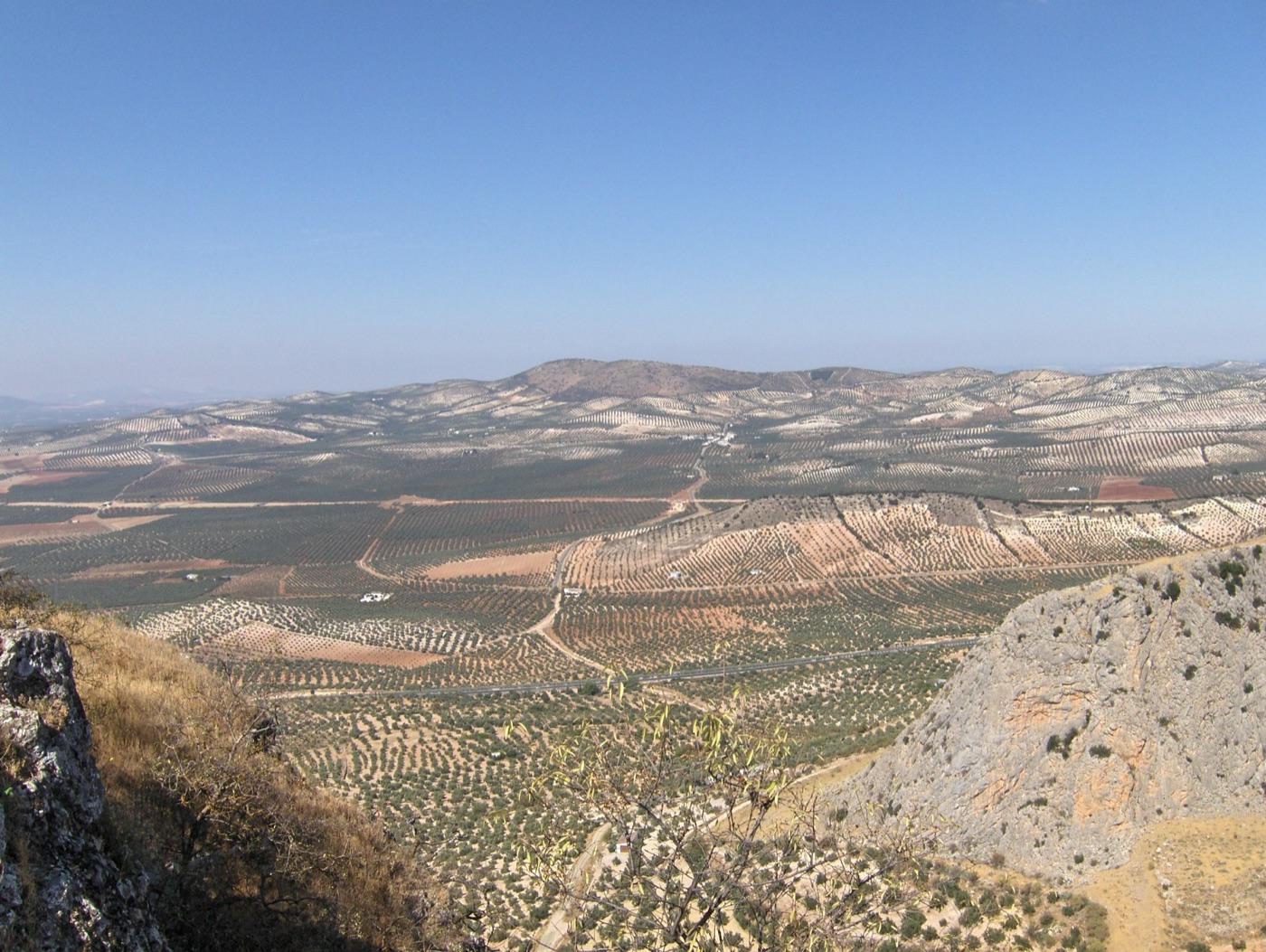
The water makes the yield. An irrigated grove gives ten to twelve tonnes of fruit a hectare against the old grove's two or three, and it gives them every year, and the oil is cheaper. It also gives the Guadalquivir basin, which the rice, the cotton, the strawberries and the cities of Seville and Córdoba already draw on, a new user, and the basin has been over allocated since the 1990s.
| Two kinds of grove | Traditional | Hedgerow |
|---|---|---|
| Trees per hectare | About 100 | 1,000 to 2,000 |
| Water | Rain, about 400 to 600 millimetres | Rain plus 2,000 to 4,000 cubic metres of irrigation |
| Fruit per hectare | 2 to 3 tonnes, alternating years | 10 to 12 tonnes, every year |
| Harvest | By hand and by shaker | By machine |
| Age at first crop | 7 to 10 years | 3 years |
| Water source | The sky | The Guadalquivir and the aquifer |
2022 and 2023
In 2022 Andalusia had the driest year in its record, and in 2023 a hot spring killed the flowers on the trees, and the Spanish harvest halved two years running, from about 1.4 million tonnes to about 660,000. The world price of olive oil tripled, the supermarkets of Spain put security tags on the bottles and locked the shelves, the theft of fruit from the groves at night became a police matter, and the Guadalquivir's reservoirs fell to a fifth, so that the basin authority cut the irrigation allocation to the groves by half and then by more. The irrigated groves, which had been the answer to the drought, had less water; the rain fed ones, which had never had any, had less fruit; and the price of the oil, which had never before been a matter of national politics, was on the front pages.
The rain returned in 2024, the harvest recovered, and the price fell back. The reservoirs did not refill, and the allocation to the groves remains a share of what they were planted for. The pattern is the one the almond article on this site describes for California: a crop planted on the assumption of water that a drought withdraws.
The mill
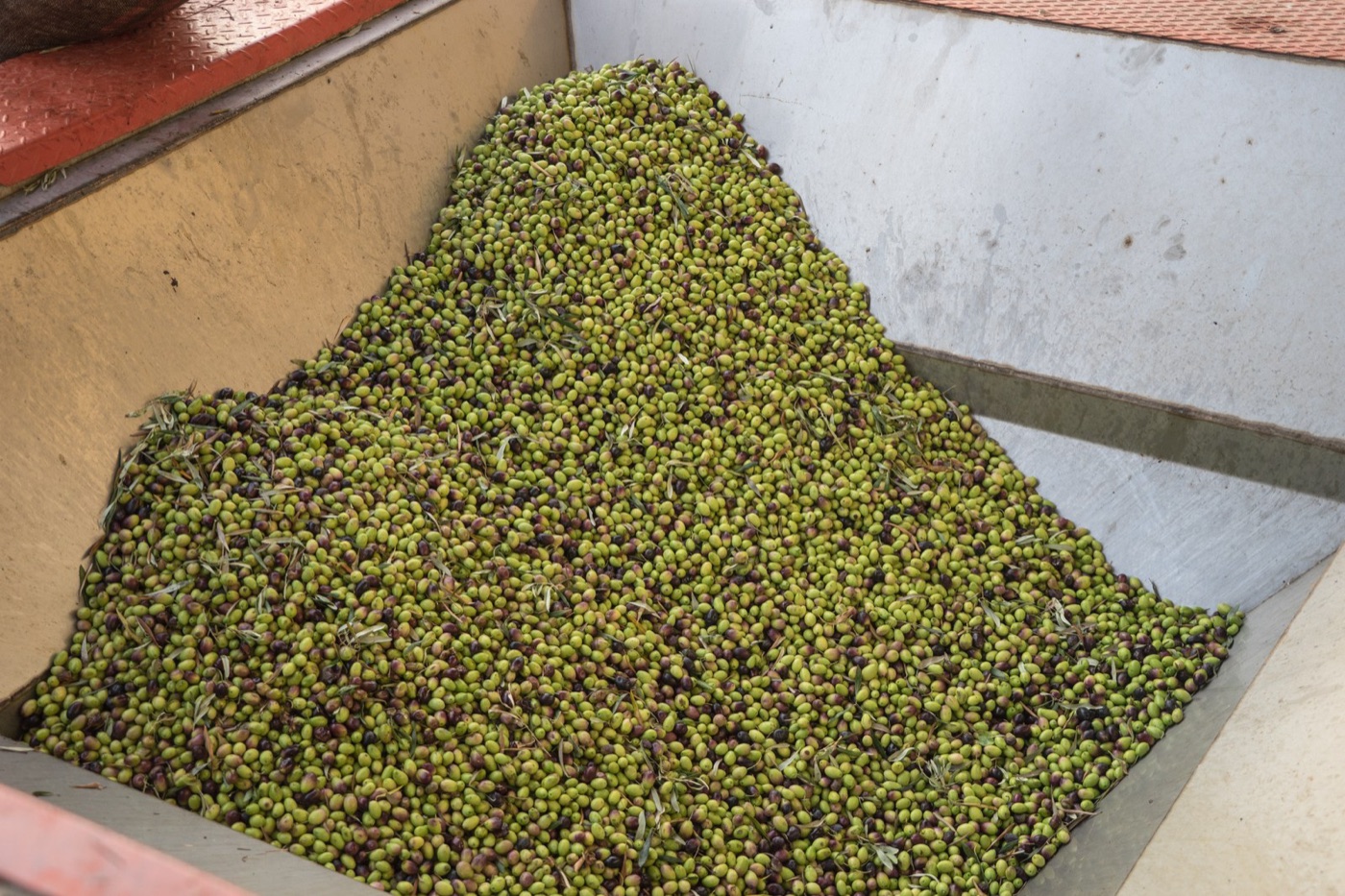
The mill's water is small and its effluent is not. Olives are washed, crushed to a paste, mixed, and spun in a centrifuge that separates oil from water and solids, and the traditional three phase mill added water to the paste and sent out, for every tonne of fruit, about a cubic metre of alpechín, the black vegetation water of the olive, with an oxygen demand of forty to a hundred grams a litre, a hundred times sewage, and polyphenols that kill the bacteria a treatment plant depends on. It was, for a century, poured into the rivers of every olive region in the Mediterranean in the months after the harvest, and the rivers of Jaén ran black. The two phase decanter, adopted across Spain from the 1990s, adds no water and sends out a wet pomace instead, which is dried and burned or extracted for its last oil, and the black rivers of Andalusia are largely a memory, though the mills of the eastern Mediterranean still run the old way.
Where the rest is grown
Italy, Greece, Tunisia, Turkey, Morocco and Portugal make most of the rest, and the pattern repeats: old groves on rain in the hills, new hedgerows on irrigation in the plains, and a rising blue share in the driest countries. Tunisia, the largest exporter after Spain, has planted hedgerows on the water of a coastal aquifer that the sea is entering. Morocco has planted a million hectares under a national plan and irrigates them from dams that its cities also drink from. California's groves, which supply the American market for oil that is not Spanish, are in the Central Valley, on the water the almond article describes. The tree of the dry hillside is being planted in the plains, on pipes, everywhere the oil is sold.
The oil in the bottle
A litre of extra virgin oil is the juice of about five to seven kilograms of olives, pressed cold, and the water in it is the water of those kilograms, which is the arithmetic in the table. The cheaper grades carry the same water and less of the tree's care: refined oil is what remains when the flawed oils are treated with heat and chemicals to remove the flavour, pomace oil is what a solvent takes from the pressed pulp, and the blends on the supermarket shelf are, on the tests that the regulators run, mislabelled at a rate that has made olive oil the most adulterated food in Europe. None of that changes the litres. The Tunisian oil sold in an Italian bottle carries Tunisian rain, and the Spanish hedgerow oil sold as a supermarket's own brand carries the Guadalquivir, whatever the label says about where it was bottled.
The tree in a warming climate
The olive is being planted in the plains because the plains have pipes, and it is also, in its old range, being stressed by a climate that has moved past what the hillsides gave it. The flower needs a cool winter to set and a mild spring to hold, and the springs of 2023 in Andalusia, with a week over thirty five degrees in May, killed the flowers on trees that had survived four hundred summers. The fly that ruins the fruit is spreading north, the drought years are more frequent, and the growers of Jaén, whose groves are too old to move and too steep to irrigate, are the ones the climate is testing first. The hedgerows in the plains, on a pipe from a reservoir, can be watered through a heatwave. The hillside, which was the point of the tree, cannot.
What it teaches
Olive oil is the product on this site whose water is changing kind. The old number, fourteen thousand litres of rain on a hillside that grew nothing else, was large and harmless; the new groves of Spain and the countries copying them turn a share of it into water from a river that has run dry twice in three years, to make an oil cheaper. The mill's black water has been fixed. The grove's blue water is the argument the Guadalquivir has not settled.
14,500 litres a litre, rain on a hillside for three thousand years, and a river in it now.
Sources
- Mekonnen, M.M. and Hoekstra, A.Y. (2011). The green, blue and grey water footprint of crops and derived crop products. Olives about 3,000 litres per kilogram; olive oil about 14,400.
- International Olive Council, world olive oil production and prices 2021 to 2024: Spain about 45 percent of world output in a normal year; Spanish production about 660,000 tonnes in 2022 and 2023 against 1.4 million typical.
- Junta de Andalucía and Spanish Ministry of Agriculture, olive grove surveys: irrigated area, superintensive plantings, water allocations in the Guadalquivir basin.
- Fernández, J.E. (2014). Understanding olive adaptation to abiotic stresses as a tool to increase crop performance. Environmental and Experimental Botany 103. Olive water needs and deficit irrigation.
- European Commission, Best Available Techniques for the food, drink and milk industries: olive mill wastewater and the two phase decanter.
- Photographs: opener: Roads crossing the Andalusian olive groves (49463059508) by Andrés Martín Rodríguez (CC BY-SA) via Wikimedia Commons; inline: Olivares en Archidona by Tyk (CC BY-SA) via Wikimedia Commons; inline: Some of my olives ready for oil at the mill. Drosia. Greece by Jebulon (CC0) via Wikimedia Commons.